
By Linda Conner Lambeck
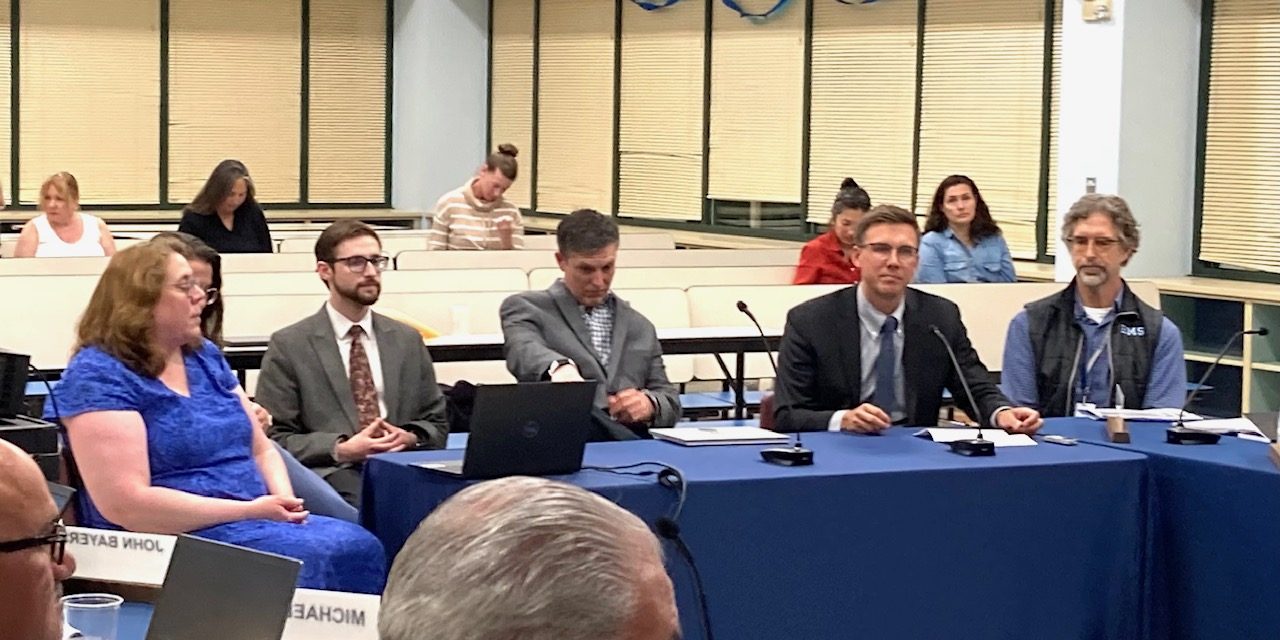
WESTPORT – Five months into a state-funded pilot to assess the impact of artificial intelligence (AI) on teaching and learning, Westport educators say the emerging technology has its place in education but has limitations as well.
“It doesn’t fit all the time, or with all subject areas. It’s an extra tool,” Superintendent of Schools Thomas Scarice told the school board at its May 15 meeting.
Scarice told the board in December he wanted to make AI part of the district’s strategic plan. Around the same time, the state put out the call for districts to help it pilot various AI education models.
The idea was to see how AI – already being used widely in some circles – might benefit educators with instruction, lesson planning, and offering feedback to students.
Also explored were the impact on student learning, critical thinking, and creativity.
Westport was one of six districts selected in January to receive a $100,000 grant to use a platform called SchoolAi, one of several programs permitted by the state. A number of other participating districts used a program called Magic School.
SchoolAi was favored, Scarice said, because it was data privacy compliant and allowed teachers to see all responses. Scarice said the district is free to change models after the pilot.
Students at Bedford Middle School and the Staples High School science department participated in the pilot program.
Mixed reactions from educators and students
Jacob Tourigny, a Staples science teacher, said he used AI in lessons on the solar system, and gave two examples of how it worked well.
Instead of lectures on planets, Tourigny said students were able to use the AI program to “travel” to different planets in the solar system. Students could explore the planet of their choice.
AI also worked well in testing student knowledge at the beginning and end of the unit, Tourigny said.
John DeLuca, the district’s science coordinator for grades 6-12, said AI had its limitations when it came to math-specific science courses such as computer science and physics.
He said it wouldn’t accept alternative methods to solve problems and sometimes gave confusing and wrong feedback.
“This is something our teachers were really looking for in terms of making sure the information that the students were receiving from AI was accurate,” DeLuca said. “And sometimes it wasn’t.”
Some coding errors were also detected in some of the AI-generated materials.
“This might be a limitation of SchoolAi specifically,” DeLuca said. He said the experience seemed consistent with what other districts piloting AI programs experienced.
“It wasn’t just us,” Scarice said. “Math and AI, right now at least, are not a great match.”
Students taking marine biology using AI told teachers that they liked the conversational style of the program but complained that the program did not know where to end. Many liked that the program did not provide direct answers but some reported that sometimes the answers that were provided were slow to come and not clear.
At the middle school level, Jeremy Royster, a social studies teacher, said it’s often difficult for students to provide sources for the evidence they gather on various topics. Often, AI creates or allows misinformation, but it can also be used to help students look for reliable sources, Royster said.
The program used also allowed students to ask the AI bots what they thought to be “stupid” questions that they might not have expressed to the teacher. Another activity allowed students to “go back in time” to interview characters involved in historical events or guess where in the world they were based on specific country details.
Given that there are some 200 countries in the world, Royster said he never could have done the activity, let alone in a single class period, without the help of AI.
Even so, Scarice said Royster was essential to the lesson because he was able to point out to students that most of the countries highlighted in the program were from Europe and Asia and not Africa which has the most countries of any continent. This shows that even with the power of AI, it can’t replace a human teacher.
“The human element to the lesson can’t be lost,” Scarice said. “(Royster’s) facilitation of the conversation afterwards for me is what made that lesson so powerful.”
As for language arts, Michelle Walker, an instructional coach, reported that AI was good for finding grammatical errors and answering specific student questions. Some students, however, reported AI to be “bossy.”
“Some students will say ‘I kind of like the way I said it better’,” Walker said of AI’s writing suggestions. She said they were told to take AI advice with a grain of salt.
Pilot feedback will be used to develop future uses
Throughout the pilot, Westport teachers have been coming up with new and different activities that use AI. The key takeaway so far is that the SchoolAi program may not be the best tool for K-12 students.
In June, teachers involved in the pilot will be surveyed and a draft of guidelines for using AI in the classroom will be shared with the state, according to Natalie Carrignan, technology director for the district, who is leading the local pilot effort. A final report to the state is due by December.
At its next meeting in June, Scarice will outline his plan to have the administrative team spend time this summer exploring six areas including the following:
- AI Vision for the District
- AI and the Student
- AI and the Teacher
- Ethics/Responsible Use
- Operational Efficiencies
- Future Proofing
A fully developed plan will be presented to the board when the district returns in September. Meanwhile, board members had questions.
“To me it’s a little bit scary,” said Vice Chair Dorrie Hordon, who referenced Scarice’s recent push to reduce student screen time with a proposed bell-to-bell cell phone ban, currently on hold while a so-called “implementation committee” decides how to proceed.
“Here, we just had a whole conversation about taking phones away and screen time and here you have these kids on the computer looking at screens,” she said.
Hordon asked if AI would turn teachers into facilitators.
“That is the direction we want education to go,” said Royster. “We don’t want as much direct instruction, lecture-based teaching.”
Tourigny said it’s not like students sit silently in front of computers. Classrooms are alive with discussions, facilitation, and enthusiasm.
“There is a balance,” Tourigny said. “AI is a tool.”
Board Secretary Neil Phillips asked how the district will guard against students relying too much on AI.
“It is a concern,” Walker said. “We are going to work on that. Many of our students prefer their own voice. We want to foster that.”
It was also pointed out that some originality programs that flag potential instances of plagiarism don’t work.
“We’d be incredibly naïve to think students aren’t using this all the time outside of class,” added Bedford Middle School Assistant Principal Jonathan Adams. “We really need to help them think about using it responsibly.”
Board member Robert Harrington called the initiative one of the most exciting things he has seen in the district in the four years he has been on the board.
“I definitely appreciate the guardrails and the need for learning,” Harrington said.
Used correctly, he said AI leads to less screen time. He called it a productivity tool.
“I am not surprised at all that you are learning within the faculty and student feedback finding that there are clear limitations … I don’t think we should be intimidated by that,” he said.
Harrington encouraged the district to think big and be bolder and not be afraid of AI.
Brian Stern, a former Board of Finance chairman who resigned his post last year, came to the microphone after the discussion to tell the board the pilot was a fabulous one.
“I think this is just an absolutely critical discussion to have,” Stern said, adding AI is much more than a tool.
“It is a whole change in the way we approach learning,” Stern said. “This is a great project, putting it into the curriculum as a mainstream, not just a tool like a calculator or a slide rule.”

Linda Conner Lambeck
Linda Conner Lambeck covers education for Westport Journal. She was a reporter for more than four decades at the Connecticut Post and other Hearst publications. She has covered education throughout Fairfield and New Haven counties. She is a proud member of the Education Writers Association.







Recent Comments