

By Linda Conner Lambeck
WESTPORT — A final decision on a bell-to-bell ban on cellphones at Staples High School remains on hold, even as a majority of Board of Education members support the idea.
Instead of taking a vote on the proposal, the board this week went along with a recommendation by Supt. of Schools Thomas Scarice to form a committee to hash out not whether there should be a ban, but the “how, when and who” of the prohibition.
Scarice told the board Thursday he remains steadfast in his desire to stop students from using wearable technology during the school day, but is willing to wait until an effective plan is in place be it September, October or beyond.
Priority is “getting it right”
“The timeline is not nearly as important to me as getting it right,” Scarice said. The school district will “find a way to thread the needle and ensure we address the high school level appropriately,”
The plan is to convene an administrative team at the high school this summer that will develop logistics that would then be vetted by parents, teachers and students in the fall before a school board vote is taken.
“I am certainly happy to hear the path forward includes a committee concept,” said board member Kevin Christie.
Board Secretary Neil Phillips agreed, saying he was leaning against a board vote on the ban if one was called Thursday. He said he wants implementation to be done the right way.
Board Vice Chair Dorie Hordon, who said she has probably gotten more emails about cellphones than any other topic since she has been on the board, also wants to see how it will play out.
“I do think this conversation has gone on for a long time,” said Hordon, adding that it has caused a lot of anxiety.
A tough call
Scarice has been pushing a bell-to-bell ban on wearable technology at Staples since last June, mirroring a policy adopted by many school districts across the state and nation.
Westport students in the elementary and middle schools already are not allowed to use cellphones during the class day.
Scarice called cellphones addictive, a distraction, a blow to students’ psychological well-being and a conduit to cyberbullying.
Some 78 percent of student discipline cases at the high school involve cellphones in one way or another, the superintendent said.
Still, he knows it is a fraught topic.
Recently, the Staples PTA Executive Board unanimously voted against a bell-to-bell ban in favor of a classroom-only ban. Earlier this month, the group also proposed that a committee be established to analyze ramifications of the proposed prohibition.
At a community forum this month, most parents supported a bell-to-bell ban.
And a districtwide survey, with 59 percent of parents responding, showed that 404 parents favor a ban on high school cellphones.
Also on the survey, 69 percent of teachers supported a ban. That figure might have been higher, Scarice said, were it not for the concern that more enforcement responsibilities would fall to teachers under a total ban.
Not surprisingly, 90 percent of students answering the survey — 791 — opposed a phone-free policy at the high school level.
In focus groups with Principal Stafford Thomas, however, most students were less opposed to a classroom ban than a bell-to-bell ban.
Phasing in ban, without Yondr bags
The school board’s two student representatives both favored a phased-in approach to any ban.
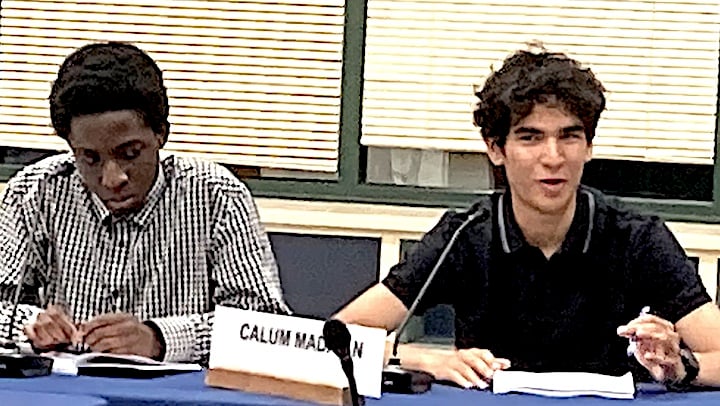
If a ban is imposed starting with the freshman class, those ninth graders — who didn’t have cellphone access while in elementary or middle schools — would not know what they are missing, said Calum Madigan, a Staples senior and student representative to the school board.
Souleye Kebe, the other student rep, agreed, but wondered if a total ban at the high school would leave students unprepared for the real world.
Both students disliked the idea of using Yondr bags, designed to lock away cellphones during the school day, saying they are too easy to disable and too expensive.
Board members supportive, with conditions
So did Hordon, who said she doesn’t want to spend money on Yondr bags at all. “I think it’s a waste of money,” she said. “I would challenge the administration and the staff to come up with a way to control the phones without the purchase of a Yondr bag.”
Board member Jill Dillon said it is glorious that her middle school daughter can’t reach her during the class day on her phone.
Dillon said she has witnessed students at the high school who are glued to their phones, unable to remember their schedule without their phones and unable to find friends in the cafeteria without their phones.
“I am in favor of a phone-free school, but implementation is important,” Dillon said.
Board Chair Lee Goldstein said she supports a bell-to-bell ban on phones at Staples. She is looking to the proposed committee to offer guidance.
“I don’t expect perfection on day one,” said Goldstein. Instead, she imagines a break from phones to be a gift as well as an opportunity to examine how technology is used.
“To be more intentional … more holistic,” she added.
Board member Abby Tolan said she also supports a ban.
So too does board member Robert Harrington, who said his view on the issue was changed by the superintendent.
“It’s pretty clear I am not a supporter of much coming out of superintendent and administration in the athletics department right now. I have been very vocal about that. I will continue to be very vocal about that,” Harrington said, referring to controversy over non-renewal of the Staples boys soccer coach’s contract. “But as I think about Tom as a superntendent, he has changed my mind on this issue,”
Harrington, who works in technology, said that after listening to Scarice’s arguments, he is willing to go along with a ban within reason. He said he supports the overall objective of a bell-to-bell ban, but doesn’t want a delay, doesn’t want it to apply to rising seniors and doesn’t like the idea of sealing phones in bags.
Parents weigh in
Only two parents spoke during public-comment segment of Thursday’s meeting.
Sean Frankel, referencing the phone in his hand as he spoke at the podium, said social media concern him more than phones.
“The issue is access to platforms, not hand-held devices,” said Frankel, the parent of two students in the district.
Ashley Zwick, a parent who supports a bell-to-bell ban at Staples, said a little inconvenience resulting from the restriction is a small price to pay for mental health.
Students who rely on their phones to know what class to go to next can memorize their schedule or check PowerSchool, Zwick suggested. Coaches can figure out a new way to communicate changes in practice schedules to student athletes, she added, and those with medical appointments should be reminded by parents at breakfast rather than by text.
Freelance writer Linda Conner Lambeck, a reporter for more than four decades at the Connecticut Post and other Hearst publications, is a member of the Education Writers Association.








Recent Comments