
By Linda Conner Lambeck
WESTPORT — For a class that entered high school during the height of the COVID pandemic, the Staples High School Class of 2024 managed to weather the storm.
Greater than 95 percent — some 426 graduates — are spread this fall between 176 different post-secondary institutions, according to a report presented to the Board of Education on Thursday.
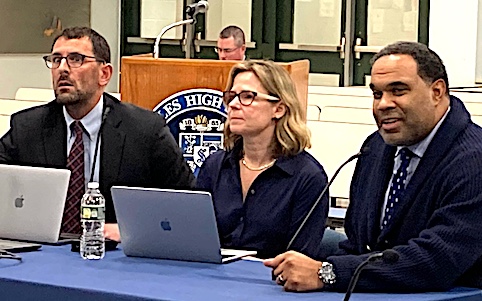
“Staples students are being accepted to hundreds of really wonderful colleges,” said William Plunkett, director of school counseling at Staples. “Our students, by and large, ended up in a really good place.”
That despite an increasingly complex admissions process that Plunkett admits stresses out many students and their parents.
Higher acceptance rates; most chose four-year colleges
Like the class before them, 93.1 percent of the Class of 2024 went to four-year colleges.
Another 2 percent went to two-year colleges, 1.7 percent took a gap year, 1.4 percent went straight into the work force and just shy of 1 percent entered the military. A fraction of 1 percent reported no post-high school plans.
It was a class that submitted fewer applications than the one before it — 3,517 compared to 3,846 — but which saw a higher acceptance rate: 58.1 percent compared to 52 percent for the Class of 2023.
Acceptance rates into the most selective colleges remains higher for Staples students than the national average. For instance, 40 members of the class applied to Boston University. Some 37 percent of those were accepted compared to 11 percent of BU’s national acceptance rate. Fewer than five members of the class ended up at Boston this fall, based on the report to the board.
On average, Class of 2024 members submitted just shy of nine applications each.
The University of Connecticut received 152 of those applications, followed by Indiana University at 85 applications and Pennsylvania State University at 81.
Which schools did the graduates finally wind up attending?
“Overall, the big size and larger universities are very popular with our students,” Plunkett said. Students are encouraged to cast a wider net, he added.
Big universities draw largest groups of Staples grads
The largest contingent — 14 — is at Syracuse, a dozen more are at UConn, 11 at the University of Colorado, 10 each at Indiana University and Northeastern, and nine went to George Washington University.
So what’s new?
Last July’s U.S. Supreme Court ruling that limits a university’s ability to take race into consideration in making admissions decisions continues to shape the process, said Sandra Zeigler, the Staples College & Career Center coordinator.
Post-secondary schools are still seeking to build a diverse student body, Zeigler said. Some are explicit about asking students on applications to describe how their identify, culture and background have played a role in their personal growth, whether they have access to the internet at home and if they are responsible for caring for younger siblings. More are using video as part of the application process.
“They are finding new ways to draw information out within the boundary of the ruling,” said Zeigler.
Most colleges remain test optional, although Ivy League schools are returning to requiring tests, the board was told.
Class of 2024, by the test numbers
Mean ACT scores for the Class of 2024 were 29.8, slightly higher than the year before and 10 points higher than the national average. Mean SAT scores for the class were 1,229, lower than the previous class, but still much higher than the state and national averages.
The class had four national merit scholars. One quarter of the class had GPAs of 4.0 or higher. About 34 percent of students taking those tests did not submit scores to the colleges to which they were applying.
As for Advanced Placement exams, both the number taken and the mean score in 2024 rose. Collectively, 1,338 AP exams were taken and 96 percent of them came back with a score of 3 or better.
Zeigler said colleges increasingly rely on early decision plans to build their classes, and Artificial Intelligence is being used by some students to help shape their applications.
A competitive process
The most popular choices for major fields of studies tend to be computer science, engineering and business.
With popularity comes competitiveness.
Still, Plunkett said 88 percent of the class reported last spring being satisfied with their post-high school plans.
Most report the programs offered, locations and campus life factored into their decisions.
For some, so did cost.
Last year, the delayed roll out of the Free Application for Federal Student Aid (FAFSA) student loan applications led some students to not apply at all. The application rate for the class was down 12 percent. This year, the roll out is expected to be smoother.
Over the past few years, Staples has begun to broaden programs for students and families as they begin the college search process.
The counseling staff also points to the data in the report to help guide students in their search.
As pleased as he was with the good news in the report, board member Kevin Christie asked staff if there was anything they lose sleep over in terms of the report.
“It is an emotional toll for some students,” Plunkett said of college rejections. Other students handle it remarkably well.
Board Vice Chair Dorie Hordon asked what guidance is given to students whose families hire private college counselors.
Plunkett said they don’t automatically know which students do, but often will help those students make sure their applications are filled out correctly.
Board Secretary Neil Phillips said he would like to see future reports explore how many Staples graduates end up transferring once in college.
Souleye Kebe, a student representative to the board and a junior, asked about how students can access local scholarships. Information about those grants provided to students in their senior year.
Freelance writer Linda Conner Lambeck, a reporter for more than four decades at the Connecticut Post and other Hearst publications, is a member of the Education Writers Association.











Recent Comments