
By Linda Conner Lambeck
WESTPORT–Kate Carver used to hate science and had no plans to take more than the minimum requirements at Staples High School until she said instructor David Rollison tutored her in a way she understood.
Rollison then talked the now-senior into taking the new Advanced Forensics, a full-year, college-level course this year.
Carver admits she was nervous, but it turned out to be a course she said she would take all day if she could.
“This course has been amazing,” Carver told the school board at a meeting last week. “Labs are great … It’s hard, but not too hard.”
The positive appraisal was one of several the board received last week on three new Staples courses previewed by the school board a year ago.
In addition to the forensics class, which offers students three-Southern Connecticut State University college credits upon completion, there is an accelerated math course that combines Algebra 1 and Geometry for freshmen, and a Spanish Films Studies course geared toward seniors who have exhausted the sequential Spanish courses now offered by the district.
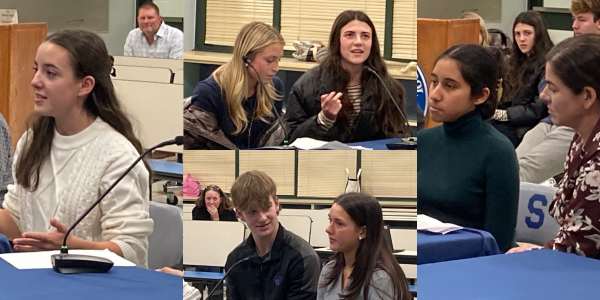
Teachers, students and department coordinators took turns sharing insights on the still evolving courses with the board.
Board members appreciated the input.
“I love this,” Board Vice Chair Dorie Hordon said of the feedback. “I love hearing from students.”
“This is great,” added Board Member Jill Dillon. “This is what education should be. It doesn’t have to be boring … It makes me excited that students who didn’t think of themselves as AP students are doing AP work.”
Forensics
The advanced forensic class was Rollison’s idea, according to John DeLuca, science coordinator for the district. There are four sections of it being offered and students use a multitude of science disciplines to analyze crime scenes.
“(Students) like solving puzzles,” Rollison told the board. The course gives them the opportunity to do it in the same way professional crime-solvers do through trace evidence analysis, ballistics, toxicology, pathology, fingerprinting and DNA.
Cat Betit, a Staples senior, said that so far, the class has been exactly what she hoped it would be. The concepts are complex, hands-on and surprising, Betit said.
Betit said she and her classmates once came to lab class to find a tent set up in the middle of the room and instructions to don protective suits to analyze blood splatters.
“I still have red paint on my shoes,” said Adam Turner, another senior. “This is not your regular science class.”
Turner described the class as not boring but also not easy.
“It’s not for those who just want to sit in the back and doze off,” Turner said.
Spanish cinema

Participants brought to the board meeting also had high praise for the new Spanish course that Maria Zachery, chair of world languages for the district, called a capstone course for students who have completed five years of Spanish, meaning they started in middle school.
Until now, the only option was a very challenging AP Spanish literature course. This year, there were no takers for that course. There are three sections of Spanish cinema.
Joe Barahona, one of the instructors of the course, said Spanish cinema is challenging, but also a course that excites students.
“They have learned foundational (language skills),” Barahona said. “Now they get to have discussions (in Spanish) through a vehicle of interest to them.”
By watching clips of Spanish and Latin American films, the students also learn about culture and history.
“Who doesn’t like talking about films,” Barahona added.
When students are asked to spend five to ten minutes discussing a film in Spanish, many will talk far longer, the teacher said.
“I was not expecting to take Spanish in senior year,” Connor Brill, a Staples student, told the board. He didn’t think he was good enough for AP Spanish, but said he knew colleges like to see four years of a language.
Spanish cinema seemed far more appealing and Brill said it was easier than expected to understand the dialogue and then talk about it.
“My Spanish has gotten so much better,” said Devyn Peffer, another senior.
Zander Bauer said the class helped provide her with an outlet to use all the grammar and vocabulary she has learned to date.
“It all comes together in the end,” Bauer said.
Board Member Andy Frankel asked if the same kind of course could be used for other languages the district teaches.
Zachery said it is being considered.
“The goal is to build proficiency,” she said.
This course, she adds, takes the training wheels off.
Integrated Algebra and Geometry
Of the three new courses, the one that attempts to help students learn algebra I and Geometry at the same time may face the most adjustments.
The course meets for two periods this semester, then one period in the spring. It is intended for freshmen who didn’t take Algebra I in middle school but hope to reach calculus by senior year.
The course has proved to be a challenge.
“It turned out to be very different from what I expected,” Karina Chabria, a freshman, told the board. “I knew it would be accelerated. I did not expect a test every week.”
That said, Chabria said it’s good for students who want to build a stronger math foundation and prepare for the PSATs and SATs.
So far, every student who signed up for the course has stuck with it.
Catherine Hall, an instructor of the course, said going forward, the plan is to make sure eighth grade teachers are aware of the program’s pace and that algebra and geometry are taught together rather than as distinct topics.
In addition to algebraic concepts, the course covers linear functions, linear systems and exponential functions then blends them together.
Stefan Porco, math coordinator for the district, told the board last year that Wilton also offers a combined Algebra and Geometry course, but in a different format.




Recent Comments