
By Linda Conner Lambeck
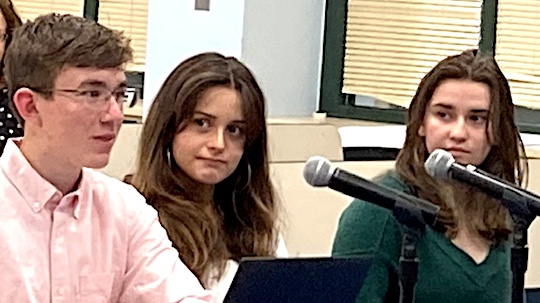
WESTPORT — The Board of Education, normally consumed with issues of policy, discipline and budgets, carved out time at its meeting last week to listen to students make a presentation on a research project involving microscopic worms, fruit flies and mice.
The six board members in attendance loved it.
“This was such a treat to hear,” said board Vice Chair Dorie Hordon. “To hear about such a positive academic experience in the high school.”
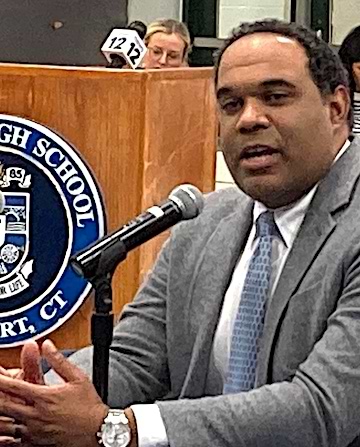
The presentation on a revamped honors-level science research course was one of two programs at Staples High School highlighted during the meeting.
The second was on district efforts to meet a state requirement that all students add a one-credit Mastery-Based Diploma Assessment, starting with the graduating Class of 2023.
Two years into implementing the mandate, which requires students to document through a portfolio how classes have helped them as “communicators, thinkers, collaborators and creators,” the board was told the state is retiring the requirement with the Class of 2025.
Even so, Staples Principal Stafford Thomas made a case for continuing the requirement because it is something the New England Association of Schools and Colleges — the school’s accrediting body — also wants.
“They are looking forward to evaluating it on their upcoming visit,” Thomas told the board about agency representatives.
College-level research
When John DeLuca was hired as district science coordinator two years ago, he presented a compelling vision of what a scientific research course could look like, Supt. of Schools Thomas Scarice told the board.
The existing course suffered from declining enrollment to the point it hadn’t been offered for several years. A decision was made to make the class more attractive by allowing students to create their own hypothesis and conduct authentic research on topics they are passionate about.
Using a repurposed stock room and equipping it with a fluorescence microscope and other equipment not typically found in a high school science lab, the class began with a dozen students who spent last summer writing research proposals so they could hit the ground running in the fall.
“Some of them came in knowing nothing about how to form a scientific question and present their ideas,” Amy Parent, the course instructor, told the board. “They are basically asking me for funding and resources. They have to back their ideas with science, research, and literature reviews.”
In all, a dozen students participated this year. Next year, 15 students are expected, including four students taking the class a second year to further their research.
This year, six of the students completed projects in time for the Connecticut Science & Engineering Fair. Three were finalists. In addition, all 12 made presentations at a Norwalk Community College Science Fair, the board was told.
One of the students, Will Boberski, used fruit flies to determine the role dietary factors play in the development of colorectal cancer. His findings were presented at an international youth forum in Singapore.
He told the school board he loved the time he spent peering into a microscope.
Student Sara De Pinho used mice in her research into why half of all IVFs fail in embryo transfers so that ways can be found to create a treatment plan improving the odds. She is now working with a post-doctorate fellow at Columbia University on her project.
Julianna Gallo, another student, put microscopic worms — smaller than the tip of a pinky nail — through the paces of several dietary changes, including the introduction of probiotics to find out if it would help relieve cellular stress and inflammation that leads to obesity. Her treatment showed promising results.
“I plan on continuing my research next year so I can measure life span and overall inflammation,” Gallo said. Her goal is to point to a cost-effective alternative to pharmaceutical interventions to mitigate obesity.
“That was incredible,” said board Secretary Neil Philips of the presentations as his colleagues broke into applause.
The students were asked how different the class was from others they take at Staples.
De Pinho said the beauty of the class is that mistakes are a learning opportunity, not a disaster — growth matters more than results.
“We all had completely different projects, but were going through a similar learning process,” said Gallo. “I literally messed up my entire project three times, but it all turned out well in the end.”
“It’s definitely a process but it pays off in the end, I promise you that,” De Pinho added.
“This is Staples High School, Westport public school education at its very best,” said board member Robert Harrington. “It’s a shining example of when it works well … It’s great to see.”
Harrington said it should inspire the energy and drive to make possible more achievements like the research projects.
Mastery-based credit
As for the state requirement that students spend time reflecting on what they have learned during their high school tenure, Thomas told board members that staff worked hard to make the experience not an “add-on,” but something juniors and seniors could complete by collecting a portfolio of their work in specific classes, then during Connections Class in senior year, creating a virtual capstone.
Anya Nair, a Staples senior and student representative to the board, said the capstones are shown to incoming freshmen to help advise them on things like time management.
The completed requirement is added to the student’s transcript. About 99 percent of students this year have, Thomas said. Two teachers oversee the portfolios.
Board Chair Lee Goldstein asked how much time it takes for students to complete the requirement.
Calum Madigan, a Staples junior and student representative to the board, said he enjoyed looking back on old assignments to create the portfolio. The time commitment? About 20 minutes, he said.
“It’s so rare for the state to take away an obligation, I wonder if it’s an opportunity to let it go,” Goldstein said.
In a memo to the board, Thomas said no fewer than four recommendations from NEASC referred to the portfolio assignment. Three other peer school districts who have gotten recent NEASC visits have received positive feedback on similar portfolio assignments, he added.
The board pledged to keep the topic on its radar.
Other actions
At the same meeting last Thursday, the board:
- Reconciled its 2024-25 fiscal year budget based on action taken this month by the Representative Town Meeting. The $143.6 million budget is 5.38 percent higher than this year, but is $3.6 million less than the board’s original proposal because of changes made in employee medical insurance coverage.
- Accepted a $7,500 gift from the Staples Players acting troupe to fund stipends for an assistant choreographer, lighting designer and One Acts Direction mentor.
- Agreed to continue a practice started this year to welcome two student representatives — a high school junior and senior — to the board table. The board agreed to revisit the bylaw again next spring.
Freelance writer Linda Conner Lambeck, a reporter for more than four decades at the Connecticut Post and other Hearst publications, is a member of the Education Writers Association.





Recent Comments