
By Linda Conner Lambeck
WESTPORT–Staples High School is set to go phones-free for students on November 5.
That’s a Wednesday, the start of the second quarter, and the day after Election Day, a school holiday.
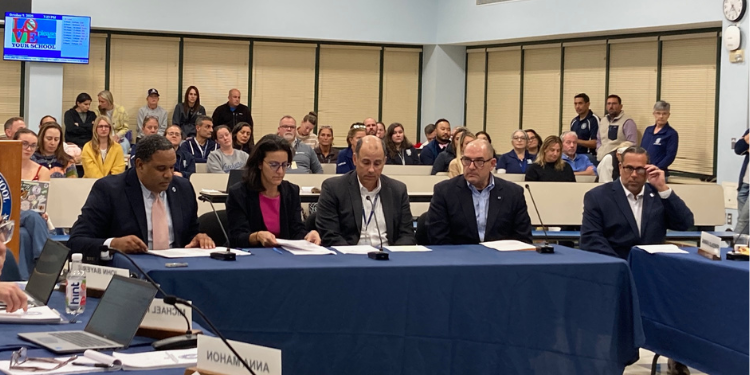
A plan that has been a long time in the making, the school board was briefed Thursday on the process, roll out implications, the expected benefits and the penalties for violating the new rule.
Students who violate the ban by possessing a personal device during the school day will have the device confiscated until dismal. A first offense would mean a trip to an assistant principal office and a detention.
Three violations would result in an in-school suspension.
Time shifts
To carve out five minutes at the start and end of school to give students the time to put their devices in their lockers and retrieve them, one minute is to be shaved off all class periods.
At Staples all students are assigned to an advisory group that meets twice a week for four years where students learn Social Emotional Learning strategies, hold discussions and deliver school information to students. Each session meets for about 20 minutes. The new plan is to offer the class once a week. Officials say that is enough because officials have gotten better at running the program
Reducing Connection periods was already under discussion last year, Schools Superintendent Thomas Scarice told the board. .
Consideration leads to broad support

Scarice, who proposed the cell phone ban more than a year ago, said the time spent considering the issue was well spent. Most faculty who were skeptical about the plan, have come to support it. A large number of Staples teachers, many wearing school jackets, sat in the audience during the presentation.
Math Teacher Lenny Klein told the board he was a non-believer in a cell phone ban until recently.
“I always felt it was not a problem in the classroom,” he said. “I am here to tell you I was dead wrong.”
Since using cell phone holders in his class, Klein said he has noticed a dramatic, positive improvement in many aspects of the classroom, including student engagement and students talking to one another.
“It is refreshing now to hear the chatter going on in the classroom,” Klein said.
Klein said there remains a small but vocal group in town that opposes a ban but said it’s an initiative that works for learning and Staples High School.
Stacey Delmhorst, a Staples teacher and president of the Westport Education Association, agreed.
“Just the general feel of the classroom has changed dramatically,” said Delmhorst. “The time I have reclaimed in my classroom…. We all feel this way. We all agree this is a great policy.”
Student support

Students, on an implementation committee at least, also are sold.
“I think the final decisions that were made were very well thought out,” said Leila Stein, a Staples senior on the committee.
Scarice said the idea behind the ban is to create a learning space that prioritizes student wellbeing, focus and personal connections.
“The evidence is clear. Smart phones and wearable technology during the day diminishes focus, undermines mental health and erodes peer interactions and puts an undue burden on faculty members for focus,” Scarice said.
Staples follows other Westport schools
Westport already bans students from using cell phones at the elementary and middle schools. At the high school, cell phones have been allowed outside of class, during lunch and free periods. Westport’s bell-to-bell ban follows many school districts across the state which now prohibit students from having phones at school.
Souleye Kebe, a student rep to the board and president of the Staples Student Government, said a large number of students he has spoken to don’t want a ban and if there is one, want to keep devices with them in their backpacks rather than lockers.
Scarice said the dings and buzzing from those devices would prove to be a distraction, even if powered down, because of their addictive nature, Scarice argued.
Awarara Olasewere, another student rep to the board and a member of the Implementation Planning Committee, added that having phones in the lockers removes the temptation to check them.

A third of lockers needed repairs
By using lockers, the district will avoid investing in pouches other districts use to keep the devices locked. It did force the district, however, to inspect and repair the school’s 1850 lockers. Many students apparently are not in the habit of using them and 600 locker cylinders had to be replaced.
The board, which in May authorized the administration to develop an implementation plan, did not have a vote to approve the ban, according to Schools Superintendent Thomas Scarice. He called it within administrative purview, and more a regulation of school operations than a change in policy. The board agreed.
Board questions
Board Vice Chair Dorie Hordon, called the ban a long time in coming, but added she was grateful so much time was taken in working it through.
She questioned, however, the reduction in Connection classes.
She was assured that Connections is more sophisticated than it was four years ago so that less time is needed to cover the material and achieve program goals.
Board Secretary Neil Phillips said he was not “on board” with a ban last spring but appreciates the thoughtfulness of the planning. He wondered if an allowance could be made for seniors who are in an important time in their college selection process.
“I do worry about seniors,” added Board Member Robert Harrington.
Others argued that excluding seniors would be hard to regulate and add to teacher enforcement responsibilities.
Assistant Superintendent Anna Mahon said the ban will be well publicized to students and parents.
While some in the committee argued for a phase in, Stein argued that would lead to students not taking the ban seriously.
Other plan details:
- No attempt will be made to search for devices.
- Allowances will be made for the small number of students who use electronic devices for medical reasons.
- The district is still researching if any classes will need additional equipment if they can’t rely on students to use phones to take pictures or measurements for assignments.
- The ban will be reviewed periodically throughout the year with a report coming back to the board in the spring.
Recent Westport Journal coverage of Westport schools
- School board requests supplemental funds for capital projects
- Fifth grade scoring drop worries board
- Strong start for school year, but Scarice warns of “storm clouds”
- 2025 school report: enrollment, staff, buses, comms, security

Linda Conner Lambeck
Linda Conner Lambeck covers education for Westport Journal. She was a reporter for more than four decades at the Connecticut Post and other Hearst publications. She has covered education throughout Fairfield and New Haven counties. She is a proud member of the Education Writers Association.





Recent Comments