

Editor’s note: this post has been updated. The chart of race and ethnicity scoring gaps has been replaced.
By Linda Conner Lambeck
WESTPORT–The school district may have finally figured out how to get more sixth graders at or above proficiency in language arts on the state assessment test but is concerned about the class coming up behind them.
There also continues to be a sharp scoring difference when it comes to race and ethnicity.
State testing results for 2025 were released to the public in August and an overview was presented to the school board on Thursday. Parents should get their individual student’s reports at the end of September, the board was told.
Taken by more than 99 percent of the district’s 3rd through 8th graders, the results show:
- 73 percent of Westport fifth graders scored at or above the state benchmark (proficiency in the eyes of the state) on the Smarter Balanced Assessment math test administered last spring. That is 10 percentage points lower than fifth-graders in 2024 and the lowest level in seven years.
- In eighth grade, 77 percent of students tested scored at or above the state benchmark in math in 2025. While two points lower than in 2024, this year’s score is higher than in 2022 when just 70 percent of eighth-graders met or exceeded the benchmark.
- In language arts, 80 percent of fifth and eighth grade students met or exceeded the state benchmark. For grade 5, that is 8 points lower than in 2024 and the lowest level in seven years. In eighth grade it represents a four-year high and is on par with 2021 scores.
- Tracking students as they advance through the grades, the percentage of students reaching the state benchmark from grades three to five and six to eight remains steady or grows in language arts but has slipped a bit in math at the elementary level.
- As for the grade five to six transition, Westport students improved slightly in math and dropped just two points in reading in 2025. That compares to an 11-point dip between grade 5 and 6 in language arts in 2024.
In the past, the board was told the decline had less to do with how well students can read and write and more with less time spent on language arts at the middle school. Also, the focus in Westport middle schools is on literature while the state test in grade 6 focuses on non-fictional materials.
Further analysis needed
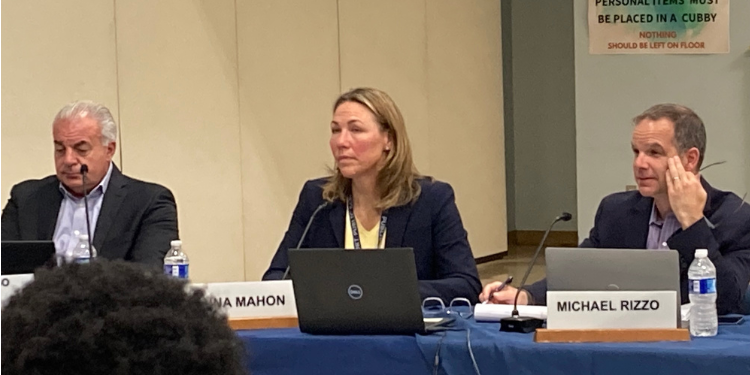
Anna Mahon, the district’s new assistant superintendent of Teaching and Learning, told the board that the turnaround was a notable and positive trend but is something that requires further analysis.
While there are dips in individual grades and cohorts, the overall district average for meeting benchmarks meets or exceeds 80 percent in both math and language arts, Mahon said.
Westport students do much better than the state on the Smarter Balanced Assessment.
In 2025, 50.3 percent of all students statewide reached the benchmark in language arts and 45.9 percent in math. In both cases, the statewide averages represent improvement over 2024 scores.
Mahon said the state test is just one way to measure student achievement.
“It’s one piece of the pie,” she said.
Classroom performance and participation, along with local testing measures, are equally important, she said.
District testing
Testing conducted by the district shows that all students experience growth over the course of a school year that is not always easy to see on a state test, Mahon added.
“The evidence suggests we are moving in a positive direction. At the same time, the data highlight cohorts of students who require additional support,” she said.
When do scoring fluctuations become a concern, asked Board Secretary Neil Phillips.
Patterns
“I look for a pattern,” said Michael Rizzo, assistant superintendent for pupil services. Not a one-year dip but multiple declines over a course of several years is what becomes noticeable, he added.
In Westport, 2,388 students in grades three through eight took the state test which is administered over several days. That represents 99 percent of students.
What is going on with fifth graders?
Fifth graders in the 2024-2025 school year were in kindergarten when the pandemic shut schools down in the spring. The first-grade experience was also disrupted when classes started in a hybrid format, Mahon said.

Those early grades are when students learn to become students, Mahon said.
Whether the disruption impacted attention spans, student behaviors and ultimately test scores is being explored.
“At what point do we look at bigger strategies,” for this grade, asked Board Member Robert Harrington.
The board was told that the difficulty some students have in regulating emotions, knowing how to wait in line, sit on a rug or take turns is not limited to one grade and is not solely the blame of the pandemic.
“There are a variety of reasons,” Mahon said.
“I would say something is going on in grade five,” said Board Member Jill Dillon. She urged district officials to do whatever they could to address it.
Board Chair Lee Goldstein pointed out that the ten-point scoring decline for last year’s fifth grade only applied to math. In language arts the dip was less pronounced and 80 percent of the class scored at or above the benchmark.
Mahon said the district will use its resources to identify both specific needs of students and determine if there are more systematic approaches that should be taken to improve student achievement, not just for fifth graders, but to address subgroup performance as well.
Persistent race and ethnicity scoring gaps
The scoring gap between students on the state test has, for the most part, not improved.

- In language arts for 2025, 90 percent of Asian students and 82 percent of white students in Westport in grades three through eight met the benchmark, compared to 51 percent of black students and 67 percent of Hispanic or Latino students. The year before, 56 percent of black students and 67 percent of Hispanic students met the state goal.
- In math, 93 percent of Asian students and 81 percent of white students met the benchmark compared to 43 percent of black students, and 68 percent of Hispanic or Latino students last spring. The year prior, 40 percent of Black and 66 percent of Hispanic/Latino students reached or exceeded the state proficiency bar.
Board Member Kevin Christie called the lack of improvement troubling.
Mahon said the district doesn’t focus on students as groups but individuals and works with each to set goals to improve achievement.
Rizzo said there has been a systematic effort to train all teachers on how to individualize instruction and that change takes time.
Other tests
On the state science test, 76 percent of fifth graders, 80 percent of eighth graders and 75 percent of 11th graders met the state standard in 2025. That represents a dip in grades 5 and 11 and improvement in grade 8.
On the school-administered SAT test, which counts as the state test in 11th grade, students scored a combined 1199. That is 15 points lower than last year. The test was taken by 405 Westport juniors, which is a 99.5 percent participation rate.
Even so, the scores were good enough that 75 percent of students met the math benchmark and 90 percent the language arts benchmark set by the state.
Westport’s school-administered SAT scores for 2025 were higher than Weston and Ridgefield and Region 8. They were lower than Wilton, New Canaan and Darien.
Mahon pointed out that Westport students also perform higher than the state average, which in 2025 was a combined score of 969.
Recent Westport Journal coverage of Westport schools
- Strong start for school year, but Scarice warns of “storm clouds”
- 2025 school report: enrollment, staff, buses, comms, security
- Daniel Cortright named Westport’s 2026 Teacher of the Year
- Redistricting, AI, cellphone ban: Westport schools face big changes

Linda Conner Lambeck
Linda Conner Lambeck covers education for Westport Journal. She was a reporter for more than four decades at the Connecticut Post and other Hearst publications. She has covered education throughout Fairfield and New Haven counties. She is a proud member of the Education Writers Association.







Obviously, education scores declining in any area are troubling. Mainly for the sake of the children who may suffer long term consequences, but also for the reputation of our town as one providing excellent public education. As we all know, the school system is one of the biggest draws to our community of upscale home buyers that contribute to the cachet of towns like Westport, Darien, Greenwich, etc. The disparity in scores in the various racial demographics is spelled out in the text. Oddly, however, the graph information leaves out the black scores but adds an amorphous, nebulous category of “multi racial” who seem to be doing rather well. The only problem is , we don’t know who they are. Clearly, the honest conversation about who is not doing well and why, is not going to be addressed here, but it should be.
I am glad to see that the graph now includes all racial demographics, as it did not when I wrote the original comment. I am compelled to say this lest readers think I am confabulating, which I am not.
Why don’t we figure out what drives the excellence amongst our Asian neighbors and seek to emulate it?