
By Linda Conner Lambeck
WESTPORT — Supt. of Schools Thomas Scarice has proposed a $150.3 million budget for the 2025-26 school year, a 4.69 percent increase that would fund several new staffing positions.
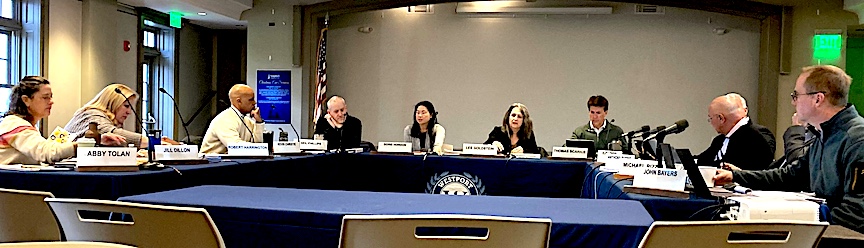
The plan to restore two elementary school assistant principal positions — “the marquee request of the budget,” according to board Chair Lee Goldstein — might have received the most attention during a day-long budget workshop Friday at Saugatuck Congregational Church, but it was not alone.
Also included in the superintendent’s budget proposal is a facilities project coordinator, a new technology assistant, two new permanent middle school building substitutes and a part time elementary school health teacher.
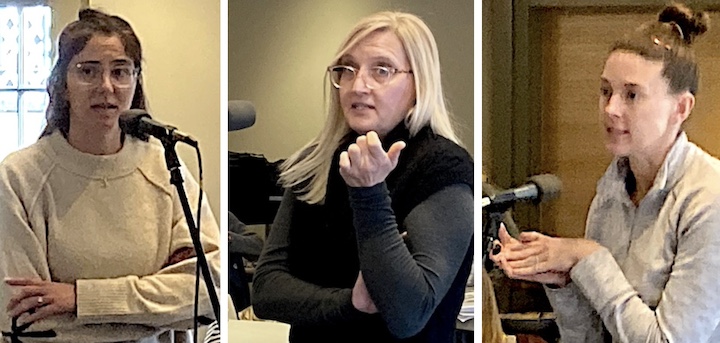
Two assistant principals and a facilities coordinator were cut during last year’s budget-making process before reaching the school board. A board vote to include money to pay assistant principals failed on a tied vote.
This time, without the uncertainty of health insurance cost hanging over the process, both items made it into the spending plan, which will be vetted through January. The board’s proposed budget is scheduled to be passed on to town funding bodies in February. A final vote on the 2025-26 budget, which will take effect July 1, is expected by the Representative Town Meeting in May.
Several members of the Board of Finance and RTM, along with a dozen or more parents and some staff members, were at various portions of Friday’s budget workshop, which stretched from 8:45 a.m. until nearly 4 p.m.
Scarice called his request necessary to operate a premier district of eight schools and a preschool, that next year is projected to serve 5,327 students.
“Our priorities were to protect current levels of staffing … and restore full administrative leadership at the elementary level,” Scarice said.
The recommendation, he said, not only responds to the learning and social/emotional needs of students, but advances the district’s forward-thinking plans.
Funds are in the budget for the district’s strategic plan as well as the district’s No Place For Hate initiative.
In all, additions to the budget beyond salary increases and rising costs represent $744,706, or about one-half of 1 percent of the bottom line.
Goldstein called the spending package very reasonable.
There are also some projected cost offsets, including modest reductions to some special education accounts, the shifting of some staff and building a $180,000 credit from the school bus provider for parking buses at Greens Farms Railroad Station into the bottom line. Some want to see the year-to-year arrangement with First Student become permanent.
Assistant principals
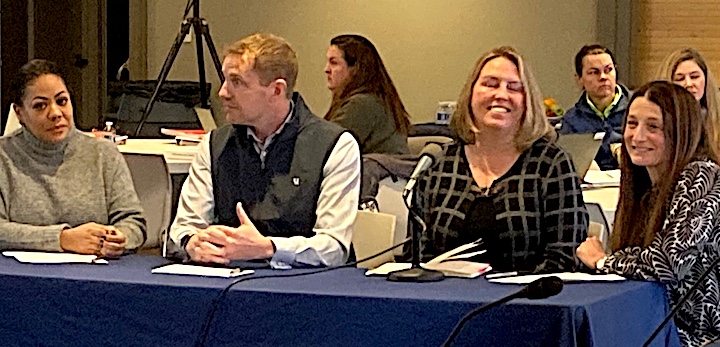
As they did last year, elementary school principals showed up at the session to make a case for adding two full-time assistant principal positions to the current six.
Long Lots now has two full-time assistant principals, while the other four elementary schools have 1.5 each.
That is not how it always was, said Kings Highway Principal Tracey Carbone, who said she once worked as an assistant principal.
The Westport model had one assistant principal handle special education matters, while the other takes on a multitude of other administrative tasks, freeing the principal to serve as a school’s instructional leader.
Enrollment decline led to the reductions, but Saugatuck Principal Elizabeth Messler said many of an assistant principal’s responsibilities are not tied to headcount.
District APs are so good at what they do, they make it look like it can all be done in half the time, Greens Farms Principal Brian Byrne told the board.
Without them, however, Byrne said his ability to observe classes and go to districtwide meetings is lessened.
“I miss out on conversations,” added Carbone.
Students miss out as well, she added. “There were times when I could be in the classroom. That is something that doesn’t happen anymore.”

Safiya Kay, Coleytown Elementary’s new principal, called the role of AP critical. She too held the position in Greenwich and said when one AP is split between two schools it is hard to carry ownership over specific tasks, especially when students and families are involved.
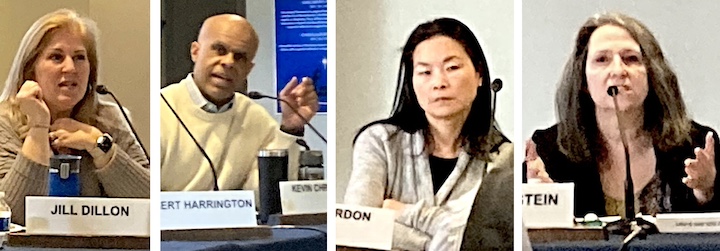
“I fully support restoration of these positions,” said Jill Dillon, one of three board members who voted to add them to the budget last year. “I think it is very important to the school culture.”
Board member Kevin Christie thanked the principals for making the current system work. Last year he voted against funding the jobs, but this time around said he hopes to be able to fully support the superintendent’s recommendation.
Adding two assistant principals, with benefits, would cost $405,888, according to the budget book.
Board Secretary Neil Phillips said his no vote last year was tied to budgetary concerns. This year, he said principals made a compelling case for why the positions have greater relevance to equity than enrollment.
Board Vice Chair Dorie Hordon, who voted yes last time, said she hasn’t really heard from the community that full-time APs are a pressing need.
Several parents who sat through the budget session came to the defense of the positions, saying it is the staff’s request that counts.
“As a parent, I really don’t know the impact, but support the APs,” said Allison O’Dell, a Saugatuck parent.
Parents often don’t know something they don’t have, added Lori Freeman, another parent.
Still, Hordon said it seemed that having two full-time APs per elementary school is a luxury. She wondered how the $405,000 to hire them might otherwise be spent.
So did board member Abby Tolan, who was new to the board last year and did not vote on the plan. This year, Tolan said she was glad to see the positions back as part of the superintendent’s recommendation. Still, she wondered about the budget impact going forward.
Ins
Other additions to the superintendent’s 2025-26 budget plan include:
● A facilities project coordinator position that would cost $132,867. The board held off discussing that to a future meeting.
● Double the number of permanent building substitute teachers at the middle schools from two to four. The cost would add $50,940 to the bottom line. Beford and Coleytown Middle both have college interns who sometimes fill the role of substitutes, but the case was made for keeping all classes covered.
● A part-time elementary health teacher, costing $65,204. Health and Physical Education Coordinator Christine Wanner said the position would come in handy when the district offers gender specific instruction to fifth graders simultaneously. The state-mandated instruction is currently covered by a sub or school nurse.
● An additional technology assistant, costing $89,807. There are nine technology assistants now. Technology Director Natalie Carrignan made the case for 10 to handle all the district devices in the hands of more than 1,000 staff members and 5,000 students across 10 locations.
● An additional $44,100 for districtwide professional development tied to district initiatives and $72,450 for strategic planning.
● Stipends are being added to handle the district’s No Place For Hate initiative, the Staples High School Honor Society advisors who previously were not paid, a head fencing coach at the high school, several middle school club advisors and elementary school choral play positions. Subtracted from the mix are three Unified Sports positions that Assistant Supt. John Bayers can be added back in if interest in the program rebounds.
Outs
Items that did not make the final cut in the superintendent’s budget include:
● A financial literacy teacher request.
● An additional part-time special education teacher at Kings Highway. Instead, a part-time position from Bedford is being relocated.
● An additional regular education paraprofessional previously cut from Staples.
● Half of a planned K-5 reading textbook purchase. The district will split the purchase and get just K-2 this year, saving $250,000. Assistant Supt. Anthony Buono said he was comfortable with the phase in.
Tradeoffs
Unlike last year, when insurance uncertainty reigned, this year the district is expecting health insurance costs to rise 4 percent, or $1 million, according to Elio Longo, the district’s chief financial officer.
Also built into the proposal is a recommendation to shift $1 million from a special district health insurance reserve fund into the bottom line.
Longo assured the board the move would not supplant budget costs, but rather “right-size” the reserve fund.
“It was an 11th hour decision to do that,” said Scarice, adding it took him time to be convinced it was not going to create a budget “cliff” going forward.
Some board members, asked to hear more about the plan at future meetings.
Although there is a projected enrollment increase of 43 students overall next fall, Bayers said that growth should not require more teachers. Like this year, 121 classroom sections are planned.
Salaries account for 62.9 percent of budget and teachers are getting 5.1 percent raises in the new fiscal year. Benefits comprise another 17.1 percent. Negotiations with four other non-certified bargaining units, including custodians, maintainers, paraprofessionals and nurses, are expected this spring.
Some 14.9 percent of students in the district are in special-education programs. The statewide average is closer to 17 percent.
This year, the district sends 36 students to out-of-district programs. The same is number is expected next year. Officials say outplacement would be much higher were it not for an investment in a program called Effective School Solutions.
In 2020, before use of the program, the district sent 42 students out of district.
Givebacks
Over the course of seven years, the district has returned $4.6 million in unspent funds, Longo said. The town, through a memorandum of understanding, allows the board to keep a small percentage of money not spent from the approved budget in a carryover account.
The town has also reaped nearly $1.8 million since 2017 in tuition paid by Westport staff for their children to attend the town’s public schools at a reduced rate. The tuition payments go directly to the town, Longo said.
The town has also received about $4.17 million since 2017 from the state’s Education Cost Sharing formula.
In all, the town gets back about 1 percent of the money it allots to the school district between tuition, ECS and returned funds, Longo said.
Freelance writer Linda Conner Lambeck, a reporter for more than four decades at the Connecticut Post and other Hearst publications, is a member of the Education Writers Association.












Recent Comments