
By Linda Conner Lambeck
WESTPORT — The Board of Finance chairwoman told the school board this week she anticipates a 2022-23 school budget request between 2.25 and 2.5 percent higher than this year’s $126.5 million.
“We want a budget that works for the schools, the students and the town,” Sheri Gordon, the finance panel’s new chairwoman, told the Board of Education at its Monday meeting.
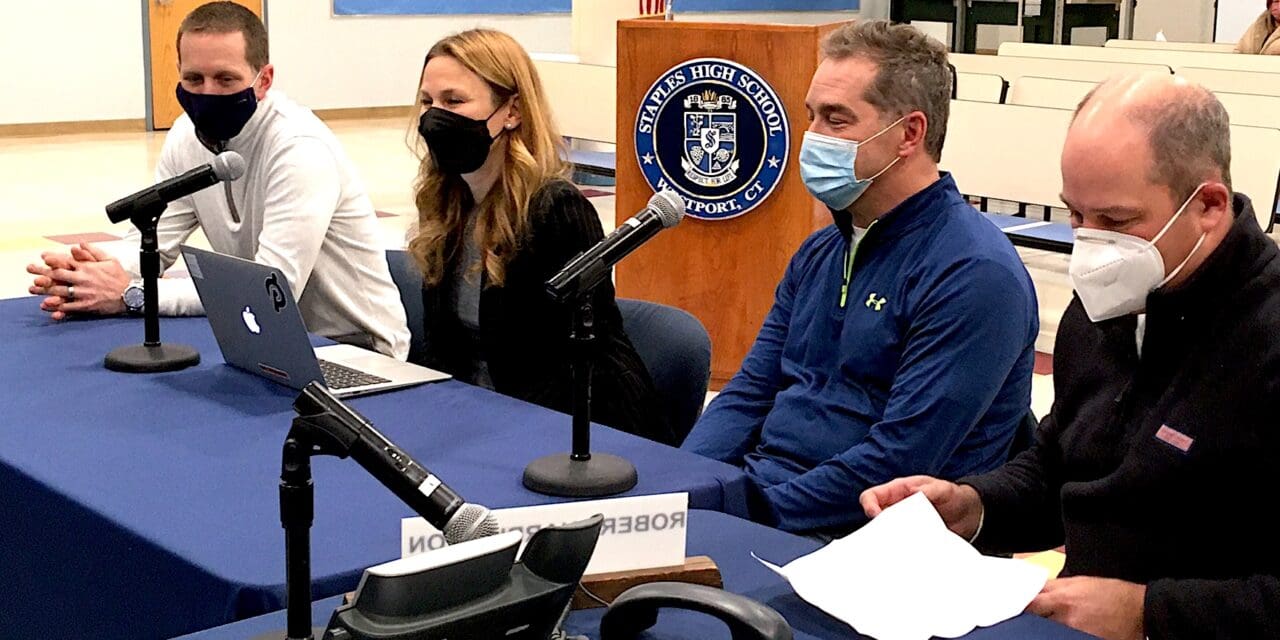
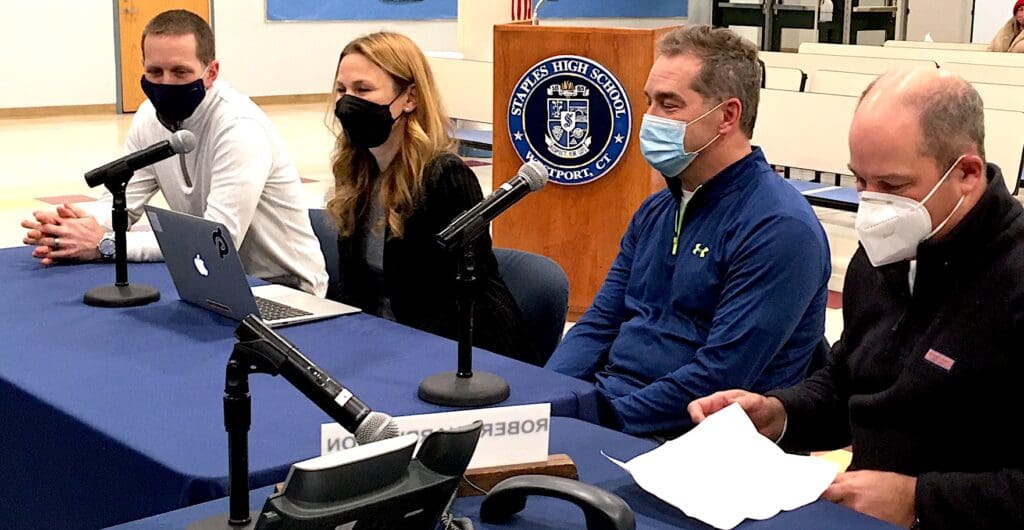
Flanked by three other members of the finance board, Gordon said the goal is to get the budget season off to a good start, put expectations on the table and avoid games she said have been played in the past.
“We have a lot straight shooters, that makes a huge bit of difference,” Gordon said.
There is no reason, she added, to rally parents and scare them if efficiencies become necessary.
The appearance of town fiscal and legislative leaders before the school board at its last meeting of 2021 is in keeping with an annual practice.
In addition to four members of the Board of Finance, an email from Lauren Karpf, deputy moderator of the Representative Town Meeting and chairwoman of its Education Committee, was read into the record by school board Chairwoman Lee Goldstein.
Karpf said she is bracing for a difficult budget year that she hopes will result in fair results for all.
Setting goals within context of broader spending priorities
The finance panel came to school officials with two distinct requests:
- The Board of Education develop a two-year capital plan.
- The board also consider supporting creation of a townwide facilities director — some called the position a “Facilities Czar” — who could assess and prioritize both town and school building needs going forward.
“We need someone to look at all facilities … so we don’t have another Coleytown,” said Lee Caney, a member of the finance board.
Coleytown Middle School was closed in 2018 because of extensive mold problems, and underwent a $32 million remediation project.
Gordon said town officials want to see Westport retain its reputation that relies heavily on its award-winning school district as a key component.
Nonetheless, she said, there are a number of competing spending priorities, rattling off a list that included a Longshore Park update, a redo of Jesup Green, 24 bridges in town that need to be rebuilt in partnership with the state, repairs to the town’s four fire stations and renovations at Police Department headquarters.
The town currently carries a debt of $100 million, a figure that is anticipated to grow.
Finance member Jay DesMarteau called the idea of a facilities czar aspirational.
School board members seemed open to the idea.
Robert Harrington, a new school board member, said a separate working group that focuses on all facilities townwide might get both sides on the same page.
Liz Heyer, the school board vice chairwoman, said she is not sure if it’s up to the school board to hire a townwide facilities official, but added the board would not stand in the way. The district already has Colliers International Project Leaders to manage its facilities, which Heyer suggested might be open to town input.
Is looking for “efficiencies” a polite way to impose spending “cuts?”
Regarding the operating budget,Caney, entering his ninth budget season, said, “Our job is to push back a little and look for efficiencies,” rather than simply accept the school budget request as is.
“Don’t start up high,” Caney said of the education budget request, while acknowledging the need for wiggle room. “But not a lot of wiggle room,” he added, noting how the school district routinely manages to end the fiscal year with a surplus.
The finance group acknowledged the district must fund a contractual 3 percent increase for teacher salaries, which makes up 80 percent of the education budget.
Still, they asked that the school board to creatively scrutinize administrative, transportation and special education costs.
Gordon said she hopes that Thomas Scarice, named superintendent a year and a half ago, will help the school district take a fresh look at optimizing spending.
“We are not just about the bottom line,” said Gordon. “We want what is best for our kids.”
Lately, she added, priorities have been so focused on COVID issues and building projects there has been no bandwidth to think about how to improve schools.
Goldstein said she looks forward to the partnership and takes finance members’ word that they care about schools.
“I think setting expectations is great,” she said.
However, she added, efficiencies are a polite way to say cuts.
Scarice said he appreciated the candor of the budget conversation, but agreed that efficiencies could ultimately limit access to some courses.
“In full disclosure … the margins are slim and getting creative sometimes means a reduction and a programmatic change,” he said.
On the flip side, Scarice told the finance members that if the budget number is wrong, he wants to know.
“That would help the board deliberations,” he said.
Discussions on the 2022-23 education budget start in January.












Recent Comments