
By Gretchen Webster
Journalism, politics, and academics came together in the forum, “Trump vs. the Media: Covering the News in Contentious Times,” sponsored by the Y’s Men of Westport/Weston on Sunday.
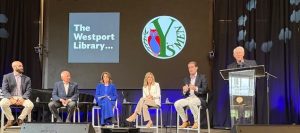
From left: Aaron Weinstein, assistant professor of politics at Fairfield University; Jim Marpe, former Westport first selectman; Rebecca Surran, news anchor on News 12 Connecticut; Alisyn Camerota, formerly with CNN and Fox News; and U.S. Rep. Jim Himes. Photo by Gretchen Webster.
The discussion, held at the Westport Library, was a deep dive into the connections between journalists, the American voter, and the government at a time when the country is in turmoil. The forum presented five different perspectives on the role of the press in Trump’s government.
“We are looking for news free of bias,” said John Brandt, the discussion moderator and member of the Westport/Weston Y’s Men to get the discussion started. “How do we choose, and who do we believe?”
“This is a perilous moment,” said Congressman Jim Himes (D-4th District), who was a panelist at the event. “This president is not comfortable as a constrained president.” Instead, he said President Donald Trump directs businesses, the press, the courts and other American institutions “to do his bidding.”
A free media under attack from American government
A free press must be safeguarded, Himes said. “We have some work to do to insulate the press from the intentions of this president – and any president. The founders knew that the press must be independent from political pressure.”
Himes and former Westport First Selectman Jim Marpe represented the political viewpoint both nationally and locally at the forum, while former CNN political commentator and Westport resident Alisyn Camerota spoke about the press at a national level. News 12 Connecticut anchor Rebecca Surran spoke about local press coverage. Aaron Weinstein, assistant professor of politics at Fairfield University, was the fifth panelist, presenting an academic look at the role of the press in today’s political climate.
“We are in the middle of a cataclysm,” Camerota said. “This is a very hard and perilous time to be a journalist,” she said, echoing Himes’s concerns.
She compared the atmosphere in the U.S. after 100 days of Trump’s second presidency as a country caught in an earthquake.
“Our institutions are shaking around us,” she said. And when the earthquake ends, “as it will … will we still have “60 Minutes,” CNN, and CBS News?”
Trump is constantly threatening journalists, she said, only allowing access from those he knows will not ask difficult questions around him. Camerota has been blacklisted by Trump, she said, as have entire news organizations including The Associated Press (AP), the global news organization that distributes national and international news to smaller, local news outlets.
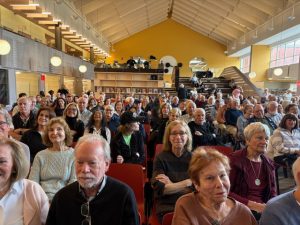
There was a sell-out crowd at the library for the forum. Photo by Gretchen Webster
The loss of AP news reports is a problem for Channel 12, and all local news outlets, Surran said. The lack of money to pay for local news has also become more of a problem and local news organizations and local journalists have disappeared from many communities, she said.
Westport, however, “has historically valued journalism,” Marpe said. “We in Westport are lucky to have many sources of news locally … what many other communities don’t have.”
“Local news more directly affects our daily lives,” Surran added. “Local news is the boots-on-the ground” type of media.
Encouraging citizens to be critical consumers of news
All the speakers at the forum emphasized that in these chaotic political times, Americans must be even more thoughtful, critical, and educated consumers of the news.
“In a democracy, people have to be engaged in the media,” Weinstein said.
He also warned that relying on polls can be dangerous and that polls showing that Trump would not win in 2016 against Hillary Clinton could have impacted the results. “A poll is only a snapshot” of a certain time in history, he said. “How to read a poll is an important skill to teach.”
“We can’t be passive anymore,” Camerota said. “It is incumbent on us to be super-educated news consumers.”
“The government has no business telling you what to think,” Himes added, before he left the forum for the VFW in Saugatuck to congratulate high school graduates entering military academies.
Freelance writer Gretchen Webster, a Fairfield County journalist for many years, was editor of the Fairfield Minuteman and has taught journalism at New York University and Southern Connecticut State University.







It is an outrage that legacy media companies are settling with Trump, ABC and now CBS has offered millions to him. Battle Royal over the “truth”. Remember when Bill Clinton said, “it depends on what the definition of the word is is!” I added the exclamation, but he was right. In order for there to be progress, avoiding a legacy media collapse, we need to have agreed upon definitions. For instance – calling Elon a Nazi, that is the most disgusting slander. Unfortunately people are not ashamed. Language usage is the cutting edge of our culture, its how we define our selves, in LLM’s or the nightly news. 1984 was only the begining. Welcome to the brave new world. This use of languge to define reality is not new…it goes all the way back to neo – Sumeria; The Epic of Gilgamesh set the stage for our modern day mythology. Trump is Gilgamesh and Elon is Inkidu. The song remains the same.
So Trump is threatening journalists? And yet I see them , including in this forum, blathering away with no problem whatsoever. Meanwhile, according to Himes the government should not be telling you what to think unless, of course, it is that Trump is Hitler and Biden is compos mentis.