


By Gretchen Webster
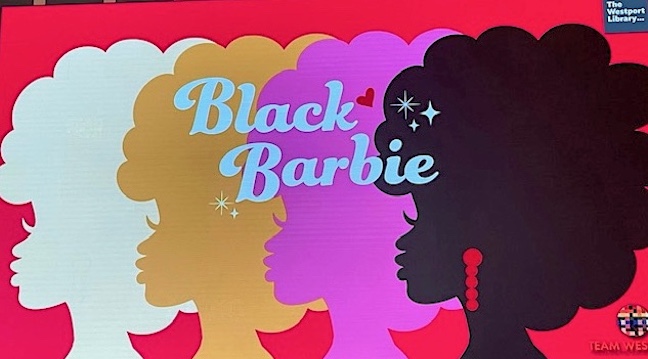
WESTPORT — A full house at the Westport Library on Monday got a first look at Shonda Rhimes’s newest film, “Black Barbie,” recounting creation of the first Black doll to join the iconic line of Barbie dolls.
The documentary, produced under the banner of Rhimes’ Shondaland production company, debuted in honor of Juneteenth — the June 19 observance of the date when the Emancipation Proclamation was last enforced to free slaves in western Texas on June 19, 1865. The film will be streamed on Netflix starting Wednesday.
Among those attending the library screening, which was followed by a conversation with Rhimes, were Gov. Ned Lamont and his wife. The governor praised Rhimes for her work as creator and producer for hit television shows, including “Grey’s Anatomy,” “Scandal” and “Bridgerton,” as well as “Black Barbie,” which underscores the importance of recognition of the Black experience.
“People want to be able to look on the screen … they want to be able to see themselves in the world out there,” Lamont told the audience. “That is what ‘Black Barbie’ is all about and that is what Shonda Rhimes is all about.”
Rhimes, a Westport resident, was introduced by Harold Bailey, Jr., chairman of the TEAM Westport, the town’s multicultural advocacy committee that co-sponsored the screening.
Rhimes briefly introduced the film, which traces the history of Black dolls, culminating in the creation of Black Barbie in 1980. Along with introducing the people who worked to get a Black Barbie onto the market, the film also focuses on the importance of having toys that represent children’s differences and how children are affected when they don’t see themselves in their play.
The documentary also featured research on the connection between dolls that looked like children playing with them — and those who didn’t. Included was footage of children taking the Clark test in the 1940s, where Black children were found to prefer and assign positive characteristics to white dolls, and have negative views of Black dolls. Discussion of how that perspective negatively affected children’s self respect is also explored with several researchers and psychologists.

The documentary also includes recent conversations with Black children in classrooms and their reaction to dolls with their skin color. Those children had a more positive reaction to dolls that looked like them than the children in the earlier tests.
“You can’t be what you can’t see,” Rhimes said after the film screening, in conversation with Bernicestine McLeod Bailey, a TEAM Westport member whose family had a toy company. “You’ll never have the power to dream it if you can’t see it.”
When the first dolls with Black skin were introduced, they were only friends of Barbie — the classic white, blonde and slim doll created by Mattel in 1959. But the Black dolls did not officially become a “Barbie,” or play major roles in Barbie stories or movies, for many years, Rhimes pointed out in the film.
Although Mattel introduced the official Black Barbie in 1980, and many more dolls with darker skin have been made since — including a doll of Shonda Rhimes herself — “It’s not enough,” Rhimes said.
“ ‘Black Barbie’ has not gone far enough … There is so much more to be done,” she said.
Freelance writer Gretchen Webster, a Fairfield County journalist for many years, was editor of the Fairfield Minuteman and has taught journalism at New York and Southern Connecticut State universities.




Recent Comments