
By Gretchen Webster
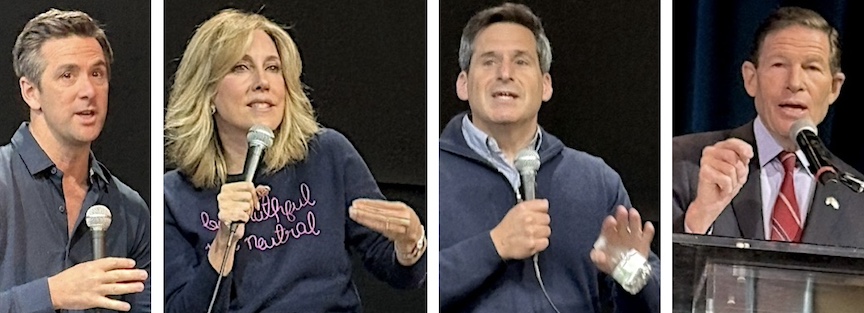
WESTPORT — Four veteran journalists and U.S Sen. Richard Blumenthal took a deep dive Sunday into the current state of American journalism at a Westport Library forum, co-sponsored by the Y’s Men of Westport/Weston.
Speakers told the capacity crowd at the “Election Impact” program they are gravely concerned about how democracy is threatened when mass-produced “news” is drawn from social media or promotes misinformation.
“Journalism is the lifeblood of a democracy,” said Blumenthal, a Democrat serving his third Senate term. “Democracy is in more danger as never before in my lifetime.”
“It’s hard to get a clear view of where the U.S. stands” after the election of Donald Trump to his second presidential term, said moderator John Brandt of the Y’s Men, introducing the panel’s journalists: John Berman, Alisyn Camerota and Dave Briggs all currently or formerly of CNN, and Dan Woog of the Westport blog 06880.
Blumenthal said he is concerned about the advent of “big tech and artificial intelligence,” as well as the demise of local, independent reporting in many cities and towns. “Democracy really depends on truthful reporting,” he said.
Camerota, wearing a T-shirt that read, “be truthful, not neutral,” said she is worried more than ever about the spread of misinformation with the recent announcement that social media giant Meta will no longer fact check information on its popular Facebook and Instagram sites. Meta’s CEO, Mark Zuckerberg, announced last week that his company’s fact checkers will be fired, and that information posted on his social media sites will no longer be checked for accuracy.
“Who will do the fact checking?” Camerota asked. “Smart, aggressive, vigorous reporting is needed.”
She blamed the growing polarization of the electorate as a major factor in the election of Trump last November, promoted by conservative news sources such as Fox News and others.
“I believe that misinformation was the main factor,” she said, citing “the horror of immigration and the dangers of wokeness” as fake news.
Briggs disagreed with her — to a point. Voters were polarized, he said, but not because of misinformation. “People knew what was happening. They knew what happened, for instance, on Jan. 6,” 2021, when the U.S. Capitol was invaded by Trump supporters trying to block certification of Joe Biden’s election. “They just didn’t care.”
Briggs said he believes the election outcome can largely be attributed to Democrats and their quick choice of Kamala Harris as their presidential standard bearer after Biden dropped out, instead of nominating several candidates and holding a primary election.
“Had Democrats used an electoral process to choose a candidate, today we’d have a different president,” Briggs said.
Blumenthal placed the blame for the election outcome on the disruption, chaos and drama precipitated by Trump and his followers, as well as “the growing power of Meta, Google and X” social media platforms.
Trump’s efforts to shake things up with misinformation, plus voters’ concerns about housing and food costs and their children’s future, resulted in “anger, grievance and fear,” the senator said. “People are angry and fearful.”
Briggs agreed. “This terrifies me,” he said of what he called “Mark Zuckerberg’s garbage dump of misinformation. I’m angry with people who believe anything because they ‘read it somewhere.’ “
Berman called it “the genius of Donald Trump” to spread misinformation by getting social media outlets to stop fact checking. Disseminating rumors, such as immigrants in Ohio were eating cats and dogs, underscored Trump’s ability to grab more attention for himself and his campaign, he said.
Blumenthal also listed Trump’s sensational statements that the U.S. will try to buy Greenland, take over the Panama Canal and make Canada the 51st state, “immense distractions” that are being amplified by social media, taking away from authentic news-gathering and reporting.
Wealthy social media moguls “have the resources to do fact checking and they don’t,” the senator said.
What’s missing, according to Camerota, is a lack of critical thinking among Americans reading or viewing news. Checking the veracity of information can be as easy as picking up your phone, she said.
“But half the country doesn’t think that critical thinking is important,” Woog responded.
As the journalists’ discussion drew to a close, Berman suggested, “Let’s make the humanities great again.”
“Let’s make humanity great again,” Blumenthal added.
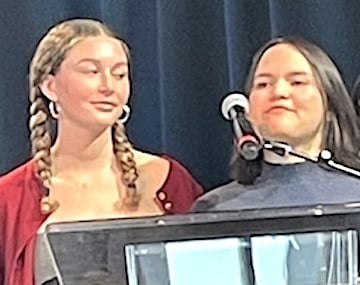
The two editors-in-chief of the Staples High School newspaper, “Inklings,” Nina Bowens and Lily Hultgren, explained how important studying journalism is to them and their classmates.
Their journalism teachers, Joseph Del Gobbo and Mary Elizabeth Fulco, said teaching quality journalism skills to young people underscored that significance. “We are privileged to be teaching this generation,” Fulco said.
As local news outlets disappear, many communities in the U.S. are relying on the high school press instead of professional news sources for local news.
“It’s important to keep local news alive,” Fulco said.
Freelance writer Gretchen Webster, a Fairfield County journalist for many years, was editor of the Fairfield Minuteman and has taught journalism at New York and Southern Connecticut State universities.





There was a lot of available information during this election cycle. The republicans followed the regular rules for choosing candidates and the win was decisive–for Trump. I remember the moment Trump was shot, cnn said he fell. That is when people made their decision about fake news and legacy media’s turn towards propaganda in the face of competition from new media sources. This is about evolution of the information revolution- see Marshall Mcluhan…the medium is the message. Journo 101