
By Gretchen Webster
WESTPORT — Is there life in other parts of the universe?
Questions about whether beings exist beyond this galaxy have preoccupied human kind from the earliest eras of recorded time on Earth.
And some humans believe beings who inhabit other parts of the galaxy sometimes dispatch things into Earth’s solar system.
Others simply do not share that belief.
Many doubters are scientists who don’t want to be risk takers, according to Harvard astronomer Avi Loeb, who this week gave a virtual lecture to the Westport Astronomical Society, defending his belief that civilizations much older than Earth’s may well be sending advanced technological objects to our galaxy.
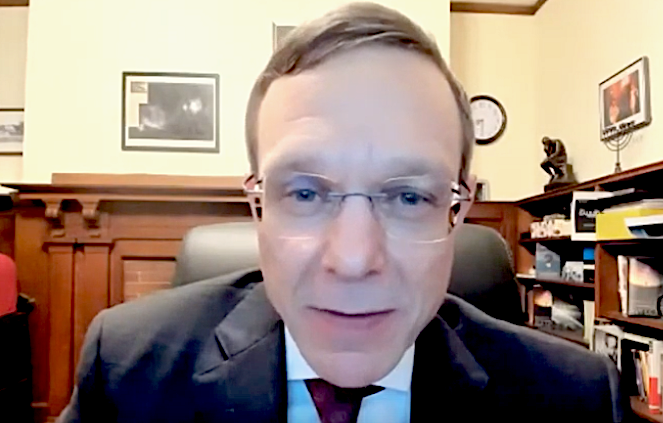
“There are more habitable earths in the observable volume of the universe than there are grains of sand on all the beaches on earth,” he said. “Most stars formed billions of years before the sun. There could have been very likely civilizations that were technologically advanced like we are — even more so — a billion years ago … Our civilization will mature by finding others.”
Loeb is the chairman of the Department of Astronomy at Harvard University, chairman of the Board of Physics and Astronomy at the National Academy, and the author of four books, including, “Extraterrestrial: The First Sign of Intelligent Life Beyond the Earth.”
He has been criticized by other scientists who believe that extraterrestrial objects observed so far are of natural origin, such as comets or gas or dust masses.
Loeb, who said he regularly seeks out evidence to prove — or disprove — his theory, has assembled more than 100 scientists in the Galileo Project to research his claim. The Galileo Project is “a systematic scientific search for evidence of extraterrestrial technological artifacts.”
The project’s goal, Loeb said, is to build more powerful telescope systems to examine and track extraterrestrial objects, and to eventually send an unmanned space mission far enough to gather more information on unexplainable objects that have been seen by scientists on Earth.
“The question that I consider the most significant in science is — are we alone?” Loeb said.
The astrophysicist explained in his lecture that since it is likely other civilizations exist — or did exist — in Earth’s galaxy and beyond, and knowing that space travel into those outer reaches is extremely difficult for humans because of heat, lack of oxygen and other problems, then it may be likely other civilizations may have navigated highly technical aircraft, instead of living beings, into our solar system.
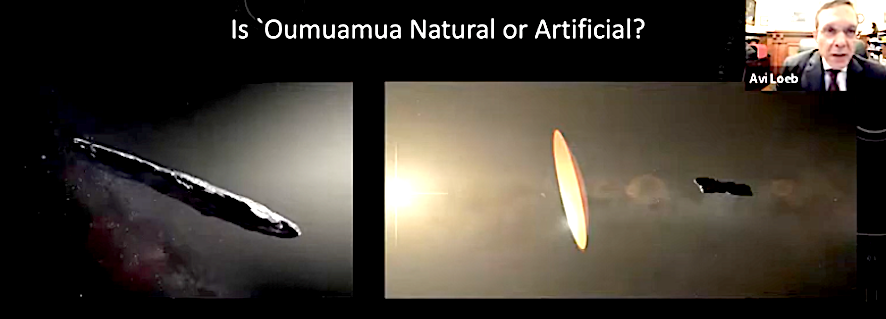
The impetus for the Galileo Project, he said, was the appearance of an unidentified object seen through a telescope at the University of Hawaii’s Institute for Astronomy in Maui, Hawaii, in 2018, and named Oumuamua — meaning “scout” in the Hawaiian language.
Loeb and other scientists have theorized using technical equipment to measure the reflection of the sun’s light off the object and other measurements — that Oumuamua is flat, resembling a pancake or disc, and as big as football field. It is unlike any other interstellar object seen before in astronomy, Loeb told the Westport Astronomical Society viewers.
Other scientists have insisted the object must be natural in origin, he said, such as a frozen cloud of hydrogen or nitrogen, which also has never been seen before.
Even scientists who do not believe the object could be an aircraft from another civilization, agree that the object is something unknown. “Given that all the proposals made invoked something that we’ve never seen before, my view is that we should leave artificial origin on the table and not just dismiss it,” Loeb said.
According to the astrophysicist, even the U.S. government believes that research into extraterrestrial objects is important and launched a task force to study them.
“Who produced Oumuamua? … It is clear that the government doesn’t know what to make of these objects. There are things that we don’t understand,” he said.
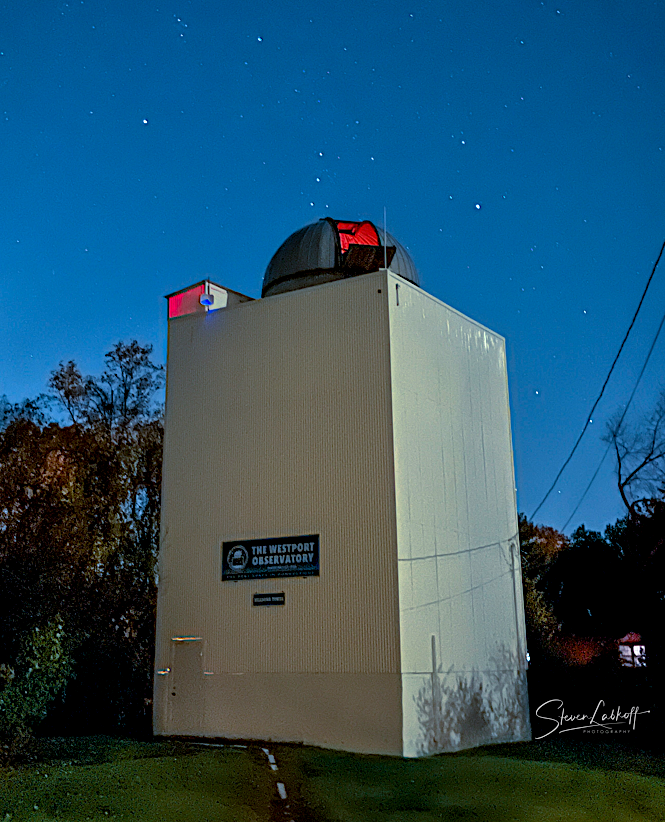
Over a hundred listeners from around the world viewed Wednesday’s lecture, one of the monthly lectures presented by the Westport Astronomical Society.
The society is a nonprofit organization founded in 1975, according to Dan Wright, a board member and past president of the society. Lectures are offered the third Wednesday of every month, he said, and speakers include astrophotographers, astronomers and other scientists.
The society also offers public star gazing on Wednesday nights from 8 to 10 p.m. when nights are clear, both on the lawn and from the dome of the observatory, 182 Bayberry Lane. All events are free and open to the public, Wright said.
The society’s mission is simple, he said: “We want to keep science in the community … Everything we do is to propagate science in our community.”
Future programs include: Jan. 18 with Clare Burhenne, PhD, student and longtime society member on “The Physical Properties and History of the Large and Small Magellanic Clouds;” Feb. 15 with Dr. Giada Nichole Arney, co-deputy for the DaVinci Mission to Venus, and March 15 presented by Dr. Nour Raoyuafi, project scientist of NASA’s Parker Solar Probe Mission. All lectures are at 8 p.m.
A calendar of events and other information is on the Westport Astronomical Society website.







Can this WAS lecture be viewed online and how?
I missed it, and would like to see it