
By Gretchen Webster
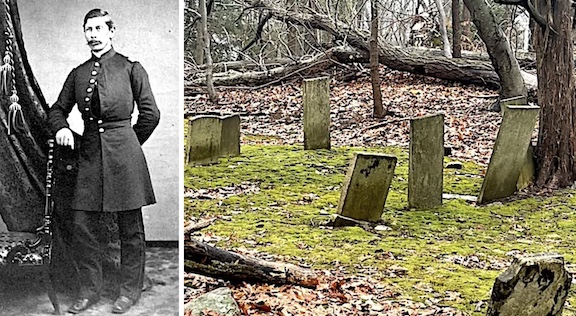
WESTPORT — A Civil War general, buried in a communal grave in historic King’s Highway Cemetery, may be honored with his own headstone more than 100 years after his death.
Union General Henry Moses Judah was laid to rest in the Westport cemetery in 1866, according to Frank Jastrzembski, whose organization, Shrouded Veterans, has installed more than 100 headstones across the country and overseas for Civil War officers. And now, Jastrzembski hopes Judah’s final resting spot will get the recognition he feels the soldier deserves.
“Some of these people went 100 years or more in unmarked graves and they were never recognized for their service,” he said.


Among Judah’s military accomplishments during the Civil War was the pursuit and capture of Confederate General John Hunt Morgan in Ohio 1863, according to an obituary in the Burlington Times. Judah was also a division commander during Union General Ambrose Burnside’s expedition to secure control of Knoxville, Tenn.
Judah’s career was not always illustrious, however. He graduated near the bottom of his class at West Point (35th out of a class of 39), and was relieved of his duties after the capture of Morgan because of “absolute rashness,” the obituary said. “He also had issues with alcohol,” according to Jastrzembski.
Although Judah is not credited as one of the Union Army’s great leaders, that should not influence the placement of a stone on his grave, Jastrzembski said. “Everyone has flaws; they’re not perfect. I still think they should be honored,” he added.
But the process to honor General Judah with a marker in Westport has not been easy. Jastrzembski first sent a letter to First Selectwoman Jennifer Tooker, who passed it along to the town’s Historic District Commission because the cemetery is within the King’s Highway North Local Historic District. The stone will require a certificate of appropriateness from the commission before it can be installed.
Commission Chair Grayson Braun has been scouting out businesses that might be able to install the stone in the rocky and hilly cemetery. The cost of carving the memorial and its installation would be paid for by the state Department of Veterans Affairs and installed with funds Jastrzembski has gotten from a donor.
“It’s a little bit tricky,” Grayson said. “He’ll ship the stone, but someone has to put it in.”
King’s Highway Cemetery is one of three historic burial grounds in Westport maintained by the Parks and Recreation Department. Park and Rec staff mows the grass in those cemeteries, but would not install the heavy headstone, said Parks Supt. Michael West. He leaves issues of historical preservation up to the Historic District Commission.
“I’m not really the steward of the history of those spaces,” West said.
Gravestones in King’s Highway Cemetery are so old that inscriptions can’t be read on most of them, and trees have fallen down in parts of the cemetery.
Plus, it would prove challenging to move the new stone for General Judah up the steep banks of the cemetery, which lies off the busy intersection of King’s Highway North and Wilton Road, where it is difficult to park a truck, said Braun. She intends to walk the site again to find an appropriate location for the new stone, and work out the details of the installation, if the HDC approves it.
“We’re putting in far more time than we anticipated” on the project, she said.
And Jastrzembski’s request highlights the issue of what the HDC’s role should be in regulating cemetery grave markers, Braun added. “Do we want to start to regulate headstones? We never issued a certificate of appropriateness to a headstone before.”
Other private cemeteries in Westport, including the Christ and Holy Trinity Cemetery down the road from the historic cemetery, are governed by trusts or boards of directors, and sometimes maintained by volunteers, Braun said.
“The Historic District Commission does have a responsibility that what occurs in these cemeteries is respectful …We regulate it technically, but does it really make sense for us to regulate them?”
Judah was in command of the military post in Plattsburgh, N.Y. when, at the age of 45, he died of a heart attack and was taken to Westport by his brother to be buried with members of his family. The grave where he lies also contains the remains of Judah’s father, the Rev. Henry Judah, the rector of St. John’s Church in Bridgeport, and his mother, Mary Jane Judah.
In 1866, the general’s body was escorted to the train by a company of the 4th Infantry from the U.S. barracks in Plattsburgh, N.Y., according to a Plattsburgh newspaper. Once Judah’s remains reached the New Haven train depot, his body was accompanied by “the military and other friends” in a procession to the Westport graveyard.
Jastrzembski said the grave-site markers he advocates be installed for military veterans, like the one for Judah, are usually put in place without ceremony, unless a local veterans organization plans one.
Although Jastrzembski is not a veteran himself, he has been researching the history of U.S. veterans for several years. “My passion has always been history,” he said.
An estimated timeline for General Judah’s new memorial to be placed in King’s Highway Cemetery — if approved by the HDC and installation plans completed — would be approximately 60 days after it is cut and shipped to Westport.
Freelance writer Gretchen Webster, a Fairfield County journalist for many years, was editor of the Fairfield Minuteman and has taught journalism at New York and Southern Connecticut State universities.








A laudable project in a town-owned historic burying ground that, like the nearby town-owned Poplar Plains Cemetery, is HIGHLY deteriorated owing to under maintenance. The only problem I see is that the HDC has not been granted the authority to regulate rocks. It regulates structures – defined in the enabling legislation as a combination of materials affixed to ground. Several years ago, the Westport HDC infamously tried to expand its reach to regulate some rocks in a field. It was ugly. The commission finally threw in the towel and, in a public meeting, agreed to quit it. Apparently, institutional memory has slipped a bit in this case.
I support this idea and hope it focuses much needed attention on this cemetery and other historic, town-owned burial sites that have fallen into some disrepair. Though not mentioned above, the Westport Garden Club (WGC) began restoration of the King’s Highway historic cemetery in the late 1940s. Over the ensuing decades, the WGC used their own money (via their own fundraising efforts) to continue this work, but they were also given annual stipends from the Town of Westport to assist in these projects. Other town historic burial sites were also added to WGC’s list. Last I knew, the WGC is still getting town money to help support their various town efforts, but I don’t know to what degree the WGC spends its time and money at the Kings Highway site anymore (or any of the historic cemeteries they formerly helped improve and maintain).
I grew up in Westport and have been working for about 15 years on a history of the Indian wars in northern California and southern Oregon during the 1850s in which Judah is a major figure. When I first learned that he was buried in my own hometown, I visited Colonel Marvin’s tomb at the first opportunity. As my memory serves, there were three subterranean tombs, once accessible through doorways in their stone fronts, whose entrances have long since been filled in to their tops by erosion so that they are visible today as mounds in the foreground of the cemetery, viewed from Kings Highway. The lowest one, closest to Saugatuck River, is the one Judah is entombed in. I visited it with my father, David Royce (d. 2014). As best I recall, the timber header above the doorway was at about ground level, so that it had completely rotted away and it was possible to peer into the tomb with a flashlight. When I did so, all I saw at first was a base layer of fine, soil-like debris with the relief of several rows of coffins visible like buildings burned or rotted down to their foundations, leaving a clear impression of their original shape in the dust. There was a lot of metal coffin hardware (like handles and hinges) lying there also, no obvious signs of bodies but I did see what might have been the top of a cranium.
I was a little disappointed that almost nothing remained, that the tomb (maybe 16′ deep by 20′ wide) was almost completely empty, until my flashlight lit upon a perfectly-preserved coffin such as I had never seen before. It looked like a metal sarcophagus in the Egyptian anthropomorphic style, shaped like a human body with a head and shoulders and chest all narrowing to the feet like the Oscar award trophy. Subsequent research revealed that coffins like this were made for a brief period in American history, essentially during the Civil War and for about a decade after. These futuristic metal coffins were designed to preserve the remains of Union soldiers during transport by train from the battle fields and field hospitals to their hometowns, for viewing and burial. They were closed with (molten?) lead gaskets for air-tight seal and some of the bodies so interred have been found quite well preserved in recent times. These coffins were built with glass viewing windows over the face, very space-man-like, and closing metal covers over the glass.
I obtained a complete list of burials at the Marvin tomb from Katie Chase (RIP) of the Westport Historical Society. None of the burials but H.M. Judah fit the period when these coffins were used, pretty well establishing the obvious, given Judah’s prominence as a career military officer: that this is Judah’s grave.
I think Judah is written off too quickly. It does appear he had a drinking problem, but alcoholism (and even drinking on duty) was pretty commonplace at that time among officers, especially Western officers like Judah who spent years living at frontier posts without family. Judah is a fascinating character, the son of Jew raised in Westport who attended Columbia College in NYC, married the daughter of an Episcopalian priest, and became an Episcopalian minister himself. His brother, Theodore, was a the visionary engineer of the nation’s first transcontinental railroad. Judah served in Florida for the tail end of the Seminole Wars after graduating from West Point. There he met his first wife, although he did not marry her until later. He served with distinction through the entire Mexican War. His Mexican War diary is lodged in the Library of Congress and over the years I have transcribed it. He was sent to California and Oregon in 1852, and his wife died just before he left. Their child was brought to Florida by Judah’s cousin (my recollection) and raised by his grandparents. Judah served for many years in California and Oregon (and Washington), when the US Army was placed in the difficult position of intermediary between the rush of miners and settlers and the suddenly displaced tribes, as well as between the federal government (which failed to treat with the tribes for their land) and the states of California and Oregon and the tribes at a time that the nation was being polarized and torn apart at the eve of the Civil War.
Sadly, about the only secondary history we have about Judah was written by people who had every reason to distort their narratives. These are the accounts by (then Lieutenant, later General) George Crook of Judah’s role in the California Indian wars and by Gen. Schofield of Judah’s role in Morgan’s Raid and the disastrous Battle of Resaca. Crook speaks of Judah as being an outrageous drunk and petty, bullying martinet. IMO, Crook was a murderous psychopath redneck who liked hunting Indians like big game and Judah was a humane and urbane northeastern gentleman who rightly restrained Crook in a matter the latter found overbearing. Crook focuses on the episode of the cave in January 1854, in which Judah becomes too sick for duty (due to delirium tremens, according to Crook). There is much more to this episode than meets the eye, more than I can quickly explain, but suffice to say that overall Judah played a heroic role in standing up for the rights of the wronged Indians in California and Oregon–he was a good guy, put between a rock and hard place.
As for Morgan’s Raid and the Battle of Resaca, I am no expert in military history, but I am also pretty well read in it; and as far as I can tell Judah can not be faulted for his performance in either event and all the blame heaped on him by Gen. Schofield (indirectly, without naming names, and after Judah was dead and no longer able to defend himself) seems rather to be Gen. Schofield distorting the truth to distance himself from failures he not Judah was ultimately responsible for. In Morgan’s Raid, Judah was faulted for being too careful, for not rushing ahead after Morgan but letting his men rest for a few hours after a forced march of days before confronting the enemy. His decision, while questionable perhaps, seems entirely logical under the circumstances and if I was a soldier under him I would rather go into battle prepared even if it meant that the enemy could run away and continue to wreak havoc for a few more hours. Morgan was successfully caught, Schofield just wished Judah had not paused to rally at the end. At the Battle of Resaca, Judah was faulted for making precisely the opposite mistake, for rushing into battle without first being sure he was prepared. Judah was one of many commanders charging across a marshy wood along a front of several miles. On the other side of that marsh was a narrow clearing, and on the other side of that clearing was a giant entrenched force of Confederates. Judah was among the first commanders to reach the clearing and his men were being cut to pieces as they stood there waiting for everyone else to catch up. When the line seemed to have all arrived, and was just standing there being murdered, Judah made what seems to me the reasonable decision to go ahead and charge (as originally ordered to) the Confederate lines before these lines were reinforced. Every minute that the assault was delayed, more reinforcements arrived on the other side, and more of the Union men were killed just waiting there by artillery and rifle fire. In a chaotic situation, he charged ahead and commanders on both sides went at the same time, or even earlier according to some reports. It would turn out that the artillery intended to support the assault was stuck in the mud and not in place in time. It appears to me that when the assault was turned back and thousands of men killed in the attempt that Schofield passed the blame to one of his commanders with a reputation for drinking too much and messing up.
After this battle, Judah was relieved of battlefield command and served in an administrative civil affairs capacity in Georgia, where the locals spoke well of his kindness towards the conquered Confederates. After 15 years of reading about Judah, I think yeah, he may have been a drunk and chronically given to messing up, but he was everything a good soldier is supposed to be: honorable and courageous and ferocious in fight. His entire life was full of great effort and tragedy and I hope he rests in peace.
If anyone wants to know more about Judah, please feel free to reach out to me. I have a whole folder of copied documents from the Westport Historical Society about the Judah family, provided to me by Katie Chase when she was alive; as well as countless other information about him related to his California and Mexican War experiences. With regard to his grave, I should note that after I found it as stated, I wrote to the Westport Historical Society and recommended they repair it. They did do so a few years later, and as luck would have it I met one of the persons involved with this, Sven, of the historical society, who showed me photos on his phone that he had taken of Judah’s coffin before they sealed up the tomb.
Zachary,
Splendid historic narrative! Thank you so much. Your father would be very proud.
Would love to talk to you and see your file. Please get in touch.
Kindest regards,
Gloria Gouveia
Gloria@landuse-ct.com
Hi Zachary,
Thanks for the thorough response!
I’m also interested in getting in touch with you. What’s the best way to do that? My email is fjastrzembski10@jcu.edu.
Thanks,
Frank Jastrzembski,
Shrouded Veterans
COMMENT I wanted to add a couple things to my comment: First, my memory as to which mound is Judah’s is rough and it may be the second of three, or the third of four or something like that. I just recall three mounds, two large and one small, and in my memory Judah’s is one of the larger mounds and definitely quite a bit downhill of the uppermost mound. Second, for any Westport historians that want to look into it, I have a hesitant and purely speculative (perhaps almost fanciful) hypothesis as to why the Judah family is buried in the Marvin tomb. I don’t have my notes in front of me to look up the names, but I have wondered whether Jewish families were allowed to be buried in Christian cemeteries, and if it is possible that the Marvin family ‘took in’ the Judah family into their tomb. I have wondered whether Judah’s grandfather or great-grandfather fought with Colonel Marvin at the upper ford of the Saugatuck when the Redcoats were returning, and for his service the favor was returned. This is a fanciful possibility but might be worth looking into. The cemetery does seem to poignantly ‘overlook’ the scene of the great battle, and could account for HMJ’s desire to be buried there, i.e. with the warriors whose legacy he carried on. Of course, the Judah family was connected with the Raymonds, who I believe lived nearby and are also buried there, so the connection might be more related to that or some similar family connection.
So, SO many cemeteries in every state are in complete disrepair. Broken, sunken markers, covered with overgrowth. I think so many believe that all cemeteries will continue maintaining headstones for all time, unfortunately this is not so. Mowing and weed-whacking is about the extent of it.
It seems there is no group “in charge” of clearing/cleaning/maintaining this particular cemetery…it would take some work, but certainly deserves it for Westport’s sake. There are companies that clean and repair headstones, and they should be done professionally.
Could the Civil War Veteran’s headstone be brought in from the back of property? If it’s the standard issue size from Dept of Veteran’s Affairs, should not be terribly large, nor weigh more than a couple hundred lbs? Hope that they will opt for granite, not marble, as marble deteriorates at a much faster rate over time.
Just some thoughts, for what they’re worth!
Dan Woog wrote a similar story about this cemetery and about Judah over three years ago. It’s worth reading again. Not much has changed since then, despite the questionable maintenance issues that were pointed out at that time by Dan and those who commented.
https://06880danwoog.com/2020/11/28/finding-new-life-in-an-old-cemetery/