
Robert Zemeckis is a courageous, innovative filmmaker. Never resting on his “Forrest Gump,” “Back to the Future,” “Cast Away” laurels, he’s obsessed with technology and its countless possibilities.
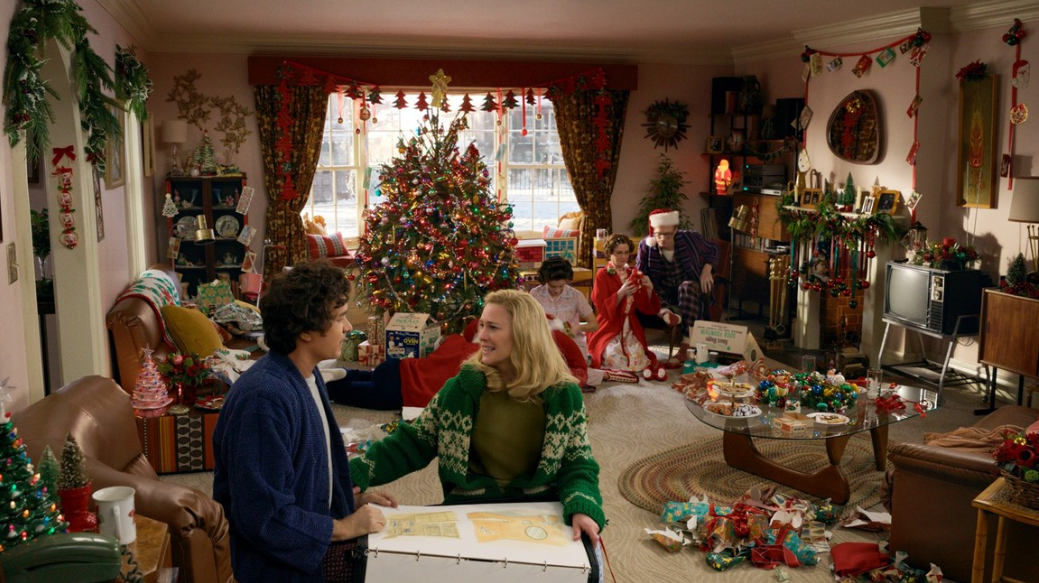
With the camera firmly fixed on a wide-angle vantage point, his newest film – “Here” – traces one particular living space through the prism of time. Set on a New England plot of land, Zemeckis’ visual perspective never changes while everything around it does.
Beginning before recorded time, Indigenous people lived there. Then came the settlers, including Benjamin Franklin’s estranged son who built a huge colonial manor across the street.
Constructed in 1902, Pauline (Michelle Dockery) first lived in the house with her aviation-obsessed husband John (Gwilyn Lee), followed by ‘reclining chair’ inventor Leo (David Flynn) and his wife Stella (Ophelia Lovibond) in the 1930s.
In 1945 – shortly after W.W.II – the two-story house was purchased for $3,400 by Army veteran Al Young (Paul Bettany) and his wife Rose (Kelly Reilly), who raised three children there.
When their son, aspiring artist Richard (Tom Hanks), impregnates his high-school sweetheart Margaret (Robin Wright), he puts his dreams aside, taking a mundane job and raising their daughter (Zsa Zsa Zemeckis). Because finances are tight, they move in with Al & Rose, although Margaret always yearns for a home of her own.
Years pass. There are weddings, births, deaths and break-ups, accompanied by suffering, soul-searching, sentimentality and a steep climb in real-estate value.
To transition between time periods, Zemeckis cleverly uses pop-up windows, evoking crucial pop culture moments (like when the Beatles appeared on Ed Sullivan’s TV show), and delves into A.I’s digital de-aging process.
Adapted from the 2014 conceptual graphic novel by Richard McGuire, it’s episodically scripted by Zemeckis’ “Forrest Gump” collaborator Eric Roth as a cinematically ambitious, non-linear, intergenerational meditation on mortality.
Only the inclusion of a ‘cautionary’ vignette featuring a contemporary Black family (Nikki Amuka-Bird, Nicholas Pinnock, Cache Vanderpuye) – who buy the house for $1 million in 2015 after the Youngs vacate – seems oddly jarring.
On the Granger Gauge of 1 to 10, “Here” is a stationary, static, yet solid 7, playing in theaters.
All her life, genial Delia Ephron has lived in the shadow of her more famous older sister: writer/director Nora Ephron. As romantic comedy writers, they often collaborated (“You’ve Got Mail”) and shared a genetic predisposition for leukemia.
But that revelation comes mid-way through Delia’s 2022 memoir-adaptation “Left on Tenth” that just opened on Broadway.
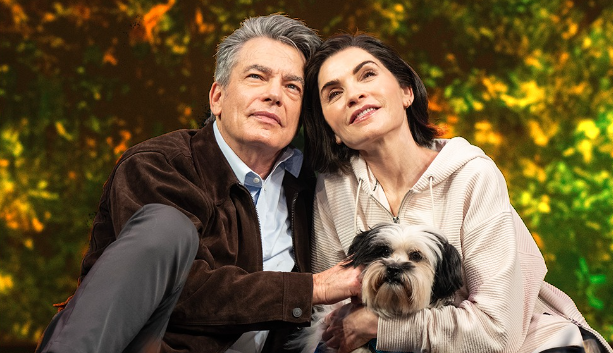
Set on a lefty street in Greenwich Village, her story, as related by Delia (Julianna Margulies), begins with seemingly endless calls to Verizon. A while ago when her husband died and she had his phone disconnected, Verizon also deleted her internet connection – a frustrating situation she’s been unable to remedy.
After the New York Times published her amusing essay about this dilemma – which Verizon eventually rectified – Delia is e-mailed by charming widower Peter Rutter (New Milford resident Peter Gallagher), a Jungian psychiatrist in Northern California, who recalls they were introduced by Nora and actually went on a couple of dates many years ago. None of which Delia remembers.
Their long-distance relationship predictably evolves into real-life romance. “I began to believe I was falling into my own romantic comedy,” she notes, revealing she’s been obsessed with love since she first watched the 1954 movie musical “Seven Brides for Seven Brothers.”
Running one hour, 40 minutes without an intermission, it grows increasingly tedious as Delia bravely battles agonizing chemotherapy with stalwart, solicitous, stoic, saintly Peter at her side. (Apparently, he slept on a cot in her hospital room.)
Problem is: the superficial script suffers from awkwardly interminable affability. There’s too little character development and even less friction or tension. What you see is what you get, including the inevitable ‘happily-ever-after’ ending.
Directed by Susan Stroman with various supporting roles played by Peter Francis James and Kate MacCluggage, it’s enhanced by Beowulf Boritt’s elegantly book-lined set design, Jeff Mahshie’s costumes, lighting by Ken Billington & Itohan Edoloyi, sound by Jill BC Du Boff, projections by Jeanette Oi-Suk Yew, wigs by Michael Buonincontro and the obedient dogs are credited to Theatrical Animals Inc.
“Left on Tenth” is at the James Earl Jones Theater at 138 East 48th Street.




Recent Comments