
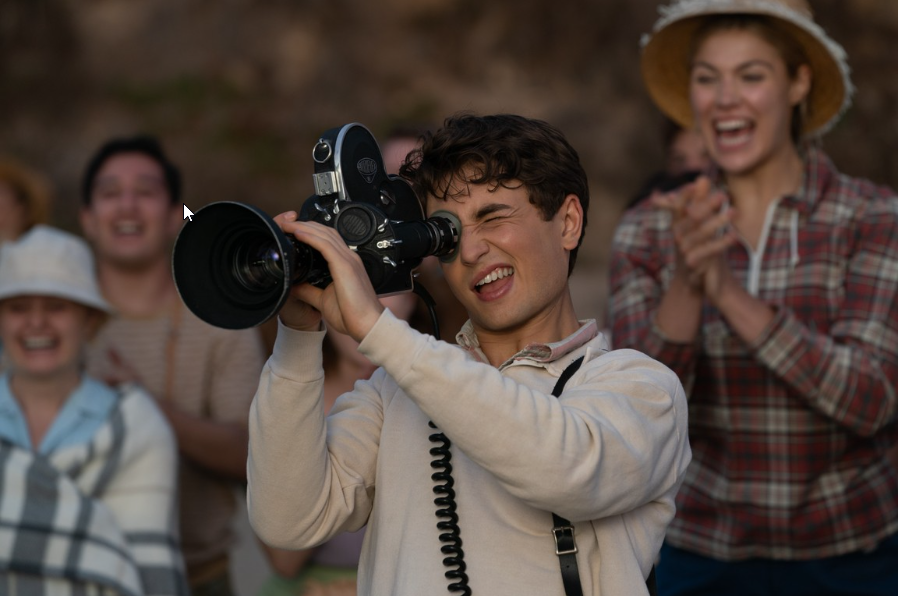
Perhaps the best way to describe “The Fabelmans” is to call it filmmaker’s Steven Spielberg’s origin story. As director and co-writer – with Tony Kushner – Spielberg reveals what ignited his passion for movies and dramatizes the various obstacles he faced growing up, particularly anti-Semitism and the dissolution of his parents’ marriage.
After crafting crowd-pleasers like “E.T.,” “Indiana Jones,” “Jaws,” and “Close Encounters of the Third Kind,” 75 year-old Spielberg realized, “This is the coming-of-age story I really wanted to tell.”
Fictional five year-old Sammy Fabelman’s fascination with film began when his parents – thwarted, mischievous Mitzi (Michelle Williams) and brilliant but stolid Burt (Paul Dano) – took him to see “The Greatest Show on Earth” (1952), an Oscar-winner in which director Cecil B. DeMille staged the most spectacular train wreck ever filmed.
After that theatrical experience, Sammy became obsessed with movie-making, shooting his own 8 mm creations as the family moved from New Jersey to Arizona to Northern California. When he was a teenager, editing footage of family outings, Sammy (Fabriel LaBelle) suddenly realized what was really going on in his mother’s relationship with family friend Bennie (Seth Rogen). It’s a pivotal and poignant moment.
Then in high school, Sammy became the target of anti-Semitic bullies and acquired his first girl-friend, Monica (Chloe East), who tried to convert him to Christianity.
Spielberg told the New York Times: “In a way, the camera was a social passport for me…I was basically weaponizing my camera to curry favor with these athletic, popular kids who eventually all wanted to be in my movies.”
Kudos to immersive cinematographer Janusz Kaminsi, Rick Carter’s authentic production design, John Williams’ evocative score, and Judd Hirsch’s indelible cameo as Sammy’s estranged great-Uncle Boris, who unleashed a torrent of life-changing advice and the sacrifices Sammy would have to make in order to achieve his dream.
FYI: Spielberg’s real-life mother, Leah, died in 2017 at age 97 and his father, Arnold, died in 2020 at age 103. After their divorce, both remarried, yet remained friends. And Spielberg’s crucial meeting with irascible director John Ford (David Lynch) unfolded exactly as depicted on-screen.
On the Granger Gauge of 1 to 10, “The Fabelmans” is a touching, tender, transfixing 10, one of the best movies of 2022.
It made no sense to have Netflix release “The Good Nurse” in late October, followed by a far-more detailed account of the same serial killer in its own “Capturing the Killer Nurse” in early November.
Based on Charles Graeber’s book “The Good Nurse: A True Story of Madness, Medicine, and Murder,” both follow the investigation that led to Charles Cullen’s arrest in 2003.
“The Good Nurse” is a true-crime drama, pivoting around Amy Loughren (Jessica Chastain), a single mother and conscientious, caring nurse at Parkfield Memorial Hospital in New Jersey. When she’s partnered with a recently hired nurse, Charles Cullen (Eddie Redmayne), they soon become friends.
Amy suffers from cardiomyopathy, a life-threatening heart condition, but she’s afraid to tell anyone because her hospital health insurance has not kicked in yet. But while working with Charlie in the busy ICU, she suffers an ‘event,’ which Charlie agrees not to reveal to anyone.
Kind, supportive Charlie helps Amy with her pain, covers for her at work and soon becomes a pal to her daughters. She trusts him implicitly until, suddenly, patients under their care start mysteriously dying.
Charlie soon becomes the prime suspect in a police investigation, and courageous Amy is called upon to help unearth information about his previous employment.
Unfortunately, screenwriter Krysty Wilson-Cairns and director Tobias Lindholm never delve deeper into the story. There’s no twist, no tension. He’s the killer; his capture and incarceration seem inevitable.
Unlike “The Good Nurse,” however, the real story, detailed in “Capturing the Killer Nurse,” offers far more insight into all the events that led up to Cullen’s arrest after killing 29 patients – with a possible total of 400. His methodology involved tampering with IV bags, filling them with lethal doses of digoxin, insulin and epinephrine.
What’s almost as horrifying is how the various hospitals in New Jersey and Pennsylvania blamed one another without taking responsibility. As Cullen said, “They didn’t stop me.”
FYI: Amy Loughren now lives in DeLand, Florida, where she’s become a Reiki Master and hypnotherapist.
On the Granger Gauge, “The Good Nurse” is a frustrating 5, particularly when compared with its documentary follow-up – both streaming on Netflix.




Recent Comments