
By Linda Conner Lambeck
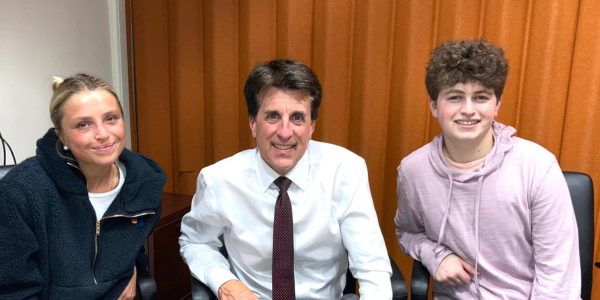
WESTPORT–Staples High School might have won approval for a new, $695,000 security system without the help of Staples Seniors Zander Bauer and Elijah Falkenstein, but Schools Superintendent Thomas Scarice said it would have been a lot harder.
“The student advocacy piece has been louder, and more organized,” Scarice said this week in a third-floor conference room at town hall, with Bauer and Falkenstein at his side. “That goes a long way towards making a compelling case.”
A week earlier, the Board of Finance gave the green light for a system that will provide more than 300 so-called “panic buttons” to every staff member at the 475,000 square foot high school by the fall.
Finance board member Jeff Hammer, before the unanimous approval, told the two students that their testimony helped seal the deal by pointing out the devices come in handy in health emergencies as well as security ones.
“The case is cut and dry at this point. In prior instances we were not so sure,” Hammer said. “I am absolutely in support of this.”
Scarice said the two students approached him more than a year ago with the idea to supply staff with panic buttons. At the same time, the district had commissioned a security evaluation of the district and doing something to strengthen security at the cavernous Staples High was a top priority.
“The last security evaluation had recommended such a system, the question was what kind of technology to use,” Scarice said.
Staples not only has big spaces, but the cellular phone signals are not always reliable.
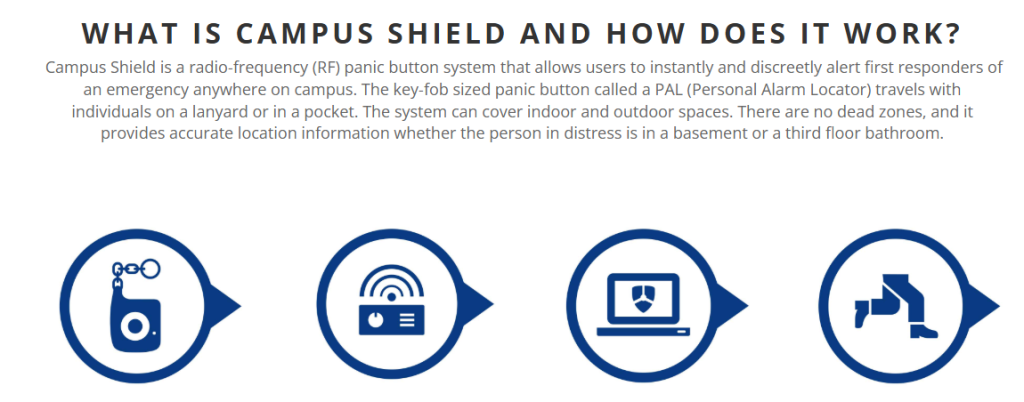
The system that will be installed this summer–named Campus Shield–will use encrypted radio frequency signals that are independent from existing cellular or Wi-Fi systems, according to Seth Romans, CEO of National Protective Systems, Inc., which developed the system. NPSI, based in Massachusetts, is working with TPC, the Milford-based emergency and security company that won the contract.
Romans was unwilling to say how many schools have systems similar to the one being installed at Staples, but said the number is growing. The system will cover the entire school and its perimeter.
Staff will be trained in how to use the devices that will be worn on a lanyard around their necks. Each one costs the district about $125, Romans said.
When pressed, the silent buttons not only alert police dispatch and security, they allow the wearer to communicate with responders so they will have information before they arrive.
Scarice likens the system to an insurance policy.
The key to safety, Scarice said, is to slow down threats and speed up response. The panic buttons help speed up response.
Westport Deputy Police Chief Ryan Paulsson told the Board of Finance the system will enhance his department’s capabilities for response at the high school.
“For any kind of hazard, not just worst case scenario,” Paulsson said.
Bauer and Falkenstein, decided to champion panic buttons after learning how effective they were in getting help to the scene of a 2024 school shooting in Georgia. Four lives were lost in that incident, but officials say the devices allowed for faster response by local police and likely saved lives.
At the time, Staples students still had easy access to cell phones, but as Falkenstein told the school board last fall: “Texting our parents won’t save lives … panic buttons will.”
Soon after arriving at Staples, the pair founded and are co-presidents of the Staples chapter of the Make Our Schools Safe club, a national organization founded in response to the 2018 Parkland, Florida school shooting,
They have testified on behalf of the devices at the local, state and federal level.
Their advocacy, last year, helped in the passage of Connecticut Senate Bill 1216, a $20 million grant that was signed into law by Governor Ned Lamont.
In February, they were invited to Washington, D.C., along with a handful of other student leaders from around the country to testify on behalf of Alyssa Act, H.R. 1524, which would require schools to be equipped with silent panic alarm systems to qualify for federal funding.
In the 2024-25 school year, Falkenstein said panic buttons were activated more than 265,000 times across the country, sometimes for shootings but most of the time for other safety concerns or medical emergencies.
Connecticut is one of at least 10 states passing laws to encourage their use.
Bauer and Falkenstein have both referenced their experience testifying for the measures on their college essays.
Bauer isn’t sure where she will go to college yet. Falkenstein plans to attend Emory University in Atlanta. Both say they are planning to major in political science. Both promise to propose panic button systems at their respective campuses–if they don’t already have them.
And although neither Bauer nor Falkenstein, will personally benefit from the system, both say they have younger siblings who will.
Bauer’s twin brothers will take over the MOSS Club next year, she said.
At Staples, the grant that will help fund the panic button installation is not from the new $20 million grant, but one that had already been secured by the district the year before. It is expected to fund about 20 percent of the project cost.
Scarice is uncertain if the system will be extended to other district schools because they are not as big.
Most of the other recommendations in the district’s 290-page security audit, Scarice said, are confidential so he was unwilling to share them.













This is either the dumbest idea or the best idea.
Institutionalized panic is the last thing we should be incentivizing, these people are paranoid.
However, just because you’re paranoid doesn’t mean they aren’t out to get you!
I could easily see if a student gets out of hand, drunk or on drugs or something it would be so easy to just reach for the panic button and walk away. If you are questioned about it later you can just say I Panicked! That’s what the button is for.”
But then, there is the psychological message it sends. A red button is there, it’s like an escape from reality hatch. If things ever get to stressful little Jonny, just hit the button.”
Or on the other side, every teacher could be armed and trained to deal with problems right then and there.
But I like how they included different scenarios like if a student is choking on chicken bones, I would hit the button for sure. Or if a terrorist was invading or a hostage standoff situation.
I don’t like the idea of panic buttons going out to all staff but you never know, might save a life, so a little forethought and planning is nice.