
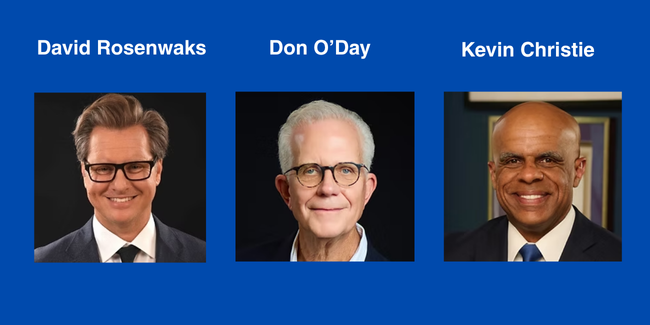
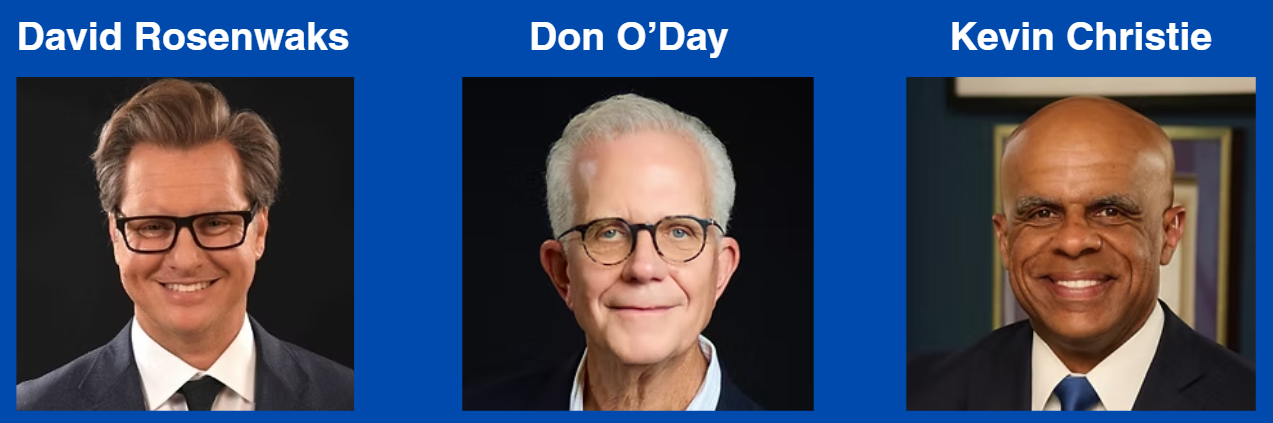
WESTPORT–The three candidates for Westport first selectman have distinct perspectives on how to manage the future of Saugatuck, a question that continues to be dominated by the Hamlet development proposed for the Saugatuck River waterfront.
The Planning and Zoning Commission (P&Z) rejected The Hamlet and the matter is now in court. The developer, Roan, has threatened to file a plan under the state’s 8-30g law, which would bypass many local zoning rules.
- Don O’Day said that, back in 2022, he was enthusiastic about a private developer coming into Westport, cleaning up Saugatuck and adding retail.
- David Rosenwaks said the information flow from Town Hall back then left Westport residents unaware of what was happening.
- Kevin Christie thought the first iteration of the project had an attractive aesthetic and was far less dense than the subsequent plans.
Here is a closer look at the candidates’ views and plans:
Don O’Day (Republican)
As a member of the RTM, O’Day took the view that private investment in Saugatuck is a good thing. He feels that “cleaning up” Saugatuck and making it “more attractive,” is a positive for the town and the neighborhood. Especially when compared to a development under 8-30g – the state affordable housing law that supersedes local zoning – with no control over the size, bulk and lack of amenities.
O’Day was a member of the RTM when citizens petitioned it to review the P&Z approval of the text amendment that allowed far greater density.
He voted to uphold the decision – and he was far from alone. The measure passed 32-1 with one abstention.
O’Day took that vote knowing the majority of the constituents that reached out to him felt the opposite way. And he stands by that decision. “I was elected to hear, assess and vote based on all the evidence that’s available to us after our research and participation in committee meetings.”
Going forward, he said, “I have a kind of a ‘justice is blind’ philosophy here.”
“You have robust public comment, robust public review of a proposal. . . . Everybody has to look at it, and that has to happen in public as many times as it takes. But to get to a place where a developer feels that they can actually come up with a plan that might meet all of these standards is something that should be done, and if that is done outside the public domain, I don’t see a problem with that.
“I don’t see a problem with town leaders, particularly planning and zoning, having those conversations.”
O’Day saw the Hamlet as “kind of binary.” Smaller developments can be controlled by P&Z and could include affordable housing, if the developer chose to do that. In contrast, the proposal for a 400- to 500-unit project with 100+ affordable units that Hamlet developer ROAN Ventures has announced as an alternate plan, would be less restricted by local regulations under the 8-30g law.
“What we would have is an unchecked development in Saugatuck, where the issues raised during the Hamlet conversation wouldn’t be addressed because Planning and Zoning would have no vote as to whether or not the development could go forward.”
David Rosenwaks (Independent)
David Rosenwaks was not an elected official when ROAN first appealed to the P&Z with its plan for the Hamlet at Saugatuck. But, he now feels that “90% of people didn’t want it.”
A Rosenwaks administration, he said, would take a “resident-driven” approach.
According to Rosenwaks, the majority of Westport residents say, “We want smart, sustainable growth and development” in Saugatuck. But, “before we try to find a middle ground, which is what everybody wants, we need to know exactly, as a town, we’re looking for . . . . And once we’re clear on that, then we can go back” and negotiate with developers, knowing what we want.
Figuring out what the town wants is “a collaboration amongst all the elected officials, all the town bodies. P&Z, Board of Finance, RTM. I want to get all these people involved early on. . . . Why can’t we have all those people, all those different groups, in a room early in the process?”
Rosenwaks muses: “We don’t have a movie theater in town, you know? Maybe we do ask for a movie theater before we go back” to Roan.
In addition to collaborating with town bodies early in the developer’s quest for a building permit, Rosenwaks is in favor of a much more proactive approach of communicating to residents what is happening in Town Hall.
Sharing information is key. Rosenwaks feels an investment in technology can enhance “information flow.” But, even without any investment, he will increase information flow with strategies such as simple brown-bag lunches and weekly five-minute videos that recap town department activity.
Kevin Christie (Democrat)
Kevin Christie doesn’t have any concrete memories from the summer of 2022, when ROAN was pitching the text amendment that paved the way for the proposal to move forward. He does recall that, later, during the application phase, the original renditions were a lot less dense than what ROAN showed during the application.
Like Rosenwaks, Christie’s approach is similarly concerned with information. He feels that just a fraction of the town was engaged with the text amendment phase of the Hamlet project.
If, early on, the town had brought “more people in . . . during the text amendment process, it could have evolved differently,” he said.
Christie sees a substantial opportunity in communication, in “amplifying the projects and initiatives that are in town.” He and his running mate, Amy Wistreich, plan to continue their “Coffee and Conversation” series of casual meetings with residents and businesses at the Westport Library.
Christie also feels the town needs to plan more comprehensively, perhaps with input from the Connecticut Municipal Development Authority and other planning agencies.
An important part of the next administration would be the completion of the 2027 Westport Plan of Conservation and Development. A POCD would provide an opportunity to engage all Westporters in a comprehensive way forward. Having Wistreich in the administration is a great asset, he said. As a member of the P&Z, she has learned first-hand about the land use issues facing Westport.
Holding an open dialog reinforces the idea that the town “government is here to support Westporters.” That goes beyond mere transparency, it’s “government engaged,” he said.
By “continuing to be responsive to emails and phone calls, continuing to build relationships in the community and with different groups” the town will have the opportunity to bring people together sooner in the process.” That, Christie said, will lead to “better solutions that work for more Westporters.”







I’m voting for Christie/Wistreich. It is the right combination of experience and track record to get things done right. Both have relevant private sector and public service experience. Their platform is driven by input from residents and local businesses. I look forward to the POCD process, and getting real citizen input to updating Westport’s vision.
In the case O’Day, he lays it out right here. He knows better than the best of us. Justice is blind? This position is neither a judge nor jury. He sounds a bit like another Republican autocrat we all know and disdain. He diminished the views and input of his constituents time and again. He openly admits some decisions are best made behind closed doors to avoid obstruction by the electorate. I’ll give him credit for admitting this.
Rosenwaks’ heart is in the right place, and I want him involved in town matters. In my view, he needs more experience in more aspects of local government. His private sector experience is questionable, and his public sector service is a brief two years. If I can believe his surrogates, he’s running against O’Day and trying to collect Republican votes. If only he’d tell all his fellow Democrats that.
OMG.
So let me get this straight:
Mr. O’DAY endorses even LESS transparency, even LESS resident inclusion, and doubles down on violating his oath to represent the will of his constituents in favor of autocratic decision-making?
Jay, my sentiments exactly.
OMG.
I guess he thinks that’s ok if he tells you this is his intention.
Get things done faster without obstructionist voters.
Never mind democracy.
Appoint more croney committees, full of their friends and supporters.
So they can tell us “we appointed a committee” just like DPIC, and LLSBC.
Neither of those committees has a bulls notion either about downtown businesses nor budgeting for a school.
Just a guaranteed rubber stamp.
I have a fundamental problem with sneaky private meetings. Such as happened with every single agenda they tried to get by.
Take a hint, if people don’t like it when you present it like a faite accompli, then go back to the drawing board.
And this administration has conducted almost all of its business in that fashion. And Moore has been complicit.
There’s not enough Xanax left on the planet to even begin to dull the painful effect of 4 additional years of an extended Tooker style administration.
Autocratic, vengeful, and divisive. And pissing away of our hard earned taxes on “expert” upon “expert”, all as clueless as the administration hiring them and paying them with our money. How horridly ironic.
Zero transparency and quite frankly at least when it comes to the downtown or the gardens as examples, Just plain arrogant and belligerent.
After attending both GFA and the chambers debate, as well as last nites casual chat at the library, it was clear that the “even handed” (according to his opponents) and logical approach of Don O’Day is the best for Saugatuck.
What one might take notice of is the character assaults and Derogatory tone in the comments of the folks opposing Don. It’s very telling.
Good luck to all! But it’s clear O’Day is the best of the three.