
Editor’s note: following is an opinion submitted by Westporter Karl Davis.

After nearly five months of debate in Planning and Zoning on adding 70-foot stadium lights at Wakeman Fields, we are left with a basic, unanswered question: Who are these lights for? We know who won’t be using them much: our schools.
Parks & Rec has requested lights as late as 10:30 PM, but Staples’ head soccer coach says he never wants his athletes on the field past 8 PM, and rightly questions why user groups haven’t been brought together to establish a reasonable schedule.[1] So, if the school teams don’t want these late hours, why is Parks fighting so hard to keep them?
The answer is Parks’ private funding approach, which has created conflicting interests. When asked by P&Z whether Parks might consider shorter hours for the lights, Director Erik Barbieri said donors needed to “maximize the investment,” and if P&Z limits the hours too much, he “wouldn’t even bother doing it” – a frank admission that the project’s goal is to satisfy private financers, not public need.[2] When infrastructure is funded by private donation, the public interest is sidelined. And, despite Mr. Barbieri’s more recent insistence that youth groups will raise the funds for these lights, the reality is that late-night field slots are not likely to be used by Westport schools or Rec teams, but instead as prime rental inventory for private, elite player development clinics and lessons run by current and former varsity coaches, for-profit regional tournaments, and adult beer leagues. Our kids certainly don’t need the ESPN broadcast-grade illumination levels that Parks has strenuously argued for using at Wakeman, but Private Equity-backed travel leagues selling parents access to game video do.
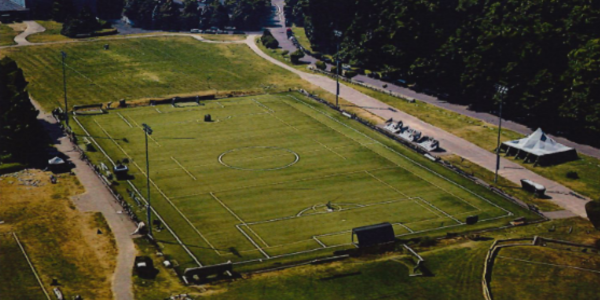
The tragedy of this situation is that our youth sports organizations seemingly really do have to fight for field time – but the empty fields we drive past on a regular basis (often lighted!) should tell you the culprit is poor resource management, not a lack of available fields. Once cherished assets like Loeffler Field are underutilized.[3] There’s no plan for how the New Long Lots fields will be used, or acceptance of the fact that losing them might have only temporarily made field scheduling more difficult.[4] And, even if the lights were approved and built today, Parks doesn’t have a plan for how to use them (in the only field usage schedule provided as part of their application, Parks simply left those hours blank [pp. 9–10]). Meanwhile, youth coaches regularly complain that overcommitted, multi-sport athletes leave them struggling to keep rosters full and practices from being canceled, resulting in empty fields.
Parks insists that Westport faces an acute field shortage, but when asked for supporting data, the administration has offered only conjecture. In late July, Director Barbieri called any skepticism about field shortages “uneducated,” promising he would be “working on making sure that this information gets out to the public.”[5] A few weeks later, pressed by P&Z commissioners for that very information, he admitted, “there’s nothing else to provide you to prove that we need more fields.”[6] Parks insists that data is “being worked on”[7] — but residents have been requesting it for years. Ultimately, the Town has offered absolutely nothing to suggest that lights are a better solution to our current challenges than smarter inventory management or technology-driven scheduling.
So, how does any of that constitute an emergency requiring permanent infrastructure entirely out of scale with a park that has always closed at sunset? Parks’ argument boils down to “trust us.” But, P&Z needs transparent, reliable data to make sustainable planning decisions — and here, it simply doesn’t have it.
Unproven demand is not the only gap in the record at P&Z. The application also lacks essential street-level renderings, relying on aerial imagery that fails to demonstrate how lights will actually impact the residential neighborhood. Appropriate renderings and schematics, a requirement for any P&Z application, were requested nearly 4 months ago, but never provided.[8] However, in voting to close the record, P&Z Chair Lebowitz and Vice Chair Cammeyer insisted they understood what this project will look like to passersby. They based their assertions on a site visit that skipped basic steps, like a balloon test to see if the lights would be visible above the tree line.[9] Their imaginations may be sufficiently rich, but does that justify P&Z’s skipping their most basic due diligence steps?
Yes, Westport deserves quality sports facilities. But Town assets should serve Westport residents and school teams under transparent, data-driven management – not be reserved for the financial benefit of connected officials and private interests, operating outside municipal oversight. Nor should they be pushed through without the same documentation and thorough analysis expected of any other major infrastructure project.
With the public hearing closed, P&Z now faces a defining choice: approve an unvetted blank check based only on Parks’ word, or insist that even Town sports infrastructure projects must follow data and serve the actual needs of Westport kids–whose coaches don’t want them on the fields past 8 p.m. anyway.
Karl Davis
Whippoorwill Lane, Westport
Sources:
- [1] Recording of August 17th, 2026 P&Z Meeting from 02:42:50 to 02:44:40
- [2] Recording of June 29th P&Z Meeting from 00:57:35 to 00:58:05
- [3] Recording of July 22nd Parks Meeting from 01:23:24 to 01:24:10
- [4] Recording of August 17th P&Z Meeting from 01:22:23 to 01:22:49
- [5] Recording of July 22nd Parks Meeting from 01:28:17 to 01:28:30
- [6] Recording of August 17th, 2026 P&Z Meeting from 01:21:48 to 01:21:55
- [7] Recording of July 22nd Parks Meeting from 01:24:29 to 01:25:42
- [8] Recording of May 13th, 2026 P&Z Meeting from 01:35:45 to 01:37:15
- [9] Recording of August 17th P&Z Meeting from 03:20:20 to 03:23:10









Recent Comments