
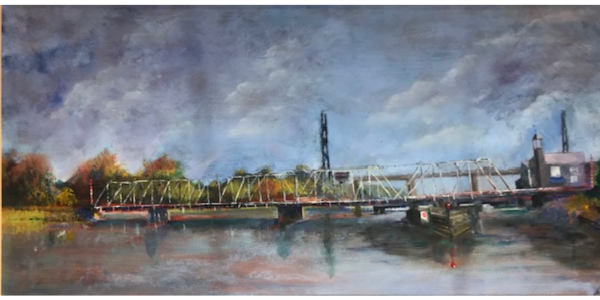
The following is an opinion from Werner Liepolt, a long time Saugatuck resident who has been immersed in matters relating to the William F. Cribari Bridge since the 1980’s.
The Connecticut Department of Transportation has scheduled a consulting meeting on how its plan for the William F. Cribari Bridge will affect the landmark properties of the National Historic Bridge Street District for this Thursday, Dec. 18 at 6 p.m. in Westport’s Town Hall.
Section 106
Section 106 of the National Historic Preservation Act of 1966 (NHPA) requires federal agencies to consider the effects on historic properties of projects they fund. If a federal or federally-assisted project affects historic properties, a Section 106 review must take place… CTDOT will conduct that review.
Section 106 is supposed to give the public the chance to weigh in on the replacement of the bridge BEFORE a final decision is made. This process is intended to be an important tool for citizens to lend their voice in protecting and maintaining historic properties in their communities.
Section 106 is not limited to physical alterations. The law requires the agencies to consider direct, indirect, and cumulative effects, including changes in traffic patterns, vehicle types, and long-term operational impacts.
Embodiment of Westport’s history
The Cribari Bridge is one of Westport’s most significant historic resources—a rare, functioning swing span that embodies the early automotive and maritime history of the Saugatuck River. It is on the National Register, and because federal funds are involved, the Federal Highway Administration and CTDOT are required to follow the Section 106 review process before any action that could affect the bridge or its historic setting is determined.
Allowing larger or heavier trucks on the Cribari Bridge is not a routine policy change. It is a significant effect under Section 106 for several reasons:
First, heavier vehicles introduce higher loads and stronger vibrations that can accelerate deterioration of riveted joints, truss members, bearings, and the swing mechanism. These are reasonably foreseeable physical effects the law requires agencies to evaluate.
Second, the introduction of tractor-trailers fundamentally alters the historic character, function, and setting of the bridge. This structure was designed for small-scale local traffic of the early automobile era—not for freight corridors. Altering this use affects the bridge’s historic feeling and association, which Section 106 specifically protects.
Third, larger trucks increase the risk of strikes, accidents, and operational stress on tight approaches. Even the risk of foreseeable damage is considered an effect under the federal regulations.
A designated Connecticut Scenic Highway
Route 136 through Saugatuck, including the Cribari Bridge, is designated as a Connecticut Scenic Highway, a status granted only to roadways with exceptional cultural, historic, and visual qualities. This designation recognizes that the roadway itself forms a cohesive historic landscape. Allowing larger trucks to cross the bridge would introduce incompatible freight traffic into an area specifically protected for its village character and historic river views—constituting a clear indirect and cumulative effect that Section 106 requires the Federal Highway Administration and CTDOT to evaluate. A scenic road designation is meant to preserve the character of the corridor and improvements must be “consistent with the scenic designation.” Opening a freight corridor is clearly inconsistent with the designation.
The nationally registered Bridge Street Historic District
The Cribari Bridge is also a defining feature of the nationally-registered Bridge Street Historic District, with 23 registered historic buildings in addition to the William F. Cribari Bridge, a rare surviving maritime, railroad building, and early-automotive era district which depends on its intact scale and historic traffic patterns. Introducing tractor-trailers would bring noise, vibration, and visual intrusion into the neighborhood, altering the historic experience of its narrow residential streets and river crossing. These impacts represent a substantial adverse effect on the district’s historic setting, feeling, and association.
Finally, increased truck access introduces cumulative impacts on the Saugatuck historic area—more noise, more vibration, greater congestion, increasingly worse particulate pollution—changing the character of this unique district over time.
Expanding truck access must be analyzed and discussed
For all these reasons, any proposal to expand truck access must be thoroughly analyzed, openly discussed, and—if adverse effects are found—addressed through avoidance, minimization, or mitigation consistent with federal law.
I respectfully ask that CTDOT and the Federal Highway Administration ensure that these issues are fully considered in the Section 106 process, that Westport citizens have a well-publicized opportunity to participate in the review, and that the community’s deep concerns about increasing traffic safety problems and preserving the Cribari Bridge’s historic integrity, its Connecticut Scenic Highway setting, and the Bridge Street Historic Neighborhood are meaningfully addressed.










It really must be saved! The bridge is for Westporters to commute to the city. It opens for larger tall masted ships if need be. It’s basically in perfect working condition.
It’s really something to think that a carriage bridge built in 1884 for $26,700 is, 141 years later, handling over 13,000 motor vehicles a day. But the Union Bridge Company of Buffalo, New York – the outfit that Westport hired to construct the span – is legendary. The Cribari Bridge contains pioneering technology, including solid die forged eye bars (easily seen when crossing the bridge), that were designed and patented by Union. It was the leader in the design of moveable bridges and was responsible for some of the largest and most technologically advanced bridges of the 19th century, including its 444 foot swing bridge across the Mississippi at Louisiana, Missouri, the world’s longest movable span; the massive 1883 Niagara Cantilever Bridge; the 1887 Hawkesbury River Bridge in Australia with seven spans and record shattering 176 foot deep footings; the 1887 Illinois Central Railroad Bridge over the Ohio at Cairo, the world’s longest bridge at the time; and the 1889 Poughkeepsie Highland Bridge – now the world’s longest footbridge. So while we regard it as something that is distinctively Westport – which it is – the Cribari Bridge is also a rare, surviving example of pioneering American engineering. That heritage needs to be preserved.
Well said and cogent, Werner. I hope the “stakeholders” see this issue (as you have described it) as an opportunity to leave a brilliant legacy for Westport.
Werner: A wonderful painting as well!!!
I agree totally with Werner Liepolt’s analysis of the replacement of the William Cribari Bridge. Having attended several town Hall CTDOT meetings regarding the disposition of the bridge, it was made clear to me that if the CTDOT is involved in replacing the bridge, that any vehicle on Ct roads must be able to use the bridge. That means Tractor Trailer Trucks (18 Wheelers). It doesn’t take a genius to figure out what that will mean to the already congested Saugatuck area and to the historic neighborhoods on the other side of the bridge. People have suggested that Tractor Trailers would opt not to use the bridge due to tight maneuverability, but I believe, if they can get over it, they will try, especially when I95 is backed up, They can get off at exit 18, and use Greens Farms Road to access the bridge as an alternative. Not to mention local deliveries. For all of these reasons, and for the safety of our children, these issues must be carefully analyzed before replacing the bridge. In my humble opinion, I recommend rebuilding and upgrading the existing historical bridge. John Sirmons
As a Bridge Street resident, I agree that the state should take into consideration all of the impact that “upgrading” the Cribari Bridge will have on Bridge Street, Greens Farms Road, Compo Road South, Imperial Avenue and all of the various side roads in our part of town.
Upgrading the bridge will inevitably bring more traffic, more noise, more pollution and less safety.
I encourage everyone who cares about the future of Saugatuck and Westport to attend the DOT meeting this Thursday at 6 p.m. at Town Hall. The state has to hear that we do not welcome an end to this historical, beautiful and relatively safe neighborhood.
Carey Weber
16 Bridge Street