
Editor’s note: The following letter was written to Planning and Zoning Commission members, and submitted to the Westport Journal for publication.
_______________________________________
Re: 13 Hyde Lane: Municipal Improvement Application #PZ-23-00716
As a professional engineer, I have 40 years of construction management experience, overseeing many high-profile and complex projects and programs, recently completing full reconstruction of the LaGuardia Airport. Twenty years ago, I was a part of the building committee that managed the reconstruction of Staples High School.
As a long time Westporter I care very much about what’s going on in our town. I’m not a gardener, but thanks to our bloggers I began following the issues surrounding the proposed reconstruction of Long Lots Elementary School and the proposal to eliminate Westport Community Gardens as a necessary component of this project.
I’ve watched the proposed plans being developed over the course of the last six months and I’m very disappointed to see what’s been presented to you in this application. These plans are not well thought-out and have many relatively obvious deficiencies.
I therefore ask P&Z to consider allowing the proposal for the new school elements to go forward while safeguarding and protecting the open space that is the preserve and the gardens.
The below points lay out the basis for my making the above statement.
Staging
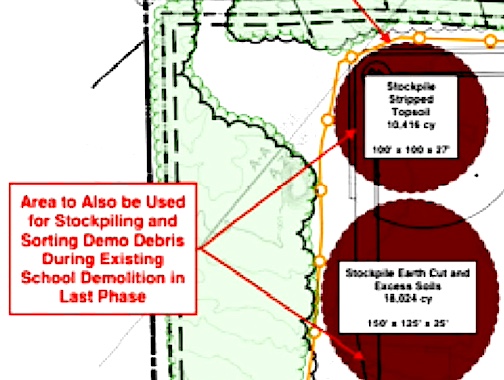
I’ll start with the most recent staging plan that was presented by the LLSBC at the Board of Finance meeting on Dec. 11. The full drawing is attached for reference. The LLSBC postulated that to execute their chosen plan safely and economically, they would need to utilize the entire site and therefore provided this detail (at left).
Environmental hazards: I can’t think of too many things that could be more wrong than dumping and sorting potentially contaminated demolition debris on a site that is occupied by school children and is directly adjacent to dwellings.
Complexities of site management and associated risks: The LLSBC also claimed that before excavated soil is removed from the site it needs to be stockpiled and tested. As someone who has done this often, I can assure you, it isn’t simple. Even when the stockpiles are covered with plastic to contain run-off onto adjacent properties, the same storms that bring rain come with high winds that sometimes rip the plastic off the piles and allow the soil to erode onto adjacent properties. Placing large stockpiles next to adjacent properties on the highest possible terrace of the site is not prudent and environmentally flawed. The soil could be tested in situ prior to excavation and if non-hazardous, immediately removed off-site without creation of large piles.
Drainage
I’d also like to discuss the proposed plans as they relate to the drainage issues during and post construction.
Deficiencies in the current proposal: By unnecessarily spreading their construction operations throughout the entire 6-acre, multi-tiered site, the LLSBC has unnecessarily constrained their ability to contain, collect and properly dispose of the run-off. I’m aware that a staging and drainage plan submission is not required for the 8-24 application, but I can’t unsee what the applicant has presented to other boards as their best idea.
Future concerns: It’s been reported by the neighbors during public hearings that the existing site has often failed to contain its run-off during all rain events. These complaints came specifically from the Muddy Brook neighbors.
I’m relatively certain that when the project is fully designed by qualified professionals, the final drainage plans would be based on proper calculation to meet applicable code requirements. As a civil engineer by training, not practice, I am familiar with the basic concept of such calculations. I know that the drainage codes are developed to cover most rain events of a particular intensity and frequency. The codes also assume certain absorption values of various surfaces from impervious to pervious to well-draining or most absorbent.
I also know that improper maintenance of such surfaces adversely impacts absorption values of such surfaces in the long run due to compaction during use. Therefore, a surface such a multi-purpose athletic field loses its absorption ability over time. Furthermore, compacted soil, such as baseball fields, does little to absorb runoff from day one. Grass areas that are used by the public compact over time.
The areas that do not change their absorption value are open spaces like preserves and agricultural land such as gardens. Native plants and gardens increase infiltration. They clean the water by reducing pollutants that end up in our waterways. With storm events often exceeding their theoretical intensity and frequency, replacing such natural sponges with much less absorbent surfaces such as multi-purpose athletic field is a very poor planning decision. I say this not because I believe that multi-purpose fields need to be excluded from the proposed reconstruction project, I say this because I’ve studied the plans long enough to be certain that the proposed elements, such as the school building, parking, fields and the open space can all fit on this property. In fact, some competent local designers have publicly shared such ideas.
As an additional recommendation, I’d like the project to consider using natural turf for the proposed athletic fields and the use of a thick layer of well-draining material under it. Also, the proposed parking and drive areas should be designed as pervious pavement, also with a thick layer of well-draining material under them.
Lastly, to have the new building install rainwater collection cisterns with pumps to be reused as gray water. If implemented, these measures would significantly reduce the need for collection and disposal of the run-off that may otherwise affect the neighborhood during heavy storm events.
As I mentioned above, the building size as shown would not prevent the site from being developed as I suggested. However, I still question the size of the proposed building structure. As we all know, it’s ideal for zoning purposes not to overbuild any site.
Building costs and size — A review of comps
In their presentation to the Board of Finance, the Long Lots School Building Committee shared a benchmarking table comparing the costs and sizes of the proposed Long Lots School to five school projects recently completed by their construction manager.
The table listed “square feet per student” ratios. Every elementary school in this table had a lower ratio than the proposed Long Lots School by 15 to 20 percent. Considering other deficiencies of the proposed design, it would be prudent to ask the applicant to re-evaluate their proposal in consideration of these excessive numbers to see why the building can’t be reduced in size while maintaining its proper function.
Although, this is not a P&Z issue, I’d like to offer this to the government bodies who may be reading this. Apparent deficiencies of this design proposal underscore the need for a competitive bid process. A properly issued Request for Proposal process would allow professional firms to compete on price as well as ideas. The proposers should be tasked to come up with a solution that would design the school with all the required elements while being respectful to the existing land conservation elements that have already been established for the greater benefit of all of us.
Yulee Aronson, PE
Westport








Just as a reminder to all reading this. The LLS building committee has only done a feasibility study to this point. The next stage being requested is funds for actual design. So to suggestion by the author that a design proposal has been provided or is flawed is premature.
Respectfully, the LLSBC and it’s numerous consultants disagree with the opinion provided here.
To quote BOF Chairman on Monday, Dec 11, 2023, during the LLS hearing: Once the design appropriation is approved, “the train has left the station,” on this project and there is “no stopping it.”
This was said, but is not accurate of the process. We are only seeking funding to go to design and then the committee must once again seek approval from town bodies for construction.
To readers who may not be aware, one of the Committee’s numerous consultants — the one who presents your plan at every meeting — asked a pertinent question in May 2023:, and I quote: “Does the Committee anticipate the group would find any project on the site problematic.”
The “group” she was asking about is the Westport Community Gardens/Long Lots Preserve group. She referred to Terrace 1, home to the gardens and preserve.
Did she get an answer, or a directive to “move along; nothing to see here?”
We have been clear from the beginning that the focus is on the school and that all other field allocations can be displaced as a result. In the feasibility study, we even evaluated a school of either end of the property.
Did she get an answer?
As you apparently the mouthpiece for the LLSBC, maybe you can address why members O’Day and Keenan have not responded to three-month-old FOIA requests.
Just a reminder to all those who did not attend the Board of Finance meeting on Dec. 11, 2023. The BOF chairman said that once BOF approved the DESIGN PHASE FUNDING, the “TRAIN HAS LEFT THE STATION,” direct quote, and there will be no stopping it.
The LLSBC has come forward with their proposal based on its feasibility study. The flaws of this proposal are the ones being discussed in this letter. The documents provided as a part of the feasibility study are the ones that are referenced in this letter. The flaws of these documents are detailed here. The plan of using Terrace 1 as a staging area for soil and demolition debris is just wrong. As mentioned in P&Z’s staff report, the existing soils maybe contaminated, hence they need to be tested and categorized for levels of contamination prior to excavation and immediately removed from site without stockpiling. In fact, the testing should be done in advance of completing the design to properly develop remediation plan. All contrary to the plan that your committee submitted. Further, the process of requesting funds for the design phase prior to issuing competitive RFP is what is premature here. I appreciate your engagement. Please consider doing the right thing. Thank you.
Just a reminder, we need to stop this project before it begins. RENOVATING is far less expensive than demolishing. Just ask Mary Ciara Webster, downtown merchant / owner of Westport’s most successful eatery and owner of a home which she shared was recently renovated for far less than the cost of rebuilding. WE THE TAXPAYERS have the right to VOTE on whether WE authorize building over renovation.
Caroline, you are absolutely correct. The savings from renovation vs new built would be 10-15%, conservatively speaking. Also, the reimbursement rate for the renovation project would be higher by another 10%. I also reference below the requirement for completive bid process.
https://portal.ct.gov/-/media/DAS/Office-of-Grants-Administration/Task-188—Required-Forms-Regarding-Plan-Review-and-Approval/FORM-SCG-2100–Commissioners-notice-of-requirements.pdf
The cost of construction is influenced by design. It’s been two months since the First Selectwoman put forward her proposed school design based on the recommendation of the Phase I design report. This report was expected to be immediately followed by the Request for Proposal competition for Construction Management and completion of Design, Phase II. Nothing happened. At the BOF meeting LLSBC projected a Request for Qualification process sometime in the future. RFQ is an opaque non-competitive process that would virtually guarantee the award to the current team. As taxpayers whose voices are being ignored by our local officials, we should consider seeking other options that are available to us.
This is not CMS (which most of the LLSBC members were involved in), so renovating is not as simply as being suggested by the commenters. The current school’s space allocation doesn’t work for the staff. To meet the Ed specs, there is more required then just a renovate. This was what was reviewed in the feasibility study. Also, if you can demonstrate that new construction is most cost effective then renovate, you can be eligible for a higher state reimbursement.
Furthermore, a suggestion that an RFP should go out before town bodies have even approved the recommendation and will find the design stage makes no sense.
I will continue to disagree with thesee opinions by commenters that are not based on facts and are only looking to protect a garden (when all field uses on the property are being displaced). We need to be considering what is the best options for the town over the next 50 years. And in my opinion, the schools come first. Everything else can be rebuilt in suitable locations, but not at the expense of impacting the school.
If only the Committee had a single purpose in mind, the school, such as you suggest, we wouldn’t be having these disputes. The scope creep into athletic fields is the rub. Schoo, and only school, first!
Our focus is the school and that is why all the field uses beside the school are being displaced. When construction of the school is complete, we are looking to return all existing field uses ( soccer fields, multipurpose field, and gardens) back to the town for use by the community. This is not scope creep, as garden supporters like to repeatedly say.
Sri, I appreciate your engagement. There is a simple way to resolve this – a competitive RFP process to see what kind of other [professional opinions we would get. Connecticut General Statutes Section 10-287 (b) (2) and 3 (A) requires a quality-based selection process which is a two-step process involving an RFQ and RFP for solicitation for architectural and construction management services. This is required prior to obtaining funding. It is also not clear why 2-months after the issuance of the feasibility study, the RFPs for phase 2 have not yet been issued. What is causing this delay? Please advise. Thank you.
Sri,
The LLSBC has come forward with their proposal based on its feasibility study. The flaws of this proposal are the ones being discussed in this letter. The documents provided as a part of the feasibility study are the ones that are referenced in this letter. The flaws of these documents are detailed here. The plan of using Terrace 1 as a staging area for soil and demolition debris is just wrong. As mentioned in P&Z’s staff report, the existing soils maybe contaminated, hence they need to be tested and categorized for levels of contamination prior to excavation and immediately removed from site without stockpiling. In fact, the testing should be done in advance of completing the design to properly develop remediation plan. All contrary to the plan that your committee submitted. Further, the process of requesting funds for the design phase prior to issuing competitive RFP is what is premature here. I appreciate your engagement. Please consider doing the right thing. Thank you.
I would like to remind our community that the LLSBC are all professionals in the construction industry with each having decades of experience. We are working with professional consultants that were hired for the feasibility study and those that consulting on prior reviews of LLS. These committee members have volunteered on multiple school projects for the town. Happy to have discussions about this topic, which we have been having for the past year. However, decisions should be based on what is best for the town as a whole and not just being reactive to the loudest individuals.
Best interests of the town? What gives you the right to define that? That is an arrogant overstepping of your role in the process.
The loudest voices? How do you think democracy works when citizens feel they are being railroaded by the “few in positions of power?” If we are not vocal and “loud,” we become indentured to the power elite. You know the type.
The common good is not something you can impose on your fellow citizens. It is the collective view of the citizens of this town. I might add that demographics may play a role in coming to terms with what is in the “best interests of the town.”
I refer you to the US Census Data for Westport. We have among the oldest median age of any town in Connecticut. More than half of our residents are over the age of 45 years; more than 25% over the age of 60. Less than 13% are under the age of 15.
Second, you are disrespecting the town’s residential property owners. Though few in number, the abutting neighbors have poured their life savings into their homes. You have no right to deface their homes for your personal views on what is best for the town. Are they too few, too loud to be counted?
You, dear sir, have no right to tell us, the citizens of Westport, what is the “best for the town,” the common good. Nor do your fellow committee members or any single elected official. We the citizens will decide that. If not today, then at the polls. You are not even an elected official; you have no claim to tell us what is best for us. Shame on you.
I too am a resident of Westport. Our charge is to act as town representatives for the long lots project. The committee has made a recommendation. The elected town officials will make the decision, not me or the committee.