
By Jarret Liotta
WESTPORT — Though I’ve enjoyed a low-key week wherein I didn’t make new enemies, I’ve decided to now alienate you good people by exploring & explaining my unpopular opinions about the Pledge of Allegiance …
In particular, I’m rather amazed that it continues to be recited in public places — in schools, for one, but also in some town meetings — and I think it’s time to put the practice on mothballs.
Official Choice
I heard complaints this week about an elected official who didn’t take or make the Pledge … I found the complaints utterly offensive & sophomoric.
For a fact, I know this official has devoted many hundreds of hours of service to this town for many years now, in and out of office … And that’s the thanks they’re getting — criticism for not reciting a poem in public?!
People are actually making the judgment that they’re doing something wrong — or not standing up to some alleged duties of citizenship or some esoteric ideal of America — because they don’t take part in this archaic and some could argue questionable Pledge ritual.
Good Lord!!
This is a person who lives and demonstrates considerable service to this town — far more than most people in Westport ever will.
Have we become that restrictive a society?! Is that what we’re about?!
Don’t You Dare Accuse Me of Being Anti-Veterans, etc.
I resent the argument that equates one’s Pledge behavior (or opinion) with their so-called respect of veterans, first responders, public institutions and the like.
One has nothing to do with another & it’s childish and insulting to say they do!
My respect — and in some cases even my love — for various veterans I know (and those I don’t know) is not linked to any ceremonial demonstrations at a town meeting, nor would it be linked to my Pledge choices in a classroom were I still a public school student.
I like to believe that the very core of our freedoms — the ones I believe any righteous vet or military participant worked for & pledged to defend — stand on the options to NOT salute a flag if that’s an American citizen’s choice, to not espouse nor enunciate the “G” word if it’s not in their particular vocabulary, to not parrot a pledge or stand at attention in order to conform at a public meeting, etc.
Bullying from Behind the Flag
Too often people cite veterans, first responders and — moreso these days — front-line workers as a sacrosanct litmus test to push policy and funding. In other words, you’re either blindly for them or demonically against them & all they stand for — no in between, period!
G-word forbid you have the audacity to even ask a question, you’re summarily lambasted as being against one of those groups & branded a hater.
Some public officials know this and use it — bullying from behind the flag, as it were — to get their ends met.
Even this week I heard a public official trying to indirectly shame members of the RTM into funding an initiative by implying that by NOT supporting it, they were turning their back on — abandoning, shaming, jeopardizing and perhaps downright hating — a body of front-line workers.
Our elected officials, in particular, should not be subject to people trying to influence them with undue guilt & shame by invoking the Spirit of America for their own ends.
I actually find THAT an offensive affront to those groups of people I sincerely do appreciate and support, regardless of their flaws and foibles — our cops, our emergency personnel, our town employees, etc.
The Weird History of the Pledge of Allegiance
It was a Boston Baptist minister named Francis Bellamy who concocted the Pledge in 1892 as part of a school-based patriotism program commemorating the 400th anniversary of Christopher Columbus’s arrival in America.
Bellamy was outspoken about the Pledge being one vehicle to help potentially indoctrinate a population of immigrants around that time — largely darker-skinned eastern and southern Europeans — Italians, etc. — including a large number of Jews and Catholics — which it was felt wouldn’t assimilate properly into the American ideal because … Well, they just weren’t white enough.
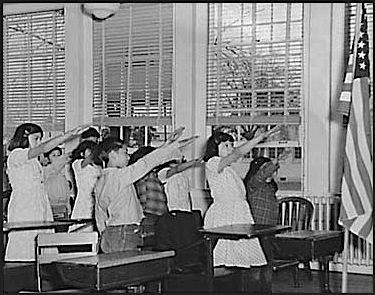
After an early version became mandatory in public schools by the 1920s — complete with the Bellamy salute — tradition took root. (Of course, after some 50 years of tradition the original Bellamy salute was discontinued around 1942 because people realized it looked almost exactly like a Nazi salute … I mean, ya can’t make this stuff up!)
Ironically it was the Catholics who lobbied President Eisenhower, on the heels of his born-again conversion to Presbyterianism, to get the words “under God” finally put into the Pledge in 1954. It was largely believed this was an important anti-Communist element to add into the Pledge, following the perceived terrors of the McCarthy Era, and it was thought this might serve as some kind of psychic roadblock to keep out the bad guys.
Bad Theater
The ritual itself, at least when seen in town meetings, is as much theater as anything at this point.
Ask yourself, do these same elected officials say the Pledge when they’re in Executive Session … or meeting when the cameras aren’t on? …
Of course not! (And if they did, that would be even weirder!)
Please Please Please Ask the Hard Questions
So why does anyone need to be put on the spot to demonstrate their beliefs?
Why practice a ritual — charming as it may be — that has the power to exclude people and — worse — ignite contempt from others who judge & resent the desire of others NOT to participate?
Why do people have to be put in a position where they have to run the risk of being ostracized because they don’t genuflect in conformity? Is it verifiable proof that the souls and thoughts of those in the room are in proper order as deemed appropriate by the crowd?
While I can appreciate the familial affection some people draw from the ritual — and I have few doubts that it’s suited to the ceremonial traditions of military-related institutions and the like — any value it serves in open-door public settings is eclipsed and outweighed by an archaic promotion of blind conformity that runs grossly counter to what we as Americans are SUPPOSED to be about.
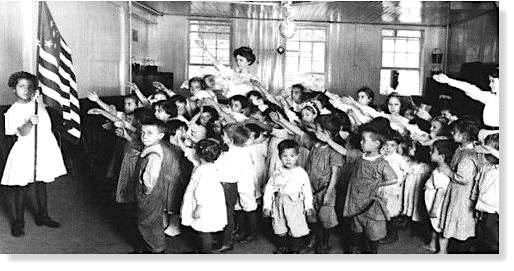







That was salute was used inmy grammar school until about 1953. A parochial school in CT
Great comment, Jarret. This rote ritual has become meaningless, because it’s done so often and so unenthusiastically. The “under God” clause is particularly problematic to me.
I could not disagree with you more. The Pledge of Allegiance is a worthy tradition for children and adults alike. It’s aspirational of American values: a republic, indivisible, with liberty and justice for all.
You seem to have a problem with that. Which of those values do you advocate for cancellation?
You say it’s a pledge for veterans? Well, yes. For the military? Sure. A pledge for first responders? Fine with me. But not meant for any of them any more than it is meant for all Americans as one.
Your cynical suggestion that the pledge is said in public meetings only to please television cameras is laughable, denied by hundreds of meetings I’ve attended when the pledge has been recited without any camera present.
I learned the Pledge as a kindergartner at Bedford El in 1962. I recited it at Coleytown El, Burr Farms, Long Lots Junior High, and at Staples. Later, as a news reporter, I said it in hundreds of public meetings in City Halls and Statehouses. It is a tie that binds.
Go ahead and grouse. It’s your right. But the Pledge links me to hundreds of millions of Americans past, present, and future. I’m proud to be associated with them.
Having attended (and survived) 12 years of catholic school, we had to recite the pledge and say prayers. Most of us did just that- recite with no consideration of the meaning, lest the nuns who schooled use rap us on the knuckles with a pointer.
Jarret, Great piece.
First, I don’t think you are being disrespectful to frontline workers or veterans by proposing such a thing as “Mothballing” the pledge.
It isn’t perfect.
I’ll only ask, isn’t it possible that pledging our allegiance, or at least considering doing it, is a good thing?
In the human psyche, there is a progression from thought…. to speech… to action.
Organizational and productivity gurus will tell you, the key to getting more accomplished isn’t just thinking about it but writing down your goals and thoughts. When you speak something, you make it more real than just when it lives in your thoughts. Daily affirmations are a popular method of changing a person’s outlook and self-image.
Therefore, isn’t saying something out loud valuable? Offering a commitment to something larger than ourselves?
Every single elected official and military member swears an oath to uphold the constitution, and protect and defend it, when they assume start their term.
But too many of our elected officials forget this oath and end up serving themselves as much as they serve their constituents.
Too often in today’s society, we think only of ourselves. We need more encouragement to think of ourselves as part of a greater whole, not less.
If you have a problem with “Under G-d”… let’s have the discussion about removing that.
No one will champion more than I the strict separation of church and state set by this country’s founding fathers and leaders and codified in principle, but not too often followed in practice.
I won’t disagree that the script could use an overhaul, but when a good idea is imperfect or grows stale, should we just throw it out?
Or should we think about why it may have been a good idea in the first place and maybe do something to help it evolve and get better.
Our words have meaning… to others and ourselves.
Our children are indoctrinated every day, into popular culture, social media and apathy. There is no avoiding it. So maybe countering that with a little indoctrination of something else can have value. Maybe a daily reminder in schools and in government that the greater community should matter to us, at least as much as ourselves isn’t really a bad idea.