

Words and photos by Linda Conner Lambeck
WESTPORT–The school board will select the consultant that conducts a review of the district’s special education program and extend the period firms have to submit requests to vie for the work.
It will not, however, exclude the administration from weighing in on the selection, something a dozen speakers urged them to do before the 7-0 votes were cast at a two-hour special meeting held Thursday at Staples High School.
Board Chair Lee Goldstein said the best way to make the process transparent is for the board to approve both the vendor and the document used to solicit them with the help of school administrators.

“We don’t have expertise, the administration does,” Goldstein said.
The selection, she added, should be based on helping the most kids and families and not simply making people feel good.
Parents unhappy with the district’s special education programs and services have urged the board through emails, public comments, special meetings and an online petition–that has received 762 signatures–to remove the administration from the process entirely, calling it a conflict of interest.
“There is no way the administration can be actively involved (in either framing the scope of the review or consultant selection),” insisted David Browne, a parent.
Other parents who spoke wanted assurance that the firm selected will be able to investigate individual parent concerns of services being delayed or denied rather than the more holistic approach that is planned.
If the board proceeds with a broad overview rather than a deep review, it is opening itself up to all sorts of litigation, Browne told them.
“This is not an investigation or a performance evaluation. It’s a program evaluation,” said Goldstein, adding she wants to keep it that way.
Board discussion
Questions and concerns about the district’s special education programs have been raised publicly at board meetings since January.
The district-initiated review described to the board in April would be conducted in the 2026-27 school year alongside a state-led compliance review.
Goldstein’s motion, which eventually passed, would direct the administration to develop a request for proposals in consultation with the board for a comprehensive system-level review of district special education programs and services, and gives the board a final say in both the wording of the RFP and the vendor eventually hired to do the work.
It would also direct the administration to provide the board with a recommendation before a board decision is made. The board could accept that recommendation, or not.
The selected firm is to report results directly to the board.
Already, the district has solicited from vendors requests for qualifications, RFQs–basically making sure vendors have the qualifications to execute the study. The deadline was Thursday. Elio Longo, the district’s chief financial officer, said ten firms filed submissions, nine in the format requested.
The board asked that the RFQ solicitation be reopened for two more weeks. As such, Longo said all documents submitted so far remain confidential until the new deadline, which has yet to be set.
A motion by Board Member Stephen Shackelford to have the board review the submitted RFQs once they are made public–and take a role in who is invited to bid on the work–also received unanimous board support.
The board rejected an idea from member Jill Dillon to create a task force to handle the nature of the review and consultant selection. Dillon also called for a survey to be conducted of parents.
“I think there is a lot of community awareness and unhappiness,” Dillon said. “I don’t want to spend all this money without asking the right questions.”
Board Vice Chair Dorie Hordon said there were opportunities other than a task force for the community to weigh in.
With roughly 770 students–just shy of 15 percent of the district’s 5,266 students this year–receiving special education services, Hordon questioned how parents would be selected for the task force.
Board Secretary Neil Phillips said a task force might only serve to delay the process.
As for developing the request for proposal or RFP, Phillips said much will depend on what the firms tell the board they can provide.
Board Member Abby Tolan said she liked the idea of a survey but not a task force. The board, she said, already knows what the public wants in the review. Tolan also called a look at individual cases inappropriate.
Board Member Andy Frankel said the board is capable of making a decision on a consultant without the help of a committee or task force. He wants the board to have direct contact with the consultant chosen and for it to have the opportunity to hear from parents.
Shackelford also wants a say in the vendor but does not want the board involved in the day-to-day process of the review.
To make the review robust and transparent, Goldstein said meetings to vet the process will be held in public with the opportunity for public comment.
Public comment
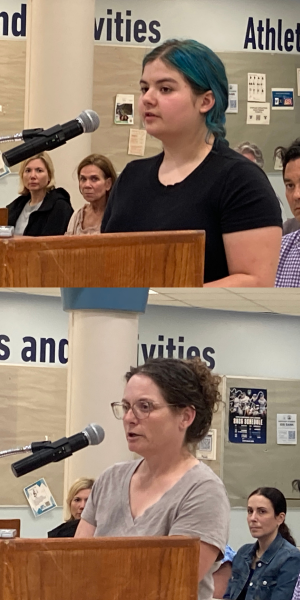
The first of the dozen speakers was Maeve Greely, who will enter the tenth grade in the fall.
She described a horror story of an elementary school experience starting with a kindergarten readiness summer camp at age 4 because of a speech delay. Her first day ended with her crying and being restrained until her mom picked her up.
In early elementary school, Greely said she was in a fight or flight state every day.
“I was restrained dozens of times,” she said.
After the pandemic, Greely said she found Bedford Middle School incredibly overwhelming, loud, busy and isolating. The school insisted her problem was anxiety that could be overcome with enough therapy and strategies, she said. Often she chose to sit alone in a special cupboard created for her, shielded all day behind a curtain with her special ed aide on the other side. The district offered her an out-of-district option, which Greely described as horrible. Her parents instead paid to place her at Easton Country Day School wheres he said she feels safe, supported and receiving honors. Recently she was identified as autistic. If the diagnosis had come sooner, she wonders if the district would have found a better way to support her.
“The way I was treated was wrong,” Greely said. “Please look deep in the review.”
Greely’s mom Jen told the board that fighting the district and paying for the right placement for their daughter cost so much they ran out of money and will be moving out of town. Jen said she has two older sons, who successfully went through Staples.
“This school district is phenomenal if you have the right type of student. I hope you get an understanding of what has gone wrong,” Jen said.
Sarah Greve, another parent, said her family moved to Westport because of its school system’s reputation but quickly lost faith in it. Mid-way through his first year at Stepping Stones preschool, Greve said she pulled her non-verbal autistic son out after being denied an alternative communication device. She was told her son would eventually become verbal.
“I found that heartbreaking,” Greve said.
She asked that the board take charge and make sure the review is truly independent.
Parent Leslie Derkash said she was denied an evaluation of her daughter’s learning disabilities until she threatened a formal complaint.
“Can you really trust the administration,” she asked the board.
“There is too much conflict for the administration to make the recommendation,” added parent Taryn Allen.
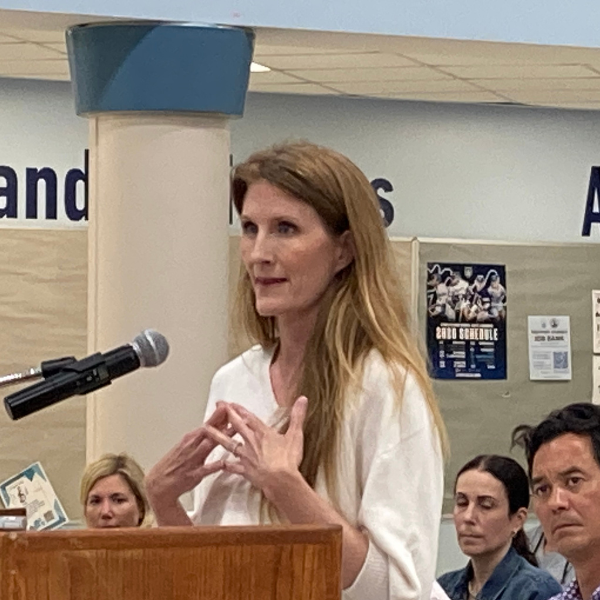
Tracey Vizzo, another parent, said her child’s learning disability was not properly identified or addressed.
“Children deserve to be taught in a way that helps them to move forward,” said Vizzo.
“We are Westport,” parent Vivian Hsu told the board. “We can do better. You can make this better.”
Hsu urged the board to not only select and oversee the review but the implementation of whatever recommendations come out of it.
“I want their advice.”
Shackelford said the board is capable of deciding which firm to pick but said it is the board’s job to take advice from each other, the public and the professionals they hire.
“I don’t believe we should recuse the administration,” he said. “I want their advice … I think it would be a mistake to completely tell the administration we don’t want a review at all.”
If the public likes one vendor more than the others, Shackelford added, they will tell us.
Once the new two-week period to submit qualifications for the job expires, Longo said, the documents, some a hundred pages long, will be uploaded and available for those who request them.
The board said another meeting would be called to discuss the RFQ’s and get public input.
In the RFP process, the vendors will tell the district what it can provide and at what cost.
Schools Superintendent Thomas Scarice said that like other program reviews, a recommendation from the administration will include a rationale for the endorsement.
Hordon said the onus on the board will be to do the same when it makes its selection.

Linda Conner Lambeck
Linda Conner Lambeck covers education for Westport Journal. She was a reporter for more than four decades at the Connecticut Post and other Hearst publications. She has covered education throughout Fairfield and New Haven counties. She is a proud member of the Education Writers Association.








Special education is neither a curriculum like math or science nor a single program. By definition, the services are specific to the students receiving them. IEP means individualized education plan. If you go on the website for any of the national consultants who routinely conduct district-wide reviews of public special education systems, they explain why they review student files. This is not done in an investigative manner. Rather, the review of categories of student files, perhaps due to a common learning difference or due to all being private settlement agreements, helps to determine the efficacy of the services being provided and measure the academic and other progress made of the affected students. There is no single special education program that serves all students and that can be reviewed. But let the consultants who conduct these reviews explain what the proper scope of a systems review may be, the process and timing for a comprehensive review. None of the Board members have experience with this type of review and I do not believe the administrators have conducted this type of review either. Let us not set the parameters of the review until neutral consultants with expertise have provided an overview of a comprehensive special education systems review.