
By Gretchen Webster
WESTPORT — The first public sign in two years of what may be in store for Saugatuck since a swath of the neighborhood was rezoned to make way for a multi-faceted redevelopment project known as the “Hamlet” was revealed last week.
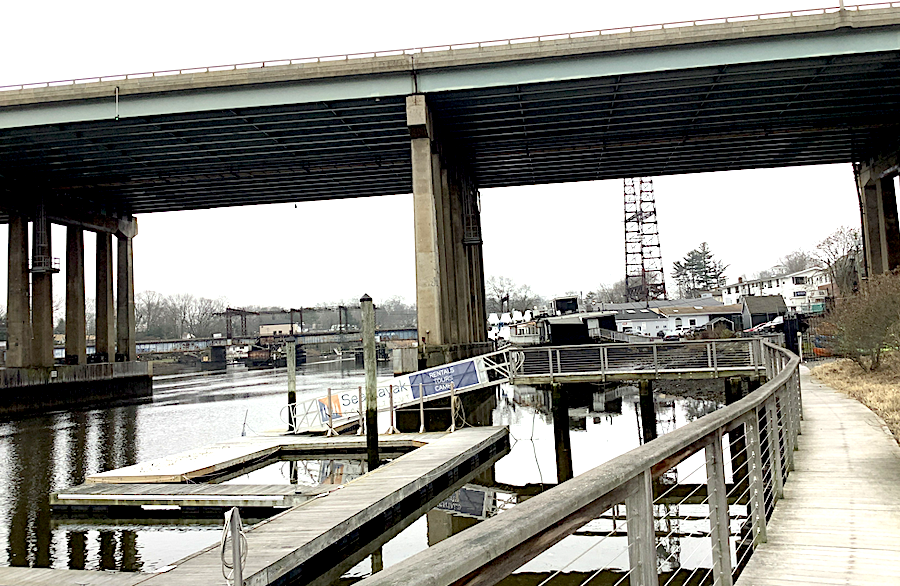
The Shellfish Commission met last Wednesday with the coastal engineer working with ROAN Ventures, the Hamlet developers, to discuss its report for the state Department of Energy and Environmental Protection on the marina segment of the project.
The commission, which was primarily concerned about disruption of shellfish beds and pollutants caused by dredging at the marina, heard there will be “multiple opportunities to comment” on the plans before construction begins, according to Devin Santa of Race Coastal Engineering.
In its report to DEEP, the shellfish panel will review several components of plans to replace the riverside marina with upgrades that include compliance with Americans with Disabilities Act guidelines, seawall repairs, a fishing pier and an extended public walkway. The new walkway will provide a link between an existing walkway at the former Gault property on Riverside Avenue that ends “without a connection to the parking lot underneath I-95 where the parcel dead ends,” according to Colin Kelly, director of the town’s Conservation Department.
The Shellfish Commission’s oversight is required because the Saugatuck River is a tidal water body, he said.
The existing marina’s piers and docks behind the Black Duck restaurant will be removed so the channel can be dredged, Kelly said. Then the seawall will be rebuilt and new docks will be installed “in the same general area” where they are now, he said.
The bulk of the Hamlet project is land-based — potentially with a mix of residential and commercial building — and was not discussed at the shellfish meeting since those plans are outside that commission’s purview.
A formal site plan for the project has not been filed with zoning officials, and one of the few comments regarding future plans came from Eric Bernheim, the developer’s lawyer, who said its construction would likely involve two to three years.
The development also depends on additional approvals for the land-side part of the project, Bernheim added. “We have to get all the approvals in order to justify the expense” for the marina and walkway parts of the project, he said.
Building the new marina and walkway will not start right away, Santa said, because several rounds of water testing will take place before dredging begins, plus it will take time to determine where to dispose of dredged materials, depending on what contaminants are found in the sediment.
He estimated that the water testing would start in January and may take several months because of the lab testing and record keeping involved.
The Shellfish Commission is concerned about disruption of sediment on the river bottom during dredging, said Chair Jamie Walsh. He said it is likely that pollutants from coal and petroleum as well as other toxins would be found because of past industrial operations in the area.
Damage to oyster beds also is a concern, he said, adding, “There are a lot of shellfish spawning there.”
“We don’t want dredging to be done when the oysters are spawning,” which usually occurs from May to October, commission member Clarinda Higgins commented.
Dredging will be done with mechanical equipment rather than by suctioning the sediment to help protect the shellfish, Santa said. The dredging is necessary, he added, because the marina’s water level is very shallow and boats currently sit in mud at low tide.
Utility connections laid through the proposed dredging area must also be addressed by the town’s Department of Public Works before dredging begins, he said.
“The project owners want to do the right thing,” Santa said.
The Shellfish Commission voted to delay its Hamlet marina report to DEEP until January so it can gather and review water-testing results from previous dredging work and other projects in the area.
Freelance writer Gretchen Webster, a Fairfield County journalist for many years, was editor of the Fairfield Minuteman and has taught journalism at New York and Southern Connecticut State universities.






Welcome to traffic hell…i mean Saugatuck. There will be avoidence maps posted for this location. Biggest mistake since the british tried invading new england. Town could have bought property and made open park land… what a disaster and disgrace. Im disappointed. Oh and the investors will lose everything- but wont care cause they need right offs. Criminal spot zoning… oh well times change
Will be following this story very very closely including the P&Z who promised us all sorts of “safety’s” were built into the reasoning.
Well we shall see.
Lots of investors here in the “know” who would do anything for $1. But we are watching !
It’s up to us to stop any skullduggery such as the member of the public who alerted the PZ to the “missing “ elevator at the inn at Longshore plan ( removed as a business decision. I guess dream lease of the century with town residents footing the bill for almost the entire 5 million wasn’t enough of an incentive to do the right thing)
But for that Good Samaritan it was all going ahead unnoticed that night.
And quel surprise at the very next meeting held very quickly, they “got away” with it all by “promising “ they will put it back in, along of course with the town attorneys persuasion.
Interesting the Feds sued inn at Longshore back in 2019 for ADA lack.
But I guess no lesson was learned.
It took “catching” them to force them to do the right thing.
Again anything for $1.
I’m holding off on my next law suit.
The next few months will be very interesting.