
By Mark Pazniokas / CTMirror.org
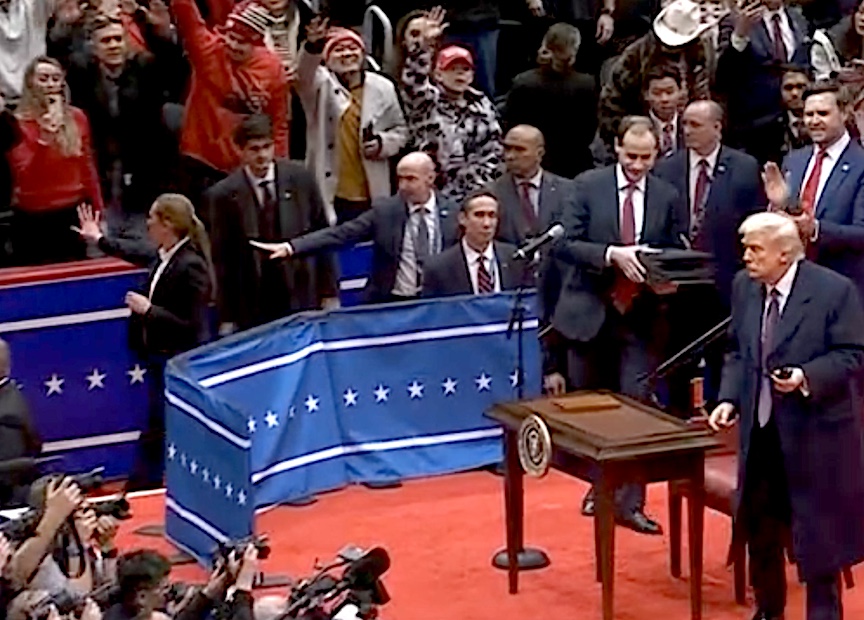
Cheered by supporters in a packed arena Monday night, President Donald J. Trump publicly signed executive orders freezing federal hiring and regulations, directing agencies to curb inflation, and withdrawing America from the Paris climate accords.
He teased of much, much more to come.
“Oh, you’re going to be happy reading newspapers tomorrow, and the next day, and the next day, and the next day,” Trump said.
Trump delivered on that promise an hour later in the Oval Office, signing pardons for nearly 1,600 people convicted of crimes related to the violent attempt on Jan. 6, 2021, to block the certification of his loss to Joe Biden in the 2020 election. He called them “J6 hostages.”
He also signed an order aimed at ending the longstanding constitutional provision providing “birthright citizenship” to any baby born in the U.S. regardless of the immigration status of their parents.
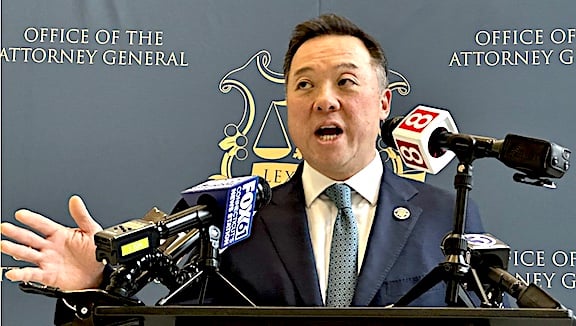
Connecticut’s attorney general, William Tong, promised Monday night he would file suit.
“This is a war on American families waged by a president with zero respect for our Constitution. We will sue imminently, and I have every confidence we will win,” said Tong, the son of immigrants.
“The 14th Amendment says what it means, and it means what it says — if you are born on American soil, you are an American. Period. Full stop. There is no legitimate legal debate on this question.”
U.S. Sen. Chris Murphy, D-Conn., one of the senators who sheltered under armed guard while police fought to regain control of the U.S. Capitol on Jan. 6, 2021, said on MSNBC that the pardons were an endorsement of political violence and “the most unconscionable act” of Trump’s busy first day.
“The bedrock that has kept us standing for 240 years is that we don’t endorse violence as a means to grab power,” Murphy said. “That’s what those protesters, that’s what those rioters, were doing. They were storming the Capitol, beating police officers over the head with flag poles, in order to seize power for their leader.”
U.S. Rep. Jim Himes, D-4, one of the last House members evacuating the House chamber that day, said on social media that the pardons were “a grotesque abuse of authority and a betrayal of our democracy.”
Earlier, Tong had said that Democratic state attorneys general waiting to challenge the president on first-day actions were left “shadow boxing.” Trump had identified his targets without immediately providing texts showing the precise methods of attack.
“It is hard to know at this moment what powers he’s going to invoke and in what manner,” Tong told reporters at a late-afternoon press conference in Hartford, while Trump’s fans awaited his arrival at the Capital One Arena in Washington, D.C.
The text of the birthright order had not been obtained Monday night.
Tong outlined his standard for challenging a president who promises to eliminate birthright citizenship, federalize state National Guards in the service of deportations, roll back clean air standards and curtail the rights and recognition of transgender persons.
“When I act, I will be guided by a very simple test: Does the action impact or harm people in Connecticut or Connecticut families?” Tong said. “No. 2, do we have good plans and defenses? No. 3, do we have standing? If all three of those prongs are satisfied, I am likely to act.”
“The 14th Amendment says what it means, and it means what it says — if you are born on American soil, you are an American. Period. Full stop. There is no legitimate legal debate on this question.”
Connecticut Attorney General William Tong
Tong, who was attorney general for the last two years of Trump’s first term, thought days ago he might have more information by 4 p.m. on Inauguration Day. It was not to be, though the White House issued a series of statements on the executive orders Monday night.
“Let me just say we’re responding in real time,” said Tong, one of 23 Democratic state attorneys general.
With inauguration events moved indoors due to cold temperatures and wind chill, the arena that normally is a venue for NHL, NBA and college games became the site of an indoor inaugural parade, a campaign-style rally and, finally, an executive order signing ceremony at a small desk on a broad stage.
On the desk were a stack of executive orders, each in a hard-cover folder, and a neat array of the black sharpies the president prefers in signing documents. An aide briefly described each one, then the president signed and held them aloft for the applauding crowd.
Awaiting him at the Oval Office, he told the cheering crowd, were papers pardoning persons convicted of crimes in the Jan. 6, 2021, attack.
Thirteen Connecticut residents — including Westport resident Benjamin Cohen, then 21 years old — were charged in connection with the riot.
“I will also sign an order directing every federal agency to preserve all records pertaining to political persecutions under the last administration of which there were many, and beginning the process of exposing any and all abuses of power, even though he’s pardoned many of these people,” Trump said.
He was referring to Biden’s preemptive pardons protecting members of the House committee that investigated the Jan. 6 attack.
“All they want to do is go after the J6 hostages,” Trump said of the Justice Department under his predecessor. “A 76-year-old grandmother was arrested the other day because she was looking, I think because she was looking, at the Capitol or something like that. Now we’re not going to put up with that crap anymore.”
Presidential pardons are beyond legal challenge. Tong’s focus was on orders that could be fought in court, notably the one attempting to limit birthright citizenship.
“Abolishing birthright citizenship will cause chaos across Connecticut and the United States, with babies born here lacking legal status anywhere, imperiling their future careers, education, health care, and more in the only country they will have known,” Tong said.
“My parents and grandparents ran for their lives, they fled war and hunger and ultimately made it to Connecticut with nothing.”



The 13th , 14th and 15th amendments were the ones addressing the freeing of the slaves and the possible repercussions to the newly freed slaves and the future possible actions by former Confederates. It had nothing to do with illegal aliens breaking into our country. It clearly states that a person born here and subject to the jurisdiction of the United States is a citizen. One could and should interpret that in the commonsensical manner that would determine a person to be under the jurisdiction of their own country, not one that they entered illegally.
Maybe this short essay from congress.gov will help you. POTUS doesn’t have the power to redefine the Constitution by executive order.
Fourteenth Amendment, Section 1:
All persons born or naturalized in the United States, and subject to the jurisdiction thereof, are citizens of the United States and of the State wherein they reside. No State shall make or enforce any law which shall abridge the privileges or immunities of citizens of the United States; nor shall any State deprive any person of life, liberty, or property, without due process of law; nor deny to any person within its jurisdiction the equal protection of the laws.
Based on the first sentence of Section 1, the Court has held that a child born in the United States of Chinese parents who were ineligible to be naturalized themselves is nevertheless a citizen of the United States entitled to all the rights and privileges of citizenship (U.S. vs Wong Kim Ark, 1898).
The requirement that a person be subject to the jurisdiction thereof, however, excludes its application to children born of diplomatic representatives of a foreign state, children born of alien enemies in hostile occupation, or children of members of Indian tribes subject to tribal laws (from the same ruling). In addition, the citizenship of children born on vessels in United States territorial waters or on the high seas has generally been held by the lower courts to be determined by the citizenship of the parents. (U.S. vs Gordon, 1861). Citizens of the United States within the meaning of this Amendment must be natural and not artificial persons; a corporate body is not a citizen of the United States.(a few rulings).
Prior to 1898 that was not the interpretation of the amendment. What Chinese immigrants in 1898 or illegal immigrants from anywhere in 2025 have to do with logical interpretation of the amendment is irrelevant to he issues of today. The 13th, 14th and 15th amendments were the post Civil War amendments as we all know, and were not added to our constitution to allow illegal aliens to create anchor babies for themselves.
The Constitution and Supreme Court decisions are certainly relevant. Just because you don’t like something doesn’t mean the Constitution and SCOTUS decisions aren’t clear.
Though I hope that this means you don’t believe in using 1873’s Comstock Act to attack on reproductive rights. (All the more ironic, given your concern about “anchor babies.”)
Furthermore, on the subject of the Wong Kim Ark case, his parents were here legally and therefore he and his parents were subject to the jurisdiction of the U.S.
Sharon – you missed the point of the ruling. His parents were denied citizenship, but he was ruled to have birthright citizenship despite his parents not being citizens. I assume that, back in the day, you were a big fan of the Chinese Exclusion Act.
But, no matter, it took about one day for a federal judge to deem the executive action, “blatantly unconstitutional” and issue a restraining order.
Todd – Trump is wasting time with moves like this, that courts will toss.
Looks like Trump is making all the moves. Joe six pack loves you!