
By John Schwing
WESTPORT — Two major projects in the Saugatuck section of town, both the subject of heated debates — one consuming decades, the other “merely” months — took tentative steps forward Thursday.
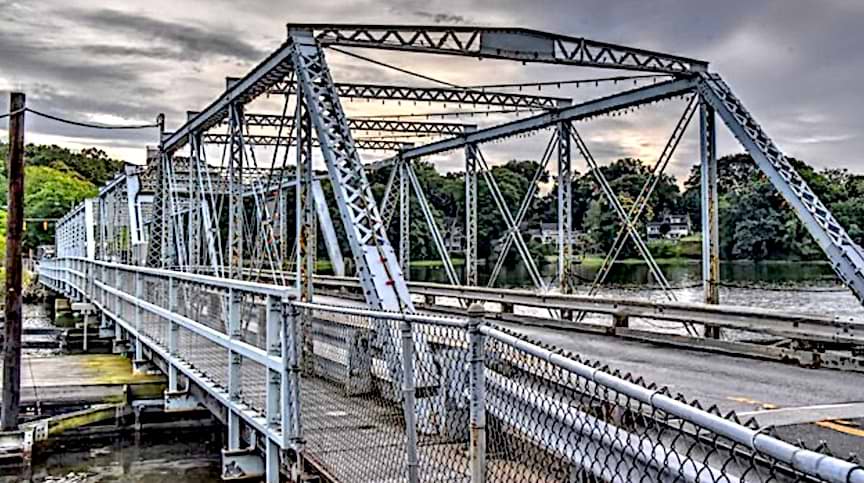
The future of the 140-year-old William F. Cribari Memorial Bridge and the yet-to-be-built Hamlet at Saugatuck mixed-use development were among the significant initiatives reviewed by the Western Connecticut Council of Governments at its midday Thursday gathering.
Aspects of each infrastructure project won support from WestCOG.
Funding for Cribari bridge redesign back on the road

Efforts to either replace or rehabilitate the Cribari bridge — the 1884 iron swing bridge carrying Route 136 over the Saugatuck River — have proved controversial dating to the late-1950s.
In the 1960s, the state proposed replacing the bridge with a fixed span — 60 feet high at its apex — with relocated approaches much longer and broader than currently in place. The plan was dropped a few years later in the face of local opposition.
In the 1980s, another tug-of-war erupted between the town and state over replacing the deteriorating bridge and, after much political drama, an agreement was forged to preserve and repair the span. It was temporarily removed from service while a stand-in fixed bridge carried traffic across the river, according to a detailed bridge history at the website, preservewestport.
Further complicating what could, or could not, be done to the Cribari bridge was its addition to the National Register of Historic Places. In 2016, another guardrail on the span’s future was designation of that segment of Route 136 as a State Scenic Highway.
And, most recently, furor flared again in 2015 after the state Department of Transportation classified the bridge as “severely deficient” and in need of extensive repairs or perhaps complete replacement.
Several years of pushback from local residents and officials ensued until 2017. That’s when then-First Selectman Jim Marpe asked WestCOG to delete a request for rehab/replacement funds from the DOT until that agency “completed a more thorough assessment with consideration of community input and consideration of the Cribari bridge’s impact on the history of the Saugatuck neighborhood, traffic concerns and design alternatives,” as described in a statement from First Selectwoman Jennifer Tooker.
That led to creation of a project advisory committee, which gathered local feedback on various options to repair or replace the bridge. In the meantime, the DOT conducted an environmental assessment and coordinated “with other state and federal agencies, as well as various stakeholders, to consider specific concerns, such as the various alternatives and impacts on historic properties,” according to Tooker’s statement.
The issue before WestCOG on Thursday was whether to endorse a recent DOT request to restore $4.1 million for the right-of-way and final design phase for the Cribari bridge’s rehabilitation or replacement in its statewide transportation improvement plan, or “TIP.”
For an issue that consumed nearly seven decades of contentious debate, Thursday’s discussion of the design funding request was both positive and brief.
Tooker, attending the WestCOG meeting in person, noted the DOT cannot release its environmental survey without WestCOG’s “administrative action” restoring design funds to the TIP.
The first selectwoman took pains to emphasize the funding will pay only for design options, and not for actual work to repair or replace the bridge.
Noting there were “lots and lots of Westporters” watching the WestCOG meeting via Zoom, Tooker emphasized that when the design work is complete, there would be more meetings to gather local feedback before any plans for the bridge’s future are settled.
“No decision is being made,” Tooker said. “We just need to continue the process in looking at whether we rehabilitate or replace the bridge — and we need to do it before it becomes a problem.”
Supporting the funding request, while emphasizing it was not a commitment to any specific plan of action, was Wilton First Selectwoman Toni Boucher, who previously represented Westport in the General Assembly as a state senator.
The agency wants to “assure members of the community that this is no way predicting either refurbish or rebuild” of the bridge, Boucher said. “It’s just to continue the process of potential designs that will be reviewed again by the community.”
WestCOG board members then voted unanimously to support the DOT request for design funding. There was no timeline available for when that work might be completed.
“Hamlet” brownfield cleanup application backed
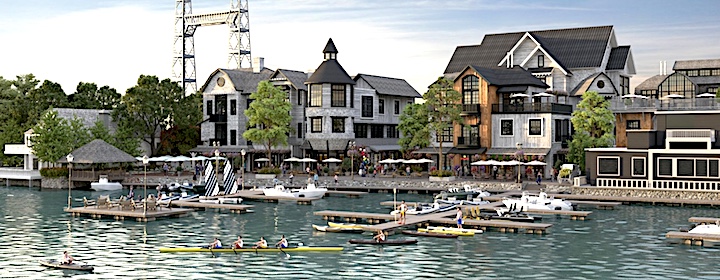
WestCOG on Thursday also endorsed an application by the developer of the Hamlet at Saugatuck for $12 million to clean up three contaminated “brownfield” sites within the boundaries of the proposed mixed-use development near the Saugatuck Railroad Station.
The sweeping project to redevelop swaths of Saugatuck, proposed by ROAN Ventures, won rezoning approval from the Planning and Zoning Commission in December 2022 after several months of contentious public hearings. The plan envisions retail space, a hotel and residential buildings between the Saugatuck River, Charles Street, Franklin Street and Railroad Place, with a 25 percent affordable housing component.
However, specific Hamlet site plans have yet to be filed, and remediation of contaminated properties is a needed step for the project to advance, according to documents filed with WestCOG.
The planning agency was asked to endorse the developer’s application for a $12 million grant — $4 million to clean up each of three polluted Saugatuck sites — to the state Department of Economic and Community Development.
WestCOG officials called the request a “pass-through” application, since it involves no agency money, with the endorsement allowing Hamlet’s developer to be considered for assistance from the DECD’s Brownfield Municipal Grant Program, which awards aid on a competitive basis.
The three polluted sites to be remediated are:
- 96 Franklin St., which according to documents, “historically served as a railroad coal yard. Byproducts related to coal and industrial activity are suspected in the upper 4-6 feet of soil.”
- Railroad Place vicinity, consisting of 91 Franklin St. and 16, 40 and 606 Riverside Ave. Contamination likely resulted from “current and historical use [that] includes a dry cleaner, automotive repair and service center …” in the upper 4 to 6 feet of soil, according to documents.
- 601 and 609 Riverside Ave., now primarily used for a marina and boating services, were formerly the site of Saugatuck Manufacturing Co., where contamination is likely from “use and storage of gasoline, oil and waste oil, in addition to byproducts related to coal …,” according to WestCOG. Pollutants are probably in the upper 4 to 6 feet of the site’s soil, documents indicate.
The state’s help with remediating the properties is “integral to a locally supported redevelopment initiative, named the Hamlet at Saugatuck, [which] will restore this area to a destination where people live, restaurants thrive and events take place,” according to WestCOG’s description.

The document also states, “The Hamlet at Saugatuck will transform this largely vacant area into a transit-oriented development (TOD) with a mixed-use neighborhood featuring a hotel, residences (with 25 percent affordable units), retail marina, dining, wellness, event spaces and a market featuring local produce.”
WestCOG unanimously endorsed the developer’s application for a brownfields grant, but several Westport speakers took issue with what they felt was an inaccurate negative characterization of the Saugatuck area as it now exists.
Matthew Mandell, a District 1 member of the Representative Town Meeting and executive director of the Westport-Weston Chamber of Commerce, told Thursday’s meeting the WestCOG report “unfairly shows Saugatuck to be a polluted and desolate area with no economic benefit, and this is absolutely not the case.”
Without questioning whether there is contamination at the listed Saugatuck locations, Mandell said he wanted the record to show the area is “a vibrant community, with a restaurant scene that is probably unparalleled in the rest of the state.” He also mentioned the annual “Slice of Saugatuck” festival, sponsored by the chamber, which draws crowds to sample the neighborhood’s cuisine and retail shops.
Joining Mandell in defending Saugatuck’s reputation were two other RTM members, Andrew Colabella, District 4, and Wendy Batteau, District 8. Batteau also agreed the area needs brownfield remediation because of “significant pollution” from various sources over the years.
Tooker, commenting on the brownfield grant application, “whole-heartedly” agreed with RTM members’ upbeat description of Saugatuck.
She called it “a thriving area of Westport,” while also supporting the Hamlet developer’s application for state aid to clean up contaminated sites.
John Schwing, the Westport Journal consulting editor, has held senior editorial and writing posts at southwestern Connecticut media outlets for four decades. Learn more about us here.







It seems beyond inappropriate for a contractor buying private land to build the monstrosities proposed ( hamlet) and objected to vehemently by the vast majority of both saugatuck residents and Westport residents as a whole, should look for the tax payer to fund any remediation whatsoever.
I attended all those zoom calls along with many very concerned and vehement objectors to the hamlet. Without any shadow of a doubt the main support for the hamlet came from the contractor, the investors, especially local ones, and a few of their friends, or folk who stand to profit from this ginormous and massively inappropriate project which is going to utterly ruin saugatucks charm.
The current owners are all very well aware of any “pollution” etc, and as such the land should be now, and likely was, years ago priced appropriately.
So now the tax payers should pay for the remediation.
That is preposterous.
Unfortunately this project the hamlet which will destroy any charm saugatuck has and it has lots, is also being heavily invested in by a few locals, who no doubt are, along with the contractors pushing to get some freebie state aid. Thing is it’s not free. We all pay for it collectively.
They should be promptly turned down, and negotiate with the owners of the properties, an appropriately discounted price, just like they, the now sellers likely paid when they first bought these.
It is beyond cheeky to think the tax payer should fund this.
I’m shocked anybody ( not standing to gain financially, in some way or other) would see this as anything but a greedy and opportunistic attempt to rip off the hard working Connecticut tax payer.
You are buying it, factor in the cost. Pay for it yourself.
The state should not contribute one cent to this “for profit” disaster, they the developers, along with their investors are planning.
And again I must reiterate for the record, it got minor resident support.
The “affordable housing” element of this project is, I understand not going to be on premises, rather I believe the developers are busy looking for off site alternatives, allowed happen far far too frequently.
Make no mistake the 25% affordable housing aspect to this is a grave inconvenience for the developer, inspite of it being one of the only ways their project was even entertained.
Another project that proves the lack of transparency in this town.
Hawk eyes are needed as this goes through the various processes.
Thanks for this informative article. Curious about the term “brownfield,” I discovered information about federal and state grants to clean up toxic sites.
For-profit entities are not eligible for brownfield clean up grants. See
https://www.epa.gov/brownfields/entities-eligible-receive-brownfield-grants
Only municipalities and municipal entities are eligible for state brownfield cleanup grants. See
https://portal.ct.gov/DECD/Content/Community-Development/03_Funding_Opportunities/Brownfields-Remediation/Brownfield-Municipal-Grant-Program
I understand the Hamlet project is currently soliciting private equity investors and does not enjoy non-profit status, so can you explain in future articles how Westport residents and taxpayers, how our municipality legitimately qualifies as a candidate for $12,000,000 in federal or state grants for ROAN ventures, and The Hamlet at Saugatuck?
Werner that is such a great question !
A 12 million dollar question in fact.
Great fact checking too.
No doubt the ROAN developers will be looking for all sorts of freebies as this monstrosity is planned and goes through the processes.
I wonder if I buy a gas station or a dry cleaner in town will I also be able to apply for the state and tax payers to remediate.
Cheek was polite.
Those who know me, know I was part of the Sensible Saugatuck Zoning Committee and strongly opposed (and still do) the ridiculous up-zoning of this portion of Saugatuck from a 0.25 FAR to a 2.0 FAR.
In my career, I have never witnessed this magnitude of FAR increase, in the five States I have performed architectural services work in.
This is by far, the worst decision handed down by the Westport Planning and Zoning in my 30+ years living in Town and perhaps the worst in Westport’s history?
Members of the P&Z who championed this complete monetary power grab, including the First Selectwoman, who until this day, has remained silent on this issue, should be reminded of their decision at the ballot box.
However, please allow me to diffuse this issue before it escalates into another Westport false narrative;
The Federal and State Brownfield Programs are extremely important and a necessity to placing contaminated and often abandoned sites back on the local tax roles. Studies have been done, this has been documented, this is a fact. For every tax dollar invested there is a multi dollar (can’t remember the exact number) return on that investment.
My Loom City Lofts project, LoomCityLofts.com was a recipient of many sources of public funding in an effort to clean-up an abandoned site and structure, listed on the National Register of Historic Places and convert the 82,000 SF mill structure into (68) units of affordable housing. Without Brownfield funding from the State, Loom City Lofts would never have been completed.
Mary, yes, if you acquired an old gas station or dry cleaner site, your site would be subject to the Transfer Act and you would be entitled to apply for Brownfield funding for remediation.
Werner, you were looking at the Federal site. Their regulations are used less often by developers and more by municipalities.
The State of CT has its own, very strong and successful Brownfield Remediation programs which are available to for-profit entities.
Connecticut is an old industrial State and years ago, our legislators witnessed the stagnation of communities due to the economic infeasibility of the remediation process.
Basically there are many sites around CT, who’s values are less than zero dollars, often because a developer would have to invest millions of dollars to remediate the site in order for the site to have any value.
These sites remained vacant and abandoned for decades until the early 2000’s when the CT State Brownfield Program was first initiated.
The State Brownfield Program is a good thing, most residents are unaware of it but it has helped clean-up sites with scrupulous owners, who fled the State in order to avoid their responsibility for cleaning up the sites they polluted.
In my opinion CT has a successful Brownfield Program that has helped projects similar to mine, come back to life and spur economic growth within communities that have stagnated and become blighted.
Despite my distain for the Hamlet Project, the developers are taking the right steps towards building their awful project.
Let’s move on, shall we?
~ Joseph Vallone, A.I.A.
The project and its investors are town ppl !
They are taking the Mickey !
It should never have seen the light of day !!! You are welcome.
This project invested in by sooooooo many towns folk, is disgraceful !
Thank Sal liccione for being the only smart rtm to stand up to it.
When you, we( ( knowing we would) are licking our wounds as some corporation no different than roan come in touting their brilliant strategy to destroy saugatuck, remember these words.
We told you so.
Now that the Select Woman has turned fate of the Cribari Bridge over to the CT Department of Transportation, it might be good for her office and the elected representatives of RTM District 1 and 9 to inform affected residents what the Department of Transportation will be doing in their Right of Way survey.
The state has right of way of 25’ from the center line of each roadway. So if (as in the past) for example, the state proposes adding a bike lane and walkway to the south side of the bridge and roadway they will likely identify about 13’ of each front yard of the 13 residences on that side of Bridge Street which they will claim and build the sidewalk and bike lane on without compensating in any way the owners of those properties.
If the Department of Transportation determines it needs more property whether residential on the east side of the Saugatuck or commercial on the west (again, as they have done in past plans), they will exercise eminent domain and seize the property they need for their project.
That our officials and representatives should fail to inform and educate our citizens on the consequences of their actions is reprehensible.
Well said, Werner. Since we can’t count on the First Selectwoman, let’s hope that our direct representatives in D1 and D9 will step up. Soon.
Werner, unfortunately reprehensible is the best word to describe everything tooker has done on the past 2 years. Isn’t it amazing how the text amendment for hamlet came and went without as much as a peep from the selectman’s office. Tho asked on multiple occasions.
Hmmmmmm one wonders why !
The animosity and vitriol at these horrendous vanity projects, being voiced by so many in direct opposition to this anti business/resident selectwoman and her anti business/resident second selectwoman just needs to be very much remembered in 2 years. We need hopefully only weather 2 more years of this storm, and then pray somebody comes forth and rights the direction of the ship before Westport is utterly destroyed, and by a non Westporter no less.
It’s all about the Benjamins it seems. Especially their own.
Next select person needs to run on transparency.
And this town should pass a law that anyone past or present involved in any way in town politics should have to disclose their interests as it pertains to investments in projects they might have a stake in and profit from, taking place in this town.
The crookedness going on right now, is a very large elephant in the town.
SMH