
By Kerri Williams
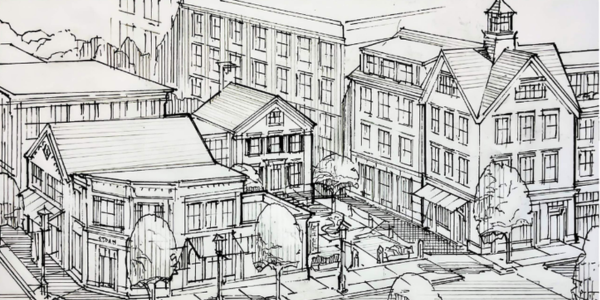
WESTPORT – The Planning & Zoning Commission got another early look Monday at a Spinnaker Real Estate Partners proposal for a 165-unit residential development on Riverside Avenue, with members continuing to question the number of affordable units proposed.
During a third pre-application, or non-binding discussion, commissioners for the most part praised the look and feel of the proposed development, which is planned for a portion of the space where the proposed Hamlet development would have been. In a recent design change, the building height has been lowered by three feet to about 70 feet.
But several members pointed out that the percentage of planned affordable units in the most recent plan is still lower than the amount required by the town. In making its calculations, Spinnaker tied the affordable unit percentage to the market rate number of units, while the town uses the total number of units to make its calculations.
When using the total number of units to calculate, the percentage of affordable units being proposed is 16 percent, instead of the 20 percent that is required by the town, Commissioner Breanne Injeski said.
“I don’t know if this adds up for me,” Injeski said. We are faced with the 8-30g reality.”
In response, Matthew Edvardsen, the owner of Spinnaker, said that no other town in the state requires 20 percent affordable housing in such residential projects.
“We have a challenge here to make that work,” said Adam Blank, land-use attorney for Spinnaker. “Something’s got to give. We can do it at 220 units.”
Spinnaker representatives also said that the affordable units may look different if the company does not receive a state Brownfield Grant for environmental remediation. Edvardson said the company is not sure it will meet the requirements for that grant, which could save them a significant amount of money. If not, the below-market units will be mostly one-bedroom ones to make up for the cost differential, he said.
Several commissioners said that making their decision without all the information would be difficult.
“For me as a commissioner, it’s difficult to make a decision until all the numbers are in,” said commissioner Craig Schiavone. “We are in limbo.”
P&Z Chairman Paul Lebowitz said that he believes the parcel can handle the density of this project because of its location near I-95 and the train station. But he added that the town needs to benefit from the project. “Why would someone who doesn’t live there come down?” he asked.

Kerri Williams
Kerri Williams is an award-winning writer and journalist. She has worked as a reporter at the Norwalk Hour, as Living editor at the Darien News-Review, and managing editor for the Norwalk Citizen-News. For Westport Journal, she is a reporter as well as a gardening columnist, writing ‘Cultivating with Kerri.’ Williams moved from Connecticut to upstate New York in 2021.












I’m not sure what the function for the town is. The density and scope rendered here is insane for our little hometown station. With traffic at a standstill you can’t really justify the safety concerns having that many apartments. Woh, 200 units could 400 cars just for residents, extra, not including retai employees let alone new customers. This scale would be the death of Saugatuck, how could it be justified? Seriously, if this is waved through Westport has a bigger problem than traffic. Does the town really need the tax money? How could that be? one of the wealthiest bedroom communities in the world. So if it’s not for tax revenue it would have to be to provide affordable housing, right. Look, I would be into it is it was for poor people but it’s not, how does a developer get spot zoning so they can make millions at every one else’s expense? This must be stopped!
Still not getting why “poor people” have a God given right to live in the fanciest towns on someone else’s dime. When I was a poor kid, I lived in Harlem and the South Bronx. That is what incentivizes you to work harder and improve your own circumstances.
For no other reason than compassion. I grew up in Westport not because worked hard, my parents did. I got all the benefits just from being lucky. As I moved out into world living in various slums, I realized how lucky I was and how beautiful people who weren’t as lucky I was are. So my argument about poor people is not about economics, it’s about humanity, and Westport kids should grow up alongside poor kids as a reality check. And poor kids should grow up along side rich, not so they can feel poor by contrast but so they visualize success which I found personally is hard to do in ghetto situations. So I would bend the rules for poor kids yes, but not for rich developers. Does that make sense, or is my libertarianism breaking developing a hole, am I starting to to bleed?