
By Gretchen Webster
WESTPORT — Businesses, both larger and higher, will be welcomed downtown under a pair of regulation changes approved Monday by the Planning and Zoning Commission.
The P&Z lifted two longtime restrictions on businesses in the downtown business district, which as of Feb. 18 will allow a single commercial enterprise to occupy a space larger than 10,000 square feet, and permit retail outlets to open above a building’s first floor.
The commission, however, did vote to maintain one control on outsized businesses: Tenants who want to occupy 10,000 square feet or more will have to apply to the P&Z for a special permit.
Special permit for larger businesses debated
Discussion of the special permit for businesses over 10,000 square feet occupied most of the public hearing on the downtown zoning regulations, with some members of the public, including landlords, advocating lifting the size restriction without having to go through a special permit process.
David Wright, a downtown landlord, said the international furniture company Timothy Oulton had been stymied in its efforts to use retail space larger than 10,000 square feet on Main Street. He told the P&Z that “the special permit is discriminatory.”
If a business now will be allowed to occupy a larger space, what would the conditions be for granting a special permit or denying it, and who would get a permit and who wouldn’t, he asked.
P&Z commissioner Jon Olefson agreed. “I’m not here to pick winners and losers,” he said of decisions made to grant special permits to some businesses and not to others. Olefson was the sole commissioner voting against approval of the amendment requiring a special permit for larger businesses.
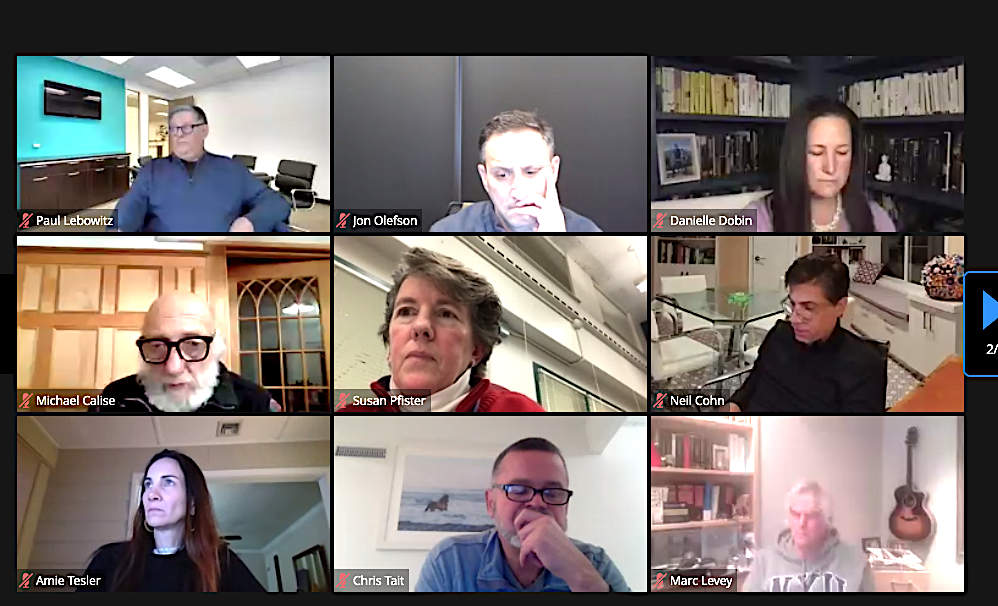
P&Z Chairwoman Danielle Dobin favored requiring a special permit for larger tenants, while the other commissioners initially were opposed, but by the end of the hearing most of them agreed with her.
One of Dobin’s arguments in favor of requiring a special permit was that most Westport residents would agree that some regulation on large stores downtown would be desirable.
“I think there are a lot of people who have placed a lot of trust in us to be sure that downtown remains our very special downtown,” she said.
According to P&Z member Paul Lebowitz, requiring a special permit for large stores is a way for the town’s planning board to retain some oversight. “If we keep the special permit in the amendment, we still want you to come in,” he said to the landlords.
“We just want that last modicum of control. We’ve committed to not using it as a club,” he said.
Ending restrictions broadly supported
But almost everyone who spoke at Monday night’s virtual hearing, including both P&Z commissioners and downtown landlords, agreed both the 10,000-square-foot space restriction and the prohibition of retail outlets above the first floor should be lifted.
“The market is changing dramatically because of e-commerce,” Marc Levey, a P&Z commission alternate who was not a voting member on the proposals, spoke as a member of the public. “Most stores are using their flagship stores to showcase their items that they sell online,” meaning that “big box stores” that need space for deliveries and a huge amount of parking would never come to downtown Westport.
“I think this 10,000-square-foot limit is silly … We bind ourselves terribly with the 10,000 limit,” Levey said.
The size limit on downtown businesses had been adopted in 2015 because of concerns that huge stores might move in, Mary Young, the planning and zoning director, told the board.
And yet, before the size restriction was adopted, so-called big box stores had not found downtown Westport a convenient place to do business because of parking restrictions and difficulties loading and unloading merchandise on Main Street, she said.
In fact, the Pottery Barn store, one of the largest downtown, is moving out of its Main Street location because of those problems, Young said. Other existing restrictions, including historic district oversight, make the size limit unnecessary, she added.
Retail above first floor designed to fill vacancies
Allowing retail outlets above the first floor of downtown businesses expands the kind of commercial uses already permitted there. Those uses include restaurants, residential units and offices.
The prohibition of retail use above the first floor downtown has been in place since the 1990s, and is limiting rentals, Young told an earlier P&Z meeting. There are currently “double-digit vacancies” on the upper floors of downtown buildings, she said.











The vote to allow increased square footage is solely based upon the narrow view that bigger is better and that real estate profitability is more important than maintaining the values of the town. Westport will only degrade the town’s overall value and livability by allowing large/big box stores to occupy the Main Street downtown area.
Sadly, this move will in the long term only hurt the homeowners..