
By Mark Pazniokas / CTMirror.org
Connecticut residents overwhelmingly favor keeping abortion legal, though with differences over the circumstances in which abortions should be available, according to a new poll commissioned by television station WTNH.
The findings mirror a recent national poll by Pew Research Center that shows voter attitudes are more nuanced than being simply for or against abortion as the nation braces for a U.S. Supreme Court ruling expected to overturn or greatly revise Roe v. Wade.
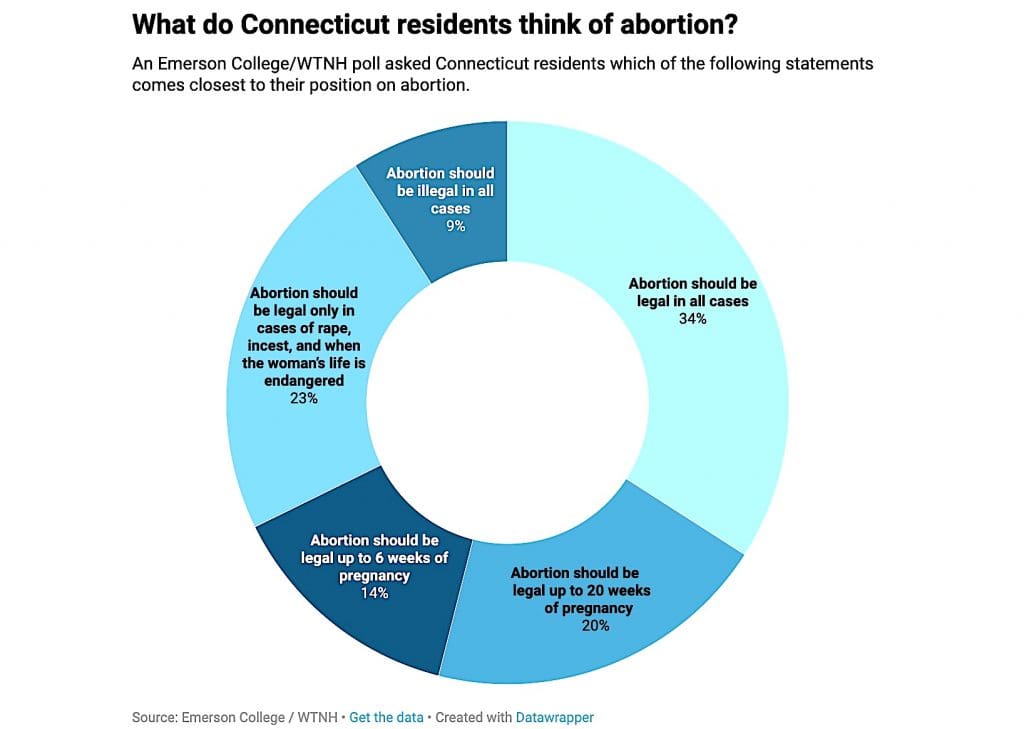
Only 9 percent of respondents in the Connecticut poll said abortion should be illegal in all cases.
Another 23 percent would prohibit abortion, except in cases of rape, incest or where the health of the mother was endangered.
The remaining 68 percent favor either no or few restrictions on abortion, though a subset indicated the current standard in Connecticut of fetal viability is perhaps too liberal.
Thirty-four percent said abortion should be legal in all cases, and 20 percent said it should be legal up to 20 weeks of pregnancy, while 14 percent favor a cutoff at six weeks.
Nearly 99 percent of abortions were done at 20 weeks or sooner in 2019, the most recent year statistics are available from the Centers for Disease Control and Prevention.
Ninety-two percent were done before 13 weeks, and 37.5 percent before six.
The poll of 1,000 voters was conducted by Emerson College for WTNH and The Hill on May 10 and 11, using calls to landlines and mobile phones and an online panel. It has a margin of error of plus or minus three percentage points.
A Connecticut law passed in 1990 affirms a woman’s right to an abortion, codifying in statute the standard set by Roe in 1973: No abortion should be banned prior to fetal viability, generally considered to be around 23 weeks.
The poll did not test voter views on whether parental notification should be required in most cases before a minor under 16 years old could get an abortion.
Gov. Ned Lamont and his Republican challenger, Bob Stefanowski, each say they support maintaining the Roe standard in Connecticut, but they differ on parental notification. Stefanowski favors it, Lamont is opposed.
“I’m asking for parental modification. Thirty-seven states have it. My position on this is mainstream. Gov. Lamont is the extreme position on this topic,” Stefanowski said Wednesday.
Connecticut law requires counseling for minors seeking an abortion, including a suggestion that they consult with a parent or family member. Lamont said he is persuaded that there are cases of abuse where parental notification is not realistic.
“My instinct is that 98 percent of people, younger people, talk to their parents if they feel comfortable, they feel like it’s safe, it’s the right thing to do,” he said.
State Rep. Jillian Gilchrest, D-West Hartford, the co-chairwoman of the Reproductive Rights Caucus in the General Assembly, offered a rebuttal Wednesday to Stefanowski on whether there is a practical difference between parental notification and consent.
“If there is a child who feels as though they cannot speak with their parents in order to access an abortion, enacting parental notification or enacting parental consent is in effect the same thing,” she said. “And so it’s going to prohibit a child who needs to access abortion care from getting that care here in our state.”
Stefanowski’s running mate, state Rep. Laura Devlin of Fairfield, recently voted for a bill that provides a “safe harbor” to women from states with restrictive abortion laws who get abortions in Connecticut, as well as the clinicians who provide them. It was signed into law by Lamont.
It also conforms state law with a 21-year-old legal opinion permitting APRNs, nurse midwives and physician assistants to perform first-trimester abortions by suction, the most common type of early abortion.
Stefanowski again declined to offer an opinion on the new law or whether he agrees with Devlin. “It’s not my place to agree or disagree with her,” he said.
He did say he would not seek to change the new law.







Perhaps a better headline for this article would be Vast Majority of CT Citizens Support Restrictions on Abortion. Per the poll, 66 percent favor some degree of restrictions. If Roe falls, it will now be up to the democratic process at the state level to figure out what those restrictions should be.