
By John Schwing
WESTPORT — Tackling what the Planning and Zoning Commission chairman called “a big lift,” a P&Z subcommittee Wednesday reviewed the next steps needed to possibly create affordable housing units on the town-owned Baron’s South open space property.
P&Z Chairman Paul Lebowitz, joined by First Selectwoman Jennifer Tooker, led discussion of the idea — requiring adoption of a new text amendment — first broached more than a year ago.
The project, if it moves forward, would involve renovating the five buildings that currently stand on the 22-acre property into as many as 19 to 22 housing units, all of which would be rented in compliance with state-set “affordable” criteria, according to Tooker.
The buildings would be redesigned to accommodate a range of one-, two- and three-bedroom units, Tooker said, but the existing footprints of the structures would not be increased.
Using “assets” the town already owns to help “diversify” the town’s housing inventory, Tooker said. It also helps overcome one of the biggest hurdles to such initiatives — the high cost of land — others at the meeting noted.
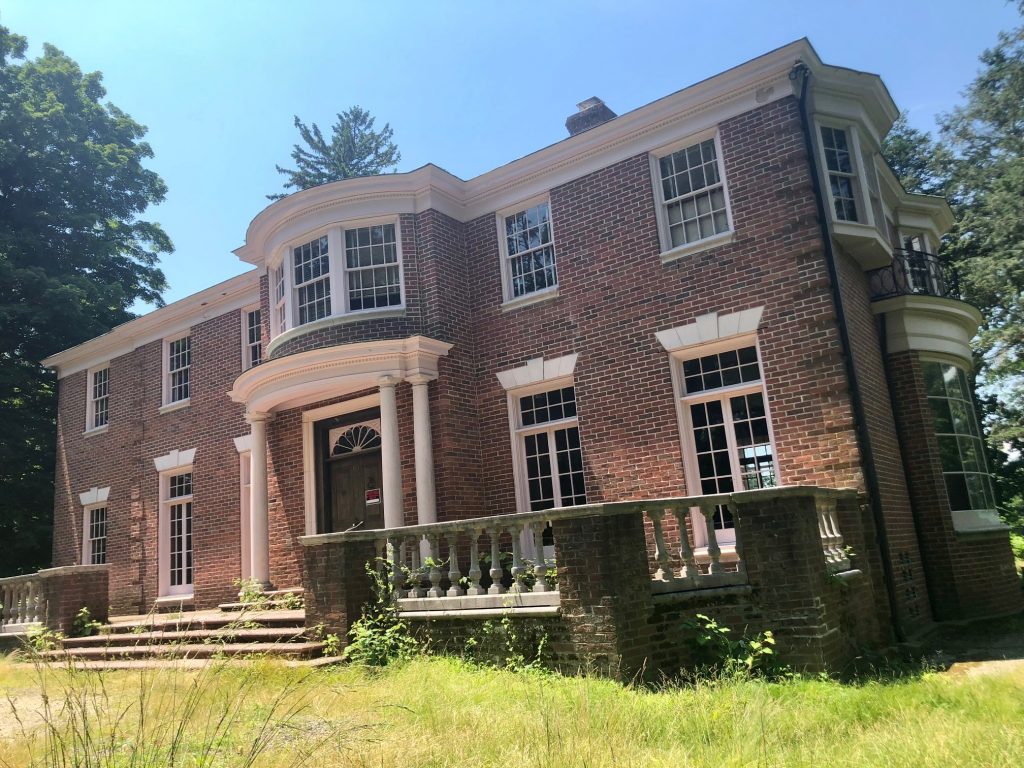
The five buildings on Baron’s South include the “Golden Shadows” mansion, so named by the property’s one-time owner, Walter Langer von Langendorff, a former Austrian baron and chemist who founded Evyan Perfumes, known for its White Shoulders and Golden Shadows scents. That building and two others are unoccupied, while the remaining two buildings are leased for “workforce” housing.
The first step to considering the idea, Lebowitz noted, is to prepare a text amendment to modify the Dedicated Open Space and Recreation District regulations that currently apply to Baron’s South. That change would have to be approved by the full P&Z, he noted, which would give the public a chance to weigh in before the housing plan could advance.
Since the town acquired Baron’s South for $7 million in 1999, advocates for preserving the land as open space have mounted fierce opposition to any proposals that might permit active recreational use, let alone construction, such as a plan to build seniors’ housing defeated in 2015.
Michelle Perillie, the planning and zoning director, explained that, as currently worded, the DOSRD regulations would not permit new housing initiatives, and restrict use of the land to passive recreational activities.

And, Lebowitz said, even if revisions to DOSRD rules are approved, the scope of the project remains large, requiring approvals for funding, a builder, property manager and involvement of town departments such as public works.
Despite what several speakers acknowledged would likely be a lengthy process for affordable housing to become a reality on Baron’s South, a consensus emerged at Wednesday’s meeting to have P&Z staff write a proposed text amendment for consideration at the group’s next meeting. Neither subcommittee members nor the public attending the meeting via Zoom raised objections.
Sal Liccione, a District 9 member of the Representative Town Meeting, had two suggestions: a field trip to inspect the properties should be organized and that Fire Department officials be consulted on how accessible the buildings would be for fire apparatus traveling through the open space.
Tooker said besides “upgrading” the buildings, the project would “work on, move the needle on diversifying our housing stock,” a goal she believes the community broadly supports.
Because all of the Baron’s South housing units would be deemed affordable, it would make “huge strides” in helping the town qualify for a new moratorium from the state 8-30g law, Lebowitz said. That’s in contrast to the minimal impact of requiring developers of large, market-rate projects to set aside several affordable units, he added.
The town’s first 8-30g moratorium expired in March 2023. The law has proved controversial because it allows housing developers to side step local zoning regulations if a community — like Westport — falls short of the 10 percent threshold of affordable housing required by the state.
Perillie estimated the project could earn anywhere from 30 to 50 points toward Westport’s efforts to qualify for a new moratorium. But, as Lebowitz pointed out, those points aren’t officially earned until a project is completed. In other words, not anytime soon.
Matthew Mandell, chairman of the RTM’s Planning and Zoning Committee, lauded the Baron’s South idea and suggested it be among the first orders of business for the town’s recently seated Affordable Housing Committee.
That committee will oversee a fund, established last February, that is to be spent exclusively on affordable housing initiatives. The fund’s revenue is derived from an “inclusionary zoning fee” — $5 for every $1,000 on construction project costs — and can be used to acquire land or facilitate construction and/or maintenance of new or existing affordable housing units in town.
The fund since its inception has accumulated more than $626,000, it was reported at Wednesday’s meeting. That figure, officials indicated, is on track with original estimates that the fee would collect roughly $1 million during a full year.
John Schwing, interim editor of the Westport Journal, has held senior editorial and writing posts at southwestern Connecticut media outlets for four decades.







Finally a plan! But something is amiss, namely the stated goal of the town: “..,to qualify for a new moratorium.”
Why strive for a moratorium on affordable housing? Isn’t the ideal “Planning” goal to have a plan to accommodate affordable housing options on an ongoing basis?
Golden Shadows, owing to its reasonably well preserved historic interior fabric (period wall coverings, marble fireplaces, bath and kitchen fixtures, doors, sashes, floors, paneling, curved staircase, etc.) is not a particularly good candidate for the proposed use. Carving it up into apartments will unfortunately cause the building, which is listed on the Connecticut State Register of Historic Places, to lose much of its historic and cultural significance – and thus diminish its interpretive value. Alternatively, the building, which was originally conceived as a two bedroom weekend residence with an emphasis on entertaining, would actually work well as administrative and/or meeting space for a non-profit or even the municipality.
One the other hand, the four other historic supporting structures (staff/guest house, chauffeur’s cottage, perfume laboratory, garage apartment) do not possess the high level of integrity that Golden Shadows does. Thus, for this and other reasons, they seem especially well suited for affordable housing as proposed.
In any event, it is well known that fire engines cannot navigate the current access roads which service these buildings and that a new, code compliant access road will need to be installed before anything else can happen. As I recall, such a plan was drawn up some years ago.
In the broader sense, it would nice to see this once beautiful but now utterly broken and abandoned park returned to service for the benefit of those who paid for it: the residents of Westport.