
By John Schwing
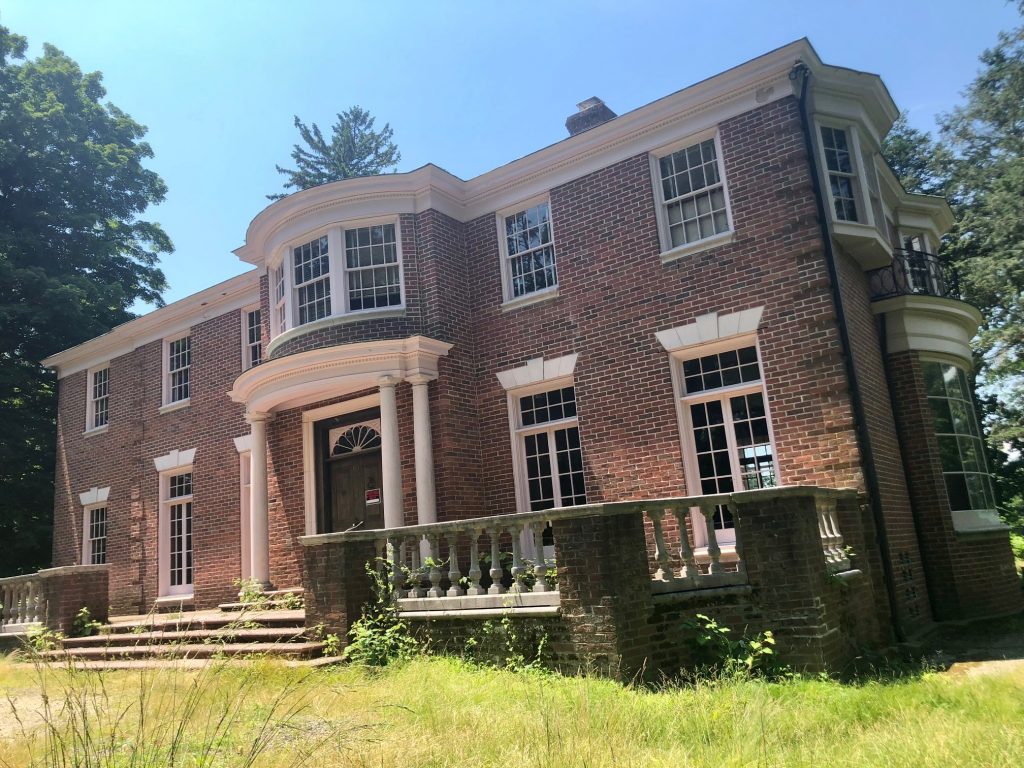
WESTPORT — Could the “Golden Shadows” mansion, once home to the “baron” renowned for formulating fabled Evyan perfumes and now sitting empty on the town-owned Baron’s South property, one day be transformed into affordable-housing units?
That’s a new “concept” for future use of the mansion and four other buildings on the 22-acre property, off Compo Road South, which was unveiled at Wednesday’s meeting of a Planning and Zoning Commission subcommittee.
The idea, repeatedly described as “preliminary,” was introduced as a way to help expand the town’s inventory of affordable housing. Town officials emphasized that exploration of the concept is in the early stages and there has been no determination on whether a formal proposal will be recommended for the full P&Z’s consideration in the future.
First Selectwoman Jennifer Tooker, P&Z Chairwoman Danielle Dobin and Planning and Zoning Director Mary Young all took pains to underscore the exploratory status of the concept — an acknowledgment that use of the Baron’s South property has been a “third-rail” issue sparking passionate debate ever since the town acquired the property nearly a quarter-century ago.
Over the years, advocates for preserving the land as open space have mounted fierce opposition to any proposals that might permit active recreational use, let alone construction, such as a plan to build seniors’ housing defeated in 2015.
Acquired by the town for $7 million in 1999, the property was previously owned by a former Austrian baron, Walter Langer von Langendorff, a chemist who founded Evyan Perfumes, known for its White Shoulders and Golden Shadows scents.

The affordable housing plan, if it moves forward, would require adoption of a new zoning regulation applying only to the baron’s one-time home, the brick Golden Shadows mansion, and four other buildings on the property, two of which currently are occupied as single-family “workforce” housing.
The regulation, according to Tooker and Dobin, would permit only interior renovations to the structures, allowing them to be divided into studio, one- and two-bedroom apartments — all of which would be deed-restricted as “affordable” in conformance with state criteria.
The Board of Selectwomen would not be authorized to propose a site plan for Baron’s South housing unless the P&Z first adopts the new regulation as outlined at Wednesday’s noontime meeting of the P&Z’s Regulation Revision/Sustainability Subcommittee.
Tooker said she considers the concept a way to increase “diversification” of Westport’s housing supply. “Repurposing and using town-assets,” like the Baron’s South buildings, she told the meeting, falls in line with recommendations from the town’s state-mandated affordable housing plan.
The regulation, although still being “investigated,” Tooker said, would apply only to the buildings’ interiors, with a possible adjustment to accommodate parking for residents. The buildings’ facades and footprints would be preserved, she added.
And the existing zone classification for the rest of Baron’s South would not be changed, the first selectwoman emphasized.
The town, she acknowledged, “has had a really hard time figuring out appropriate uses” for the Baron’s South buildings. The affordable-housing plan could be a productive use for structures that, she said, “quite frankly, have not been activated” since the town purchased the property.
The site is well positioned for housing given its proximity to the Post Road corridor, Tooker said, and would not add significantly to traffic volume.
“I think it’s really exciting that the town is looking at moving forward with truly exploring real-world solutions that could really work for Westport,” Dobin said.
“But,” she acknowledged, “there’s obviously a real impediment with regard to current zoning” for Baron’s South, which blocks any housing development on the property.
That’s why she advocated that the P&Z subcommittee and staff continue exploring a new regulation before Tooker’s administration spends more time on a housing plan that could not advance otherwise.
Dobin also emphasized, “This is about the adaptive re-use of existing structures only, not the creation of any new structures …” The regulation would be written to preserve the remainder of the Baron’s South as passive open space, she added.
If the plan wins eventual approval, Dobin said, all of the units would deed-restricted for 40 years, and would qualify for the town’s overall inventory of affordable housing as measured by the state.
Young also underscored the preliminary nature of the discussions, and to allay concerns there may be “hidden agendas,” said the new zoning district should be established to allow greater residential density for only the buildings in question and prohibit any other uses. Restrictions should be encoded in the new regulation to assure that people “concerned about the remainder of the property being forever preserved as open space and recreation will hopefully feel that it will stay intact,” she said.
Three other P&Z members who joined the meeting — Michael Cammeyer, Neil Cohn and Marcia Falk — all expressed general support for continued discussion of the idea.
As did several members of the public who spoke.
Although one, Wendy Crowther, expressed reservations about renovating the interior of Langer’s Golden Shadows mansion.
Crowther described the building’s interior as “incredibly unique” and a well-preserved example of mid-century decor. “The baron and his wife had really good taste,” she said.
Crowther did not object to converting the four other buildings into affordable units, but regarding Golden Shadows, she was concerned by the prospect of “chopping it all up” to accommodate apartments.
John Schwing, the Westport Journal consulting editor, has held senior editorial and writing posts at southwestern Connecticut media outlets for four decades. Learn more about us here.











Recent Comments