
By Thane Grauel
WESTPORT — A couple who bought the house at 12 Cottage Lane in June has run afoul of the Conservation Department after soil was deposited in a wetlands area on their property.
Wetlands are protected, and any activity there is regulated.
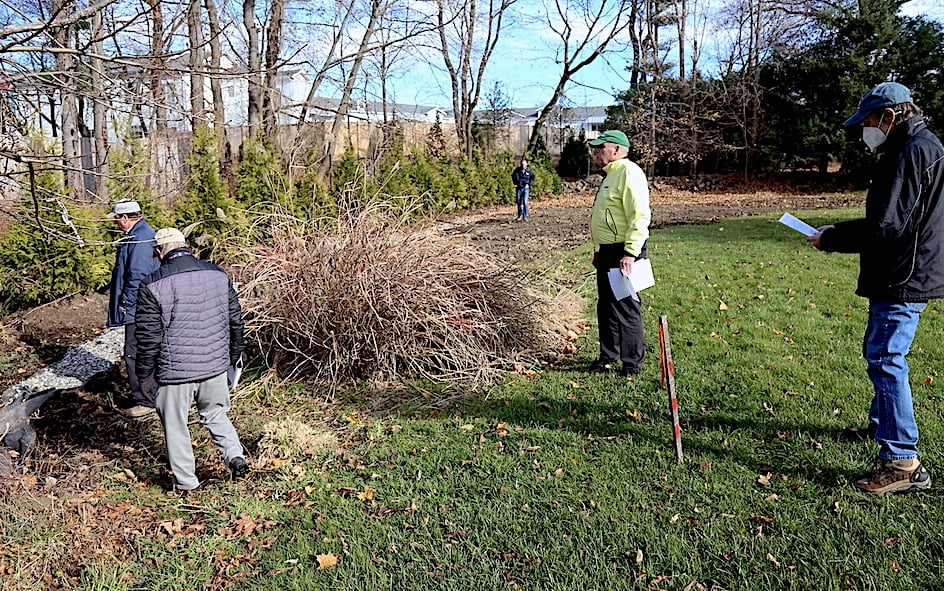
The Conservation Commission held a special meeting Wednesday on the issue — billed as a show cause hearing on “a Cease and Correct Order” — after a neighbor filed a complaint in November.
Erin White told the hearing that after purchasing the property, she and her husband hired a surveyor.
“It came back saying there were no wetlands,” she said of the survey.
In October, the back yard flooded after torrential rains, so the owners hired a contractor to improve drainage.

Conservation Department paperwork says a berm with arborvitae trees was installed, as well as a fence, French drain (crushed rocks to channel water) and about 20 cubic yards of soil was added.
White said that after the October storm, floodwater was creeping toward the house and hadn’t drained after two weeks.
“Our concern in trying to improve the drainage wasn’t the aesthetics … we were worried that it was flooding and not going anywhere,” she said.
White also said they believed the water was coming from a new condo complex on the nearby Post Road East.
Peter Romano of LandTech noted the wetlands had not yet been added to the town’s Geographic Information Systems map, so anyone checking those would think the property was clear.
Conservation Director Alicia Mozian noted that the department had sent a letter to the new owners warning that inland wetlands were on or adjacent to their property.
Commission members and staff discussed a plan Romano had come up with to restore wetlands on the site.
“The crux of the plan is, when you restore a wetland you have to embrace the function of a wetland,” Mozian said. “I know it may not seem like it, but if this is enhanced it could actually help you with your flooding problem. It’s going to store the water and hopefully not bring it closer to your house.”
“Actual trees might do a lot more for your flooding than just the wet meadow because they absorb hundreds of gallons of water a day when they’re mature,” said Nathan Hartshorne, a conservation compliance officer.
“I’m not against trees,” White said.
The commission agreed to allow the area to be mulched with hay for the winter to keep it intact, and also to let the berm and arborvitae remain.
The fill, however, must be removed and the area regraded.
Other details will be worked out between the staff and Romano, who is to submit an updated plan by Feb. 1.
Remedial work is to begin in spring.












The GIS System has not been updated since 2019. There are additions and new construction that have not been added since then. How can that be a reference at all for anyone looking to get real time info
So LandTech designed the apartment complex causing unprecedented runoff behind the property and creating the problem. And now the residents harmed by the problem get to pay LandTech to fix the same problem?