
By Kerri Williams
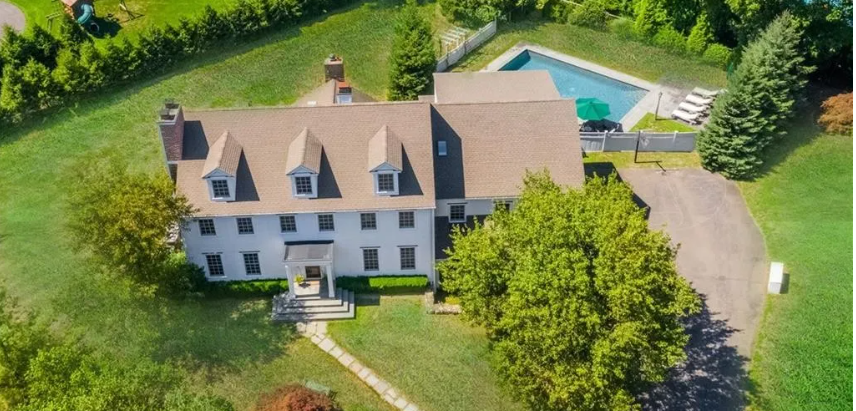
WESTPORT – The Chairman of the Planning & Zoning Commission took to task a builder and homeowner at 6 Mayfair Lane on Monday for another “Oops” application before the commission.
“Following the rules is not hard,” Paul Lebowitz said, concerning the request to authorize non-exempt grading for construction of a patio and retaining walls at 6 Mayfair Lane. “Your owner and the person paying the bills needs to understand just how egregious we view this.”
The commission approved a similar application on Partrick Road last week where non-exempt grading and fill took place on a property there. The Mayfair Lane public hearing was left open by the commission. The matter will be “continued” to the next meeting, scheduled for Nov. 24.
Upset neighbor
Mayfair Lane neighbor Valerie Jacobs, who, along with her husband Mark, wrote several letters to the commission with their objections to the project, spoke out Monday on her concerns about increasing drainage issues in the neighborhood.
“This (instance) is a poster child for the P&Z to step in and protect a neighbor from a drainage risk,” Jacobs said during public comment. She added that it is “not fair” for her and her husband to be sitting in on long meetings about an issue that was not of their making.
“We built our home to a tee and followed regulations,” Jacobs said, adding that she should not be “biting her nails” that there will be drainage issues on her property.
Builder “did not know”
In response to Lebowitz’s comments, builder David Vynerib, founder of CCO Habitats, who did work on the property for Arturo Poire and Maria Solodad Matteozzi, said he “did not know this was an issue,” adding that the surveyor did not bring to his attention that small portions of the new patio were outside the setback.
“Ninety-five percent of the patio is within regulation,” he said earlier during his presentation. “A little sliver is not.” He added that the drainage from the site should not be affected by the work on the property.
But Lebowitz said he doesn’t like “these excuses,” saying that he could see “very clearly” that there is an issue with the site lines on a small computer drawing. “It’s still your responsibility,” Lebowitz said.
Vynerib responded that, “At the end of the day, it stops with me,” but said he was not trying to create an issue.
Multiple permits issued
Also at the meeting, commissioners brought up that multiple permits have been issued for the property since 1987 under a previous owner, which include plans for a new residence, a pool, additions, and most recently, a covered porch and other improvements. Several Zoning Compliance Certificates remain outstanding.
Vynerib said his clients were holding off until this issue was rectified to resolve the outstanding permits.
Neighborhood beset with complicated drainage
In her letter to the commission, Jacobs explained the current drainage situation on Mayfair Lane, which occurred in response to a lawsuit filed by the Compo Hill Association. The town agreed to reroute the runoff and storm water from Mayfair Lane away from Compo Parkway and through a drain in the street between 6 and 8 Mayfair Lane and a drain behind 8 Mayfair. In addition, the town required the owners of #8 to install and then maintain a retention pond behind their house to hold extra runoff in the event of severe storms.
“The problem is that this proposed project at #6 would add more runoff to those drains, which are already severely taxed during storms,” Jacobs said in a letter to the commission. “Moreover, this project could potentially cause the retention pond to overflow if the drain backs up.”
Improvements recommended
Lebowitz and other commissioners suggested that some improvements to 6 Mayfair may help the drainage situation, including planting some trees or creating a berm along the property line, adding another filtration system, or adding a drainage system under the driveway that has already been built on the property.
In response, Vynerib said that much of the drainage issue on the street is created by another house. “I am not sure why my client has to bear the burden for what happened in the past,” he said, adding that the entire landscape and yard on the property had already been ripped up once.
“We want to be fair to both sides,” Lebowitz said in response. He added that the fact that the request “is an oops application doesn’t help.”








Can someone answer for me what power P&Z has in this situation?
I assume they can say, “it can stand” (with a wag of the finger) if they think it is minor and unintentional.
I assume they can say, “it wasn’t built to the rules. Make the patio compliant” (effectively requiring a rebuilt of the patio).
I don’t know what the middle ground would be on something like this, but I assume they could look for one.
This is a 100% request for how this works. I 100% presume it was an honest mistake, but a mistake, nonetheless. (Though “a little sliver was not” is awfully cringe.)
But if there was a builder that was doing this kind of thing repeatedly, does the P&Z have the power to act punitively? Can the builder sue if that happens? Can P&Z stonewall future applications from someone who repeatedly builds non-compliant structures? Can the neighbor sue Town for not enforcing regs? Short question is what can P&Z do to protect the neighbors from wasting their time (and money) dealing with this stuff and prevent builders from acting in bad faith.
TIA to anyone who can enlighten me!
As a real estate developer and real estate attorney for over 40 years, I am sick of seeing the same B.S. over and over again. Property owners and builders keep doing the “oops” program because they can get away with it. It goes to the old adage “it’s easier to ask for forgiveness than ask for permission.”
I can recall hearings where the builders actually laughed at the Zoning Board of Appeals members as they brought up serious and egregious construction issues and transgressions.
It is time to hold these builders and owners accountable. The regulations provide for penalties including remediation. Also, why was this property owner able to proceed with anything while they had a large number of open zoning compliance certificates.
It is time for our zoning board members and our building, flood erosion and control and conservation department to enforce the rules. You certainly should be fair to the applicants but you must always be fair to adjoining neighbors and our Westport community as a whole.
This is a decades-long problem. The longer it goes on, the worse it gets.
This is just part of our zoning regulations concerning zoning enforcement:
§45 ZONING ADMINISTRATION AND ENFORCEMENT
Revised 02-15-13
45-1 Zoning Enforcement Officer
These regulations shall be enforced by the Planning and Zoning Commission which may appoint
a person or persons to act as a Zoning Enforcement Officer. The Zoning Enforcement Officer
shall be directly responsible to the Planning and Zoning Commission, but for administrative
purposes shall report to the Director of Planning, and shall carry out his/her duties according to
law and under such rules and regulations as the Planning and Zoning Commission may, from time
to time, adopt. All references to Zoning Enforcement Officer in these regulations shall also be
interpreted to include the Director of Planning and Zoning, the Deputy Director of Planning and
Zoning, the Zoning Official, members of the Planning and Zoning Commission or any other
person designated by the Planning and Zoning Commission to enforce the zoning regulations.
The Zoning Enforcement Officer is authorized by the Planning and Zoning Commission to
enforce the conditions listed in the Certificate of Appropriateness from the Historic District
Commission pertaining to the premises designated by the RTM as Historic Districts and Historic
properties.
45-2 Enforcement
The Zoning Enforcement Officer may cause any building, structure, place or premises to be
inspected and examined, and to order in writing the remedying of any condition found to exist in
violation of any provision of these regulations. The owner, agent, lessee, tenant, architect, builder,
or contractor of any building or premises or part thereof in which a violation has been committed
or exists shall be considered the violator and shall be subject to the penalties in accordance with
§8-12, Planning and Zoning Statutes of the Connecticut General Statutes. Any official having
jurisdiction may institute an action (such as an Order to Discontinue or a Cease and Desist
Order), proceeding or other remedies to prevent the unlawful erection, construction, alteration,
conversion, maintenance or use of a building or to restrain, correct or abate such violation, or to
prevent any illegal act, conduct, business or use in or about such premises.
All Orders to discontinue and Cease and Desist Orders shall be filed on the land records in the
Town Clerk’s Office.
45-3 Zoning Permit
No building or structure shall be erected, added to, or structurally altered and no change of use
shall be established until a Zoning Permit has been issued by the Zoning Enforcement Officer. No
Zoning Permit shall be issued for any building, structure or use that requires site plan review
under these regulations without the prior approval of said site plan. If the conditions of the
Planning & Zoning Commission resolution, conditions of the Zoning Board of Appeals variance
or Zoning Permit have not been met, have been violated or if work extends in time or scope
beyond approvals then the Zoning Permit shall be revoked. A Zoning Permit shall be rendered
null and void if there are any substantial changes or alterations to the Plot Plan, Building Plans
and/or other supporting application documents after the issuance of such Zoning Permit. All
applications for such permits shall be in a form prescribed by the Commission and shall include
the following information:
Conn. Gen. Statutes Section 8-12 provides in part:
If any building or structure has been erected, constructed, altered, converted or maintained, or any building, structure or land has been used, in violation of any provision of this chapter or of any bylaw, ordinance, rule or regulation made under authority conferred hereby, any official having jurisdiction, in addition to other remedies, may institute an action or proceeding to prevent such unlawful erection, construction, alteration, conversion, maintenance or use or to restrain, correct or abate such violation or to prevent the occupancy of such building, structure or land or to prevent any illegal act, conduct, business or use in or about such premises. Such regulations shall be enforced by the officer or official board or authority designated therein, who shall be authorized to cause any building, structure, place or premises to be inspected and examined and to order in writing the remedying of any condition found to exist therein or thereon in violation of any provision of the regulations made under authority of the provisions of this chapter or, when the violation involves grading of land, the removal of earth or soil erosion and sediment control, to issue, in writing, a cease and desist order to be effective immediately. The owner or agent of any building or premises where a violation of any provision of such regulations has been committed or exists, or the lessee or tenant of an entire building or entire premises where such violation has been committed or exists, or the owner, agent, lessee or tenant of any part of the building or premises in which such violation has been committed or exists, or the agent, architect, builder, contractor or any other person who commits, takes part or assists in any such violation or who maintains any building or premises in which any such violation exists, shall be fined not less than ten dollars or more than one hundred dollars for each day that such violation continues; but, if the offense is wilful, the person convicted thereof shall be fined not less than one hundred dollars or more than two hundred fifty dollars for each day that such violation continues, or imprisoned not more than ten days for each day such violation continues not to exceed a maximum of thirty days for such violation, or both; and the Superior Court shall have jurisdiction of all such offenses, subject to appeal as in other cases. Any person who, having been served with an order to discontinue any such violation, fails to comply with such order within ten days after such service, or having been served with a cease and desist order with respect to a violation involving grading of land, removal of earth or soil erosion and sediment control, fails to comply with such order immediately, or continues to violate any provision of the regulations made under authority of the provisions of this chapter specified in such order shall be subject to a civil penalty not to exceed two thousand five hundred dollars, payable to the treasurer of the municipality. In any criminal prosecution under this section, the defendant may plead in abatement that such criminal prosecution is based on a zoning ordinance or regulation which is the subject of a civil action wherein one of the issues is the interpretation of such ordinance or regulations, and that the issues in the civil action are such that the prosecution would fail if the civil action results in an interpretation different from that claimed by the state in the criminal prosecution. If the court renders judgment for such municipality and finds that the violation was wilful, the court shall allow such municipality its costs, together with reasonable attorney’s fees to be taxed by the court. The court before which such prosecution is pending may order such prosecution abated if it finds that the allegations of the plea are true.
Let’s all do our jobs and protect our community from this “oops” abuse.