

By John Schwing
WESTPORT — Compliant, but not acceptable.
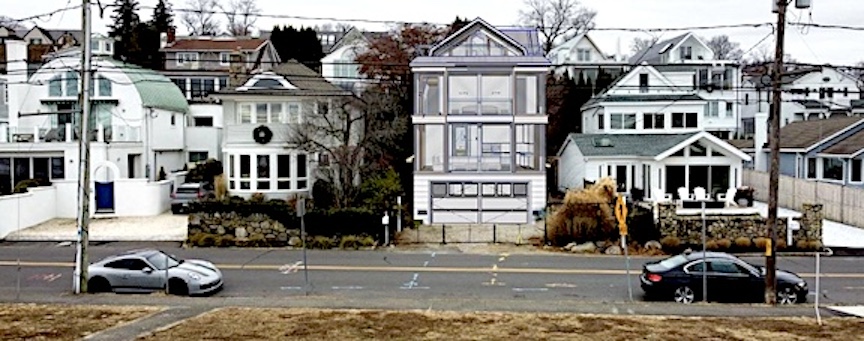
That’s the rationale behind the Zoning Board of Appeals split decision Tuesday to deny variances for a controversial plan to build a 36-foot-tall, flood-zone compliant house on the site of a single-story, century-old cottage in the Old Mill Beach neighborhood.
The proposal for 238 Hillspoint Road, in its third appearance on a ZBA agenda, had been criticized as too large and out-of-character with the beach area in numerous emails sent to the board since the plans were filed last fall and subsequently revised.
The application, presented Tuesday night by land-use consultant Cindy Tyminski, sought the board’s approval for variances of the zoning regulations for non-conforming new construction, setbacks, and building and total coverage.
The proposed 2,200-square-foot, single-family home would supplant the small house built in 1920 on a non-conforming lot facing Old Mill Beach, and as such, within a flood zone.
Describing the living space as comprising two stories, Tyminski explained because the house is proposed in a flood zone, Federal Emergency Management Agency regulations mandate that its first level be raised at least a foot above the base flood elevation, which combined with calculations for average mean sea level, require that it be raised significantly higher above the ground than the existing home.
The height of the habitable space as measured from the elevated first floor, in compliance with town regulations at the roof midpoint, is 26 feet, 11 and 7/8 inches, just below the 27-foot limit, she said. The lower level, in order not to be considered a story, can be used only as a garage and for storage.
The town’s policy that sets height measurements at the roof midpoint was criticized by ZBA Chair Jim Ezzes and other board members as both confusing and sorely in need of revision.
“Elevating a home is not optional for new construction or when substantial improvements are made to an existing home” in a flood zone, Tyminski wrote in notes filed with the application. “The properties in the neighborhood that are non-conforming in respect to FEMA will also ultimately be required to be elevated as they are renovated.”
While neighborhood critics faulted the overall height and mass of the structure, Tyminski pointed out that state and local regulations do not guarantee “protection of views.” Ezzes agreed with that, but added he found the lack of such rules surprising.
Calling the proposed home consistent with neighborhood character, Tyminski also noted that virtually every nearby home on Hillspoint Road and Sherwood Drive has at some point been granted variances for coverage and setbacks like those sought for 238 Hillspoint.
“The issue is,” she said of neighbors, “they want their own variances, however, they want everything to stay the same once they receive their variance.” That is now impossible, she added, with requirement to comply with FEMA regulations in the area.
One of the neighbors, architect Joseph Fuller whose Sherwood Drive property abuts the rear of 238 Hillspoint, called the proposed house “overdeveloped” for the 0.3-acre lot and “a glass box” that would clash with the neighborhood’s character. If approved, given its size and location next to Old Mill Beach, he said, the house would be something many people “would come to regret.”
In discussing the application, ZBA members struggled with the proposal’s apparent compliance with regulations given its pre-existing, non-conforming status and FEMA requirements versus concerns about the house size, particularly the height measurement as currently defined by the town’s zoning rules.
Ezzes, responding to a neighbor’s comments that the home’s proposed “attic” appeared to be the size of an additional floor, said it nonetheless did conform with the town’s height regulation, which is something he clearly feels needs to be revised. Board members Joe Scordato and R.B. Benson had similar qualms about the measurement of height as currently defined in the zoning regulations.
But, the long-serving board chairman added, “We [the ZBA] do not write the regulations, the Planning and Zoning Commission does.” As to FEMA requirements, he said, the board would not contravene those standards since it could affect insurance rates paid by many Westporters.
Questions about the 238 Hillspoint application, which Ezzes said have arisen repeatedly in connection with other projects in the neighborhood, could be better addressed by re-zoning the area, he suggested.
Ezzes, in voting to approve the application, said the house would conform with the height and stories standards as defined in the zoning regulations, and had been signed off on by the town’s engineering staff.
“Our hands are tied,” he added, “because the house conforms with the regs.”
Sheri Gordon expressed frustration that “the P&Z puts us in this position,” which by not re-zoning the neighborhood, makes variances necessary for virtually any building project in the area. However, she also voted to grant the variances.
But Josh Newman disagreed. While other aspects of the application conform with regulations, he also had questions about how the structure’s height was measured, but added that his “big concern” was the proposed 50 percent increase in building coverage over the existing house.
“The mass of the structure is too big … it’s too much,” he said.
Ezzes responded that variances requested for the 238 Hillspoint Road house were consistent with others granted for houses throughout the Old Mill neighborhood.
Not only did he fail to convince Newman, but Scordato and Benson joined in voting no, denying the application by a 3-2 margin.
John Schwing, interim editor of the Westport Journal, has held senior editorial and writing posts at southwestern Connecticut media outlets for four decades. Learn more about us here.








Recent Comments