
By Linda Conner Lambeck
WESTPORT–As state academic performance inches upward, Westport students continue to help lead the pack, with roughly four out of five students meeting or exceeding the state goal in reading, math and science, a just-released state report shows.
Statewide, between 61.7 and 65.0 percent of students met the goal the state set for them on 2026 tests released Monday by the state Department of Education.
- Reading: in Westport, 80.9 percent of students met or exceeded the target compared to 65 percent statewide.
- Math: in Westport, 79.8 percent of students met the state target, compared to 61.7 percent statewide.
- Science: in Westport, 80.3 percent of Westport students taking the test met the state target, compared to 63.1 percent statewide.
In addition to nearly a two-point gain in science from 2025, when 78.4 of Westport students hit the target, local officials point out that Westport 11th grade science scores were the highest they have ever been–at 85.1 percent.
For all three subjects the state’s goal is to see at least 75 percent of students reach grade level targets. Only a handful of towns meet this threshold. Westport is among them.
Achievement targets set by the state are not the same as raw scores on the state’s standardized test scores, but they factor into the equation.
Commissioner of Education Charlene M. Russell-Tucker called it a more holistic picture during a press conference to announce the results on Monday.
The state’s Smarter Balanced Test is given each spring in grades 3 through 8. All 11th graders take the SAT’s in school which counts as the state test.
Connecticut also considers growth over time to capture the progress of all students collectively to ensure they are moving in the right direction, even those not reaching certain benchmarks.
Overall, state officials say the system is heading in the right direction, but it would like the growth to go faster.
State stats
According to the state, math and science improvements represent the fourth consecutive year of growth, moving achievement levels in both subjects closer to pre-pandemic achievement levels. English language arts results in 2026 also improved from the previous year at the state level.
Ajit Gopalakrishnan, chief performance officer for the state Department of Education said that at the statewide level, even fractional improvement in scores represent thousands of students performing at higher levels.
Gopalakrishnan added that he is confident in the numbers because essentially every kid is tested.
“This is not sample data … it’s the whole state and the whole state is moving up,” Gopalakrishnan said.
State officials also celebrated a continued decline in chronic absenteeism rates.
In 2022, in the throes of the pandemic, chronic absenteeism stood at 23.7 percent statewide. In the 2025-26 school year, it fell to 16.4 percent, meaning nearly 35,000 more students statewide are attending school regularly.
In Westport, the chronic absenteeism rate–meaning students missed 10 percent or more of a school year–was 6.6 percent in 2026. That amounts to 346 students and compares to 609 students or 11.6 percent in 2021-22.
Local results
Assistant Superintendent Anna Mahon, who heads up Teaching and Learning for the district, said local results will be presented to the school board with an administrative analysis at the board’s Nov. 5 meeting.
Highlighted will be grade level data from the state test as well as other district-level assessments used to inform curriculum and instruction.
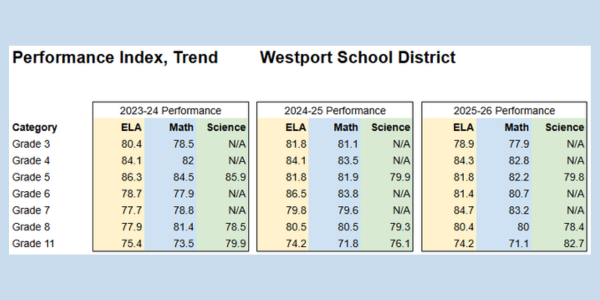
Charts provided by the state on its EdSight web page, however, show the following:
- In Westport roughly 2,400 students took the reading and math tests. For science, only grades 5, 8 and 11 take the test. The participation rate in Westport was 99 percent.
- Westport overall reading performance dipped fractionally from last year–from 81.2 to 80.9 but remain higher than 2024.
- Among 7 peer districts, Westport falls at the median for reading and just under for math (median is 80.3 percent, Westport is 79.8 percent).
- Although Westport 6th graders (Class of 2032) performed slightly lower in reading and math in 2026 than the sixth grader class that came before them, the class did better in math from when they were 5th graders (72.6 percent as fifth graders vs. 79 percent as sixth graders.) In reading, that class dipped, from 79 percent in 2025 to 76.1 percent in 2026.
- Statewide, there are nine districts with fractionally higher overall students reaching the state reading goal than Westport. In math, only two districts, Weston and Wilton, had a higher percentage reaching goal, according to state data.
- The gap between non-high needs and high needs populations are not significantly different this year as opposed to last year in Westport. The state defines high needs as including students who receive special education services, qualify for free/reduced lunch, and/or English learners.
- Singled out, the gap between Westport students with and without disabilities remains in the double digits but narrowed slightly in reading. Between 57.3 and 60.9 percent of students receiving special education in Westport met math and reading targets in 2026 compared to 84.4 and 83.7 percent of non-disabled peers. The changes were not significantly different, Mahon said.
- Westport students with disabilities did do better than disabled students statewide, where between 42.2 and 47.1 percent met targets. Statewide, the gap between students with disabilities and the general student body shrank by about one point in both reading and math.
At Monday’s press conference, Gopalakrishnan said performance gaps can be deceiving, particularly in high performing districts where most students are achieving above the norm.
“We are not satisfied with gaps (but we) don’t want to bring down the top,” added Russell-Tucker.
As for scoring differences between students of different race and ethnicities, there remains an 18-point target gap between Black (63.1) and white (81.4) Westport students in reading–and a 19-point gap in math–60.8 percent for Black students and 80.1 percent for white students.
The gap is as prominent or more so at the state level where, among Black students, 48.7 percent met the math target and 55 percent the reading target.

Linda Conner Lambeck
Linda Conner Lambeck covers education for Westport Journal. She was a reporter for more than four decades at the Connecticut Post and other Hearst publications. She has covered education throughout Fairfield and New Haven counties. She is a proud member of the Education Writers Association.







Recent Comments