
By Linda Conner Lambeck
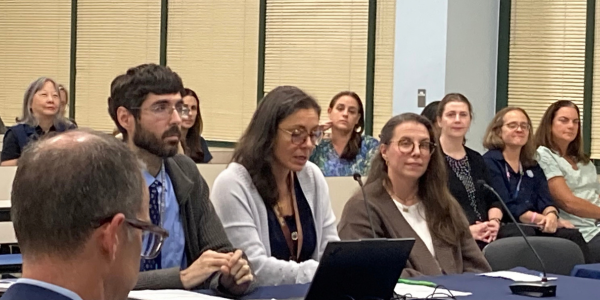
WESTPORT–School board members say they don’t want to stop the growing use of Artificial Intelligence in Westport Public Schools but neither do they intend to stop questioning it.
“I do have concerns. They will change,” said Board Member Jill Dillon at a meeting last week. “I support this, I support the plan, but I still have questions.”
“I think we all support (AI) but for me it’s how do you wrap around the effectiveness of it,” added Board Vice Chair Dorie Hordon. “It’s all new.”
The comments came as district staff offered the board examples of how AI is being used this school year by students and teachers.
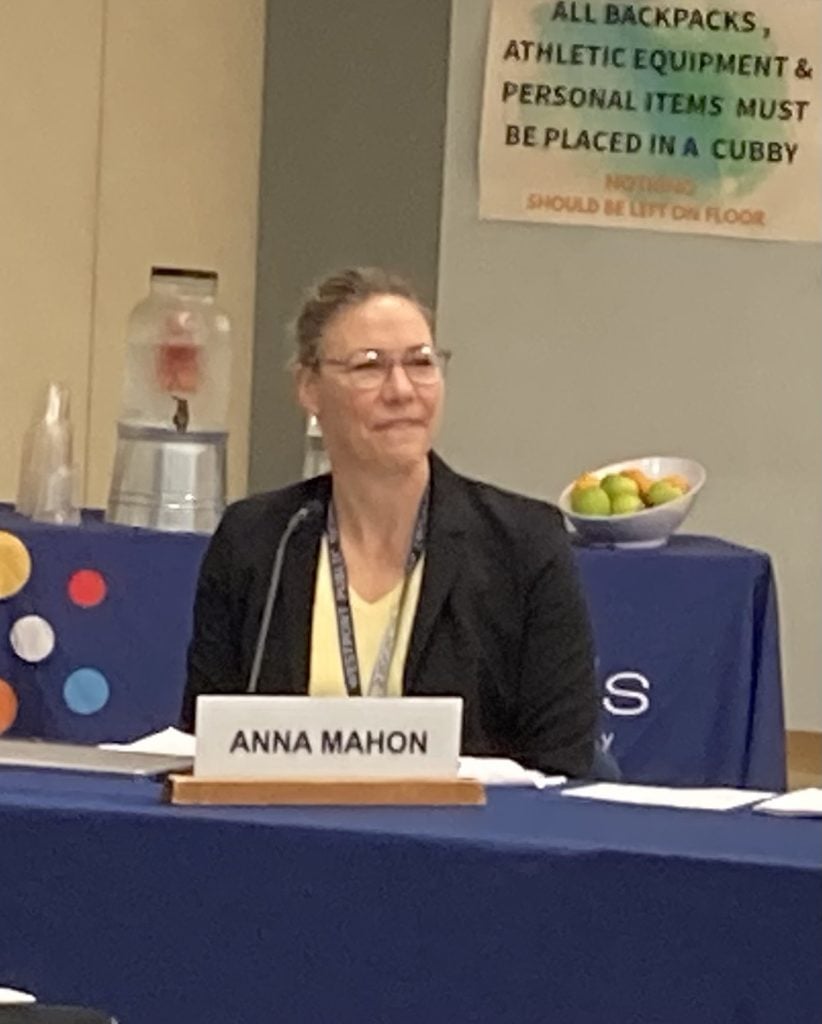
With a thick packet describing the status of the district’s plan to use AI intentionally and ethically as back up, Assistant Superintendent Anna Mahon and others walked the board through Gemini Notebook, the privacy-compliant platform that can assist students in completing assignments, and Gem, a program teachers can use to decide if what they are teaching would benefit from including AI.
The technologies were repeatedly referred to as “just a tool,” remaining optional for teachers to use.
The district added the use of AI to its Strategic Plan a year ago at the urging of Schools Superintendent Thomas Scarice.
Last week’s update was to show how the vision is moving into practice.
“We’re off to a great start,” Scarice said.
Teachers are being trained and students are being introduced to what is allowed and what is not when it comes to AI assistance.
An entire crew of teachers sat in the audience in the Staples cafeteria, prepared to answer questions.
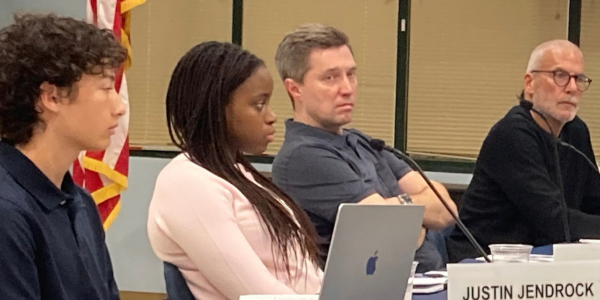
More than once, the board’s two student representatives were called upon to explain what is happening from their perspective.
Anawara Olasewere, a Staples senior, said she has only used the new technology to complete one or two assignments.
“They are taking it slow” she told the board.
Justin Jendrock, a Staples junior, agreed.
“Teachers are very open to how they would like AI to be used (or not) in assignments,” Jendrock said.
So far, he said, students have been introduced to Gemini Notebook but he has not yet used it.
Students are curious about what they can do with it, added Scarice.
Student use
At Staples, students have received two lessons in how to use Gemini Notebook in Connection classes.
The district likes Gemini because information added to the platform cannot be accessed by Google, the board was told. Also, Gemini only uses materials uploaded to it.
Through Gemini Notebook, students can study, conduct research or create videos, podcasts and digital flash cards using up 50 uploaded sources.
“It’s a research assistant,” said Rasha Tarak, a Staples math teacher and part of the district’s AI integration coaching team.
Students are taught that Gemini is not a person and not a friend. It is also, for the most part, grounded to what has been uploaded so its reliability depends on the veracity of added source materials.
Board Member Andy Frankel wondered about students relying on bad or incomplete information.
Jendrock said he would avoid misinformation by putting only primary source documents into his notebook.
Scarice said the technology almost forces students to know their academic content, so they know what is missing or wrong.
Michelle Walker, a middle school instructional coach, said though the technology has not yet been introduced to sixth through eighth graders, she has been observing the Staples roll out.
“We know it is coming,” Walker said.
Hordon was interested in the district exploring how many students might be better off just reading books.
“This is not a replacement, it’s another tool, an option for students,” Mahon told her. Students, she added, still read books.
With technology changing so rapidly, Horden said she also worries that investing so much bandwidth in a particular tool–Gemini Notebook–might be a waste of instructional time.
It reminded her of the “tech ed” push to teach students computer program languages that are now obsolete, Hordon said.
“My question is what does the board want faculty to do,” asked Board Chair Lee Goldstein as the questions continued. “We can’t keep talking around our concerns. The message is either we … shut down Google all the way or keep going.”
It’s getting confusing, Goldstein added.
Dillon called that an unfair way to categorize ongoing questions when AI is changing so rapidly.
“We would be remiss to not keep talking about it,” Dillion said. She lauded teachers for making the topic so understandable but promised to keep the questions coming.
Teacher choice
The second demonstration was on the use of a tool called Gem, that helps teachers plan and make more intentional choices about lessons, assessments and learning experiences.
Gems are preprogrammed to remember and always consider certain instructions and rules. In Westport that includes pieces of the district’s strategic plan.
“We are not asking the question, ‘How do we get teachers to use more AI.’ said Ali Antuovich, a Bedford language arts teacher. Instead, Gems are used to help teachers decide when using AI supports learning and when it gets in the way.
Scarice said Gem puts teachers in the position of having to critically analyze what they are doing and how.
Board Member Stephen Shackelford called Gem and how the district is using it amazing.
When Goldstein asked if the board supports district AI efforts, Shackelford said the district approach is what gives him comfort.
“This is exactly the sort of thoughtful approach to it that I am very happy to see,” Shackelford said.

Linda Conner Lambeck
Linda Conner Lambeck covers education for Westport Journal. She was a reporter for more than four decades at the Connecticut Post and other Hearst publications. She has covered education throughout Fairfield and New Haven counties. She is a proud member of the Education Writers Association.







Recent Comments