
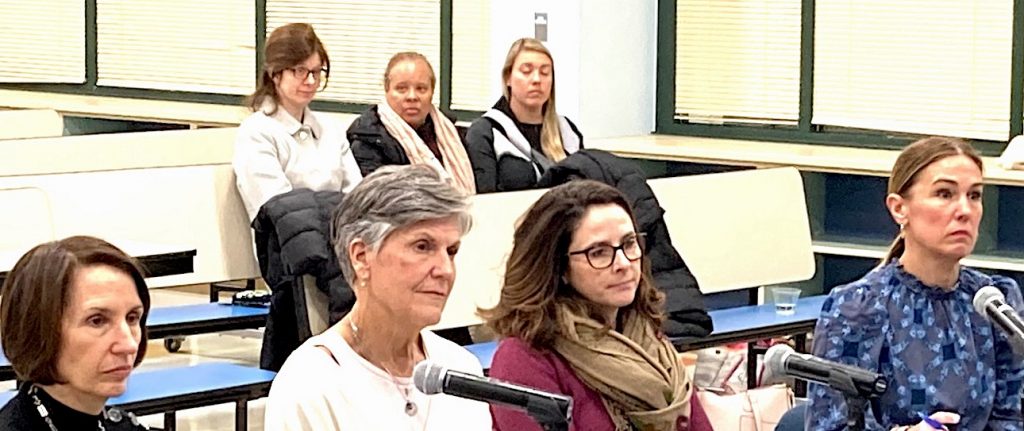
WESTPORT — Long-term efforts to improve the well-being and problem-solving skills of Westport students are moving from the “why it’s important” phase to “how do we do it?”
During a two-hour presentation at Monday’s Board of Education meeting, school district administrators — not focused for the moment on the budget — explained to the board steps being taken to roll out Supt. of Schools Thomas Scarice’s strategic plan.
Emerging details of the plan have board members excited, but there were questions.
Board Secretary Neil Phillips wondered if there is time for it.
Board member Dorie Hordon wondered about buy-in from students.
Board Vice Chairwoman Liz Heyer wondered if the district will focus on initiatives that have the most impact.
“Getting the most bang for our buck … not financially, necessarily, but time-wise,” Heyer said.
The plan has seven objectives:
- Establish a Westport Public Schools Center for Leadership Development.
- Help all students stimulate growth mindset belief systems.
- Give specific instruction in social and emotional capacities.
- Elevate student voices and engagement.
- Anchor the curriculum with collaborative, problem-solving cornerstone tasks.
- Infuse the curriculum with problem-solving processes.
- Revitalize learning spaces.
Scarice called the plans to establish a Center for Leadership Development ambitious.
“This is the one that I think would distinguish our district,” he said. “It would take a lot of energy to continue pushing it forward. I have a lot of passion about it.
The idea is to expand leadership opportunities for students, and offer training, seminars, speakers and a library. The center would have an advisory board, and eventually, a physical location.
The council could be formed quickly, he said. A site might have to wait until 2025.
Board member Robert Harrington said Scarice’s passion is evident.
“It makes me really excited about you being here and what you are going to do with the district,” Harrington added.
Helping students realize their abilities can be developed through effort and grow over time — growth mindset — will involve examining policies and practices that encourage them to realize that success is often dependent on persistence, time and effort and not fixed talents or intelligence.
For this, there will be professional development for teachers and shared reading and workshop experiences for school communities.
Bolstering social and emotional learning — including self-awareness, self-management, social awareness, relationship skills and responsible decision-making — is in the hands of action planning committees, according to Valerie Babich, coordinator of psychological services for the district.
Curriculum will be developed for all grade levels, but a lot is in place already, Babich said.
To elevate student voices and engagement, Ann Neary, a Staples High School English teacher, said schools are looking to seek student feedback on decisions affecting their schools and appointing students, where appropriate, to serve on leadership teams.
There is a plan to appoint student representatives to the school board, but board members are not sure how they want to do that.
“A number of districts have them … [I] want to make sure the role is as impactful as possible,” said board member Kevin Christie.
Hordon said she wants student input, but is not sure making them endure board meetings that can last past midnight is the way to do it. She wants to hear from more than just two students and likes the idea of creating problem-solving cornerstone tasks students would complete at various junctures of their academic careers.
The idea would be to make the tasks cross disciplines, perhaps grades.
More problem-solving would also be integrated into the curriculum and an evaluation would be conducted of physical and online learning resources used by the district. The evaluation would include recommendations that could affect the budget.
Lauren Francese, chairwoman of the Staples social studies department, called the planned role out ambitious, especially since it is being carried out by teachers after they complete their day jobs.
Additional time set aside for the work would help, she said.
Hordon said the one area of the plan some members of the public remain uncomfortable about is social emotional learning as it relates to equity.
“A strategic plan should be something that brings the entire community together,” added Harrington. Clarification is needed to make the broader community feel comfortable, he said.
Babich told her the skill-development work focuses on building competencies in personal effectiveness, emotional regulation, self-awareness and interpersonal relationships.
It’s not necessary to be a mental health professional to teach those skills as long as the underlying principles are understood, Babich said.
Heyer said most important to her is helping students develop executive functioning skills that enable them to plan, focus and juggle multiple tasks.
Next steps involve working through the summer and coming back in the fall with more action plans.
Harrington suggested updates be given on specific pieces of the plan, such as leadership development, as they occur.
Scarice said he liked that idea.
“I hadn’t thought of it that way,” he said. “It might be easier for the board to digest in bite-size chunks.”
Freelance writer Linda Conner Lambeck, a reporter for more than four decades at the Connecticut Post and other Hearst publications, is a member of the Education Writers Association.




Recent Comments