
By Linda Conner Lambeck
WESTPORT — School officials will work over the summer and into the fall to flesh out an equity study that some Board of Education members say doesn’t identify root causes promised by the 72-page report’s title.
Others, during a three-hour discussion and public comment session Monday, counter that the controversial effort is just a starting point for tackling systemic inequities that disproportionately affect some local students, particularly students of color.
“We should move forward,” said board member Robert Harrington. “I don’t think we should be scared.”
Commissioned a year ago by the school board and prepared by New York University’s Metropolitan Center for Research on Equity and the Transformation of Schools’ Innovations in Equity and Systemic Change, the study included an equity audit, what it called a Root Cause analysis process, data points and focus groups.
The Westport school district had 5,341 students in the 2019-20 school year, of which 2.19 percent were Black and 6.91 percent were Latino. Just shy of 79 percent of students were white and 6.65 percent were Asian.
The report found that across several points of analysis, inequities exist that disproportionately affect Black and Latino students.
White and Asian students, the report said, have greater access to rigorous instruction and curriculum, consistently score higher on academic assessments and are affected the least by the district’s disciplinary system.
The report also found that students of color were more likely to be placed in lower level classes, more likely to be identified as needing special education services and more likely to receive suspensions.
Some disciplinary practices, the report found, include “implicit biases impacting responses, decisions, treatment of students, (and) perceptions of families.”
There also exists a culture of competitive pressure in the school district that motivates a need for students and families to fit in, the report concludes.
The report makes four broad recommendations:
- The school district develop welcoming and affirming school communities.
- Increase access to education programming for every student.
- Overhaul data systems to disaggregate data collection, analysis and usage.
- Invest in ongoing professional learning and development.
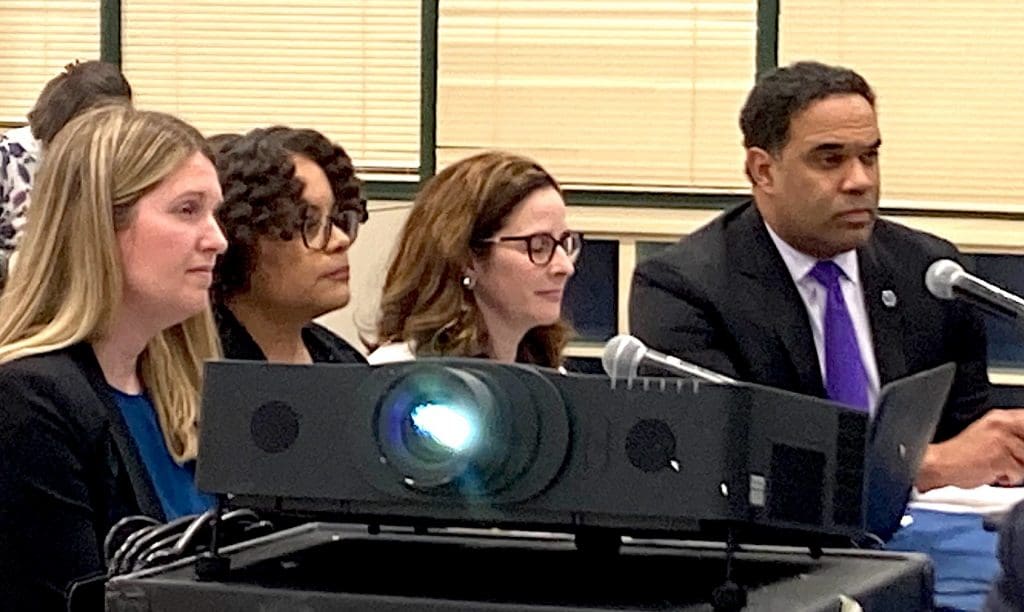
Staples High School Principal Stafford Thomas, part of a team of educators who presented the report findings to the school board, said the district’s records on discipline vary by school.
Faith Sweeney, a district literacy coach, said there are pockets throughout the district where work is being done on professional learning and restorative practices that could improve experiences, but there also needs to be a district-wide system.
Supt. of Schools Thomas Scarice said that Westport is not alone in examining its commitment to diversity, equity and inclusion. It is a focus for educators at the state and national levels as well.
He also called it natural for school districts to ask questions when subgroups of students perform differently.
Subgroups can be divided by race, gender, socio-economic status or disabilities. A significant portion of the report presented to Westport’s board focused on race.
“You can’t do the three R’s without a strong sense of belonging and affiliation,” Scarice said.
The intent, he added, is not to slice the pie up more, but get more pie.
He called the equity process a moral imperative.
Board members scrutinize findings
Board Vice Chairwoman Liz Heyer said one concern she has with the report is its general recommendations are not based on any identified root causes for inequities.
“I don’t know how you can develop actions without knowing what the causes of the problems are,” Heyer said. “That is a big pause for me.”
She also questioned the heavy focus on race in the report.
Board member Dorie Hordon questioned if the researchers’ biases influenced the study. She called the Metropolitan Center an activist organization.
Everyone wants to give every student the best opportunity to succeed, Hordon said. But, she added, there is a concern that equity outcomes based on race might lead to the conclusion that Asian students, for example, are over-represented in AP classes.
“If I am wrong, correct me,” she said.
Sweeney told Hordon the goal is to help all students thrive. “It is not about taking students away from what they are already achieving,” she said.
Board member Neil Phillips called the presentation excellent and said the report recommendations are not ideological in nature.
“I think you are on the right track,” he said.
“We need some kind of baseline,” added board member Christina Torres. The lack of details, she added, is not a reason not to move forward.
Board member Kevin Christie praised the report but said he wants to hear more from students.
Harrington, supportive of the study and its recommendations, said that parents also need to be part of a balanced discussion about biases that exist in the school district.
“Clearly biases exist,” Harrington said. “We shouldn’t be fearful of the discussion.”
He called the report pretty timid and vague.
“There are signs of too much political activism in this report and that scares some people,” Harrington said.
What baby steps can the district take to begin removing biases, he asked, and suggested the district identify five concrete things it can do to make progress.
Scarice said he was glad the report was not prescriptive, but rather leaves local school officials to craft their own action plan.
Public weighs in with diverse opinions
After listening to the school board debate the issue, a full audience in the Staples High School cafeteria got a chance to critique the report.
Two dozen town residents rose to speak.
Many urged the board to move forward, while others labeled the document and its statistics, “baloney.”
Parent Tarin Evans described how her 9-year-old Black son was treated differently than a white classmate when it came to discipline.
Evans’ son was punished after a playground incident, she said, but when her son was subsequently struck in class, she said the teacher told him he was being disruptive.
“Your kids are seeing this,” Evans said.
One classmate, she added, suggested to her son that he paint himself white to fit in better.
“I am telling you as a mom, something needs to be done.” Evans said. “I am tired.”
“We can and should do better than this,” argued Dave Kershner, a report critic who said the study had very little credibility in his eyes.
Camilo Riano, a parent, called the study racist. “The labels are the problem,” he said.
Darcy Hicks, who told the panel she works in educational research, called efforts to derail the study by obsessing on root causes and pie charts “fear driven.”
Hicks said she and her husband grew up in town and had a lot of catching up to do in terms of learning how diverse people played a role in the nation’s history.
“My kids had a much better experience learning the truth about history,” she said, urging the district to be braver in addressing equity issues.
Anne Alcyone told the board that disproportion is not the best metric for making judgments, and that rather than define students by groups, they should be judged as individuals.
Olga Roberts, parent of a first-grader and another poised to start kindergarten, said she supports the recommendations.
“I understand how not having a sense of belonging impacts performance,” Roberts said. “I believe we have to make sure every child has the same opportunity to succeed.”
Selectwoman Candace Savin, a former school board chairwoman who worked on the equity study team, said there is plenty of evidence that there are problems and challenges the school district needs to address.
“This is a good first step,” Savin said.
Michelle Mechanic, the mother of two students in the district, said the study indicates the bare minimum of what the district should be doing.
Nat Smitobol spoke about his experience as someone who grew up feeling completely marginalized in town. Now his son attends Sauguatuck Elementary School.
“I am back here because of the work you are doing,” Smitobol said, adding that he appreciates the equity study and the changes it could prompt.
Harold Bailey, chairman of TEAM Westport, the committee that advocates for multi-cultural issues in town, said he also supports the work being done. Rather than trying to identify root causes, he said the work should focus on treating what the effects are.











This work is so important – our white kids need to have their consciousness raised when it comes to inequities too. I want my grandchildren to notice those inequities and be a part of the change. Definitely add more testers and administrators who are people of color. Also I agree parents need to have their consciousness raised too – many of these racist attitudes begin at home
Yeah Julie, choose the testers and admin strictly based upon race, religion, sex, whatever. That will solve the problem….good luck w that.
How about a name, “T” , to identify the brilliance.
Soooo race over meritocracy? That’s now how it works. You’re hired and picked based on the qualifications and what you have completed to be the best in your field. That’s just ignorant.
The study is directly political, the charts and visuals are what drive the fears to become outcry. Therefore, it is very vague.
We are an inclusive town. Religion, gender, even ethnicity. Anyone can move here, and anyone here can move to such more diverse place if they feel the need to.
Simple as that.
Mr Bonaham, I would suggest it is not “as simple as that”. The lived experience of students and families indicate there is, in fact, work to be done to examine inequities, bias and systemic racism in our lovely town. I don’t think Westport has ever been a take it or leave it community, but rather one valuing inclusiveness, education, personal growth, artistic expression and thoughtful discourse. We should not fear the opportunity to be more inclusive or to examine barriers to education, unintended or otherwise. I applaud the work being done in this study and beyond.
“one classmate suggested to her son that he paint himself white to fit in better”. Really? Was there an immediate outcry? Was this reported to teacher/staff? Some might call BS on this one.
“Harold Bailey, chairman of TEAM Westport, the committee that advocates for multi-cultural issues in town, said he also supports the work being done. Rather than trying to identify root causes, he said the work should focus on treating what the effects are.”
— how can you treat anything if root causes are not identified?
The root cause is 400 years of slavery, and the deeply rooted and intractable systemic biases (in housing, employment, education, the legal system) that continue to this day. Most of the white population like me don’t see these biases or appreciate the effect they have on the black population. That doesn’t make us racist – we just don’t experience it.
This report may not be perfect but it at least puts forth concrete steps in addressing the effects of those systemic biases in our own educational community. We may not be able to fix the root causes, but we can mitigate the harm. I would encourage those who are against these efforts to think about it not as a zero sum game, but as a rising tide.
Did ya’ notice that, in the current USN&WR rating of public high schools, they rated 5 in CT and Staples came in FIFTH; out of all, Staples came in #315…..the trend is down, even though “Niche” rated staples # 1 in CT, the “Niche” vetting is far less vigorous than is USN&WR.
Does the rating include race diversity of students? Is USN&WR Vigorous?