
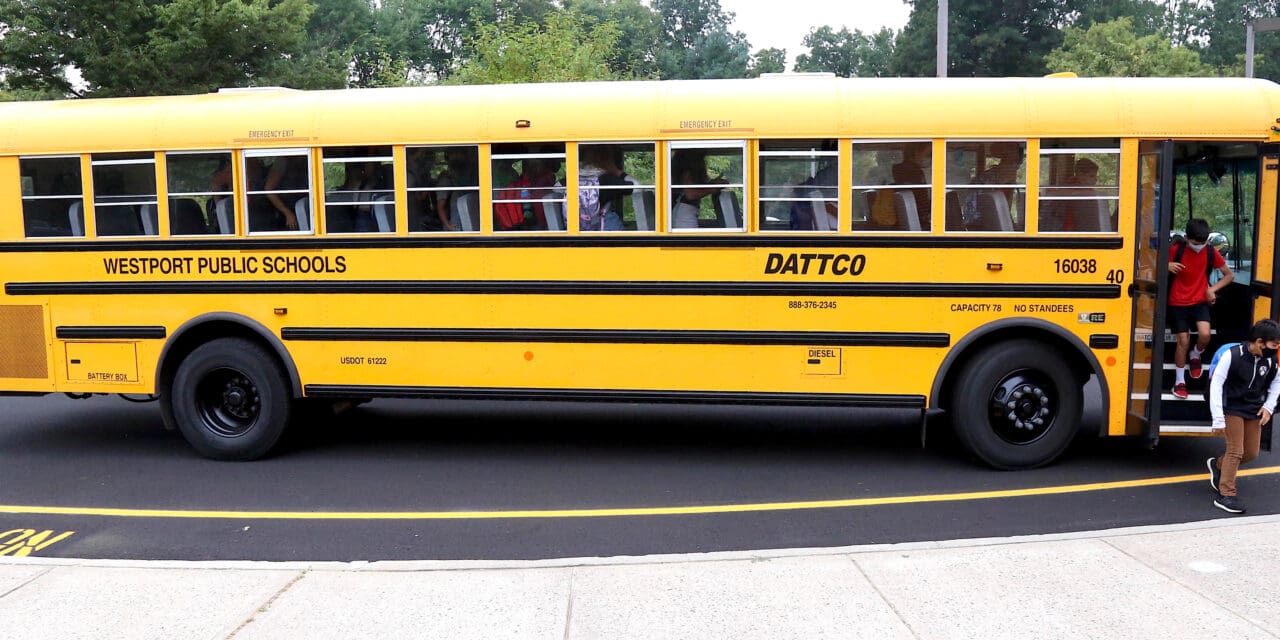
WESTPORT — Disruption of local school bus transportation, plagued by delays and abrupt schedule changes, continues to intensify into what now appears to be a widespread crisis.
Supt. of Schools Thomas Scarice, in a lengthy message emailed to the community Friday afternoon — said “the daily challenges in transportation have evolved” and cites a variety of factors that “conspired to significantly impact our ability to provide reliable transportation.”
These factors, which he said “impact the actual school day in a variety of ways,” include the loss of nine drivers by the school bus contractor, Dattco, since the start of the year in addition to a dispatcher and its operations supervisor.
‘Critical’ shortage of drivers a primary factor
The “critical shortage of drivers,” along with increased daytime volume of traffic on local roads, initially resulted in problems with student drop-off times, particularly for elementary students.
Gradually, Scarice said, the problem has “worsened into a lack of reliability and consistency for families at all levels.”
That not only means delays in pickups and drop-offs, but “last-minute condensing of routes leading to confusion, disruption and further delays,” the schools chief reported.
Scarice said Dattco “has assured the district” there are 13 people currently being trained for their required bus-driving license, who are “scheduled to join Westport this school year. Six of these candidates are only awaiting the comprehensive background check and clearance.”
But, he added, while the new drivers “will help mitigate the driver shortage … additional measures will need to be taken in the interim as the process of licensing can take an extended period of time.”
Meanwhile, without giving specifics, he said school officials are working with Dattco to improve retention of the local bus drivers.
Fewer bus routes, crowded buses, longer rides
To cope with continuing problems, the temporary consolidation of the existing 57 bus routes will be permanently reduced to 51 routes.
That means, the superintendent said, “there will be more students on individual buses and the routes will be longer” — an undesirable consequence, he admitted, “particularly given our successful mitigation efforts with COVID on our buses and in our classrooms.”
If the route consolidations fail to ease the problems, Scarice said other measures may have to be considered.
Other possibilities: Fewer stops, more time between tiers
These might include “cluster or community bus stops,” which would be created by combining several stops into one. Fewer stops serving the same number of students would help drivers complete their routes more efficiently, he said.
“Finally,” Scarice added, “creating more time between bus tiers might be necessary to accommodate the newly condensed bus routes. Currently, the district provides for 30 minutes between each of our three tiers.
“This is an extreme intervention,” he said, “and would only be considered if all other interventions fail to provide the necessary reliability and consistency in pick up and drop off times for families. These interventions will be considered after four weeks of the newly condensed routes being implemented.”
Scarice also advised “frustrated” parents to be patient when problems arise.
“Calling or emailing Dattco, or our transportation coordinator, Buffy Barry, is the appropriate action,” he said. “However, given the crisis, if you do not receive a reply, please understand that this is entirely related to these members of the transportation team performing their essential functions in resolving issues and working to ensure that each student is driven back and forth to school safely.”







Cluster bus stops are a wonderful idea in our neighborhoods instead of door to door service! It shouldn’t take a busing crisis to implement this. Many of us in town over the years have followed a bus and asked themselves why the bus stops so frequently from driveway to driveway. Just think of the positives-our kids will get fresh air, a little morning walk, meet their neighbors face to face and have actual conversations before getting on a bus. Bus routes will have less stops and therefore be more efficient. Sounds like a win/win!