
By Ken Valenti
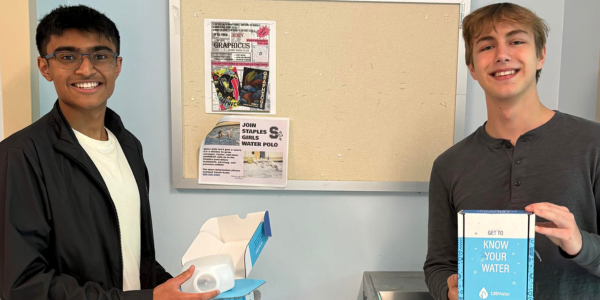
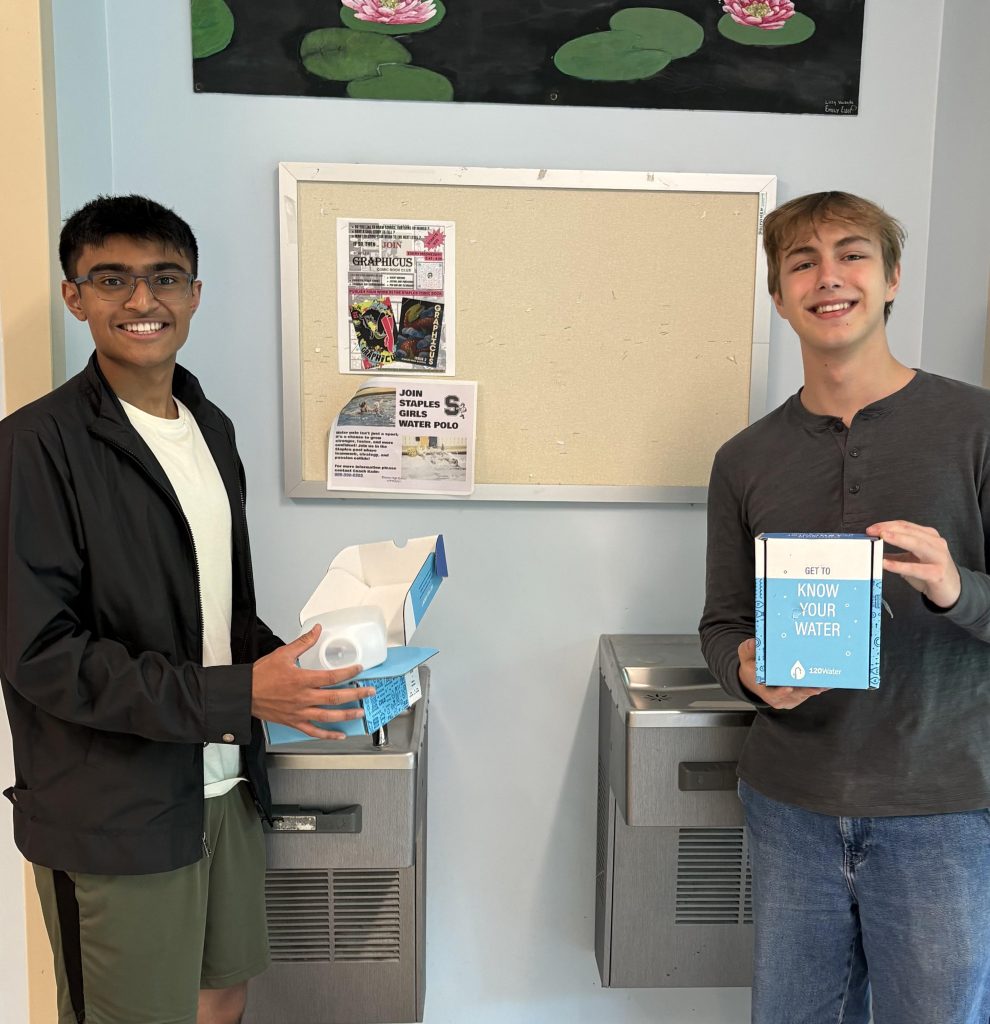
WESTPORT–At first, it wasn’t easy for Staples High School juniors Ignacy Nieweglowski and Sahil Vora to raise awareness about lead in the water. After creating a website to map the presence of the heavy metal in residents’ water, the two students put in the more old-fashioned effort of walking door to door.
They were handing out lead filters, trying to convince residents to test their water for lead.
“It was winter, and it was dark,” Nieweglowski said. “So a lot of people were very mistrusting of us and very scared of these two teenage boys coming up to their doors.’
Once people learned what the two teens were doing, however, “everybody was so accepting,” he said.
The effort paid off when the program had mapped about 200 instances of lead in residential water, and they have expanded their efforts to testing schools.
Recently, the Staples students’ Lead Watch program won the Presidential Environmental Youth Award. Perhaps even more significant, they have convinced residents to remove lead from the water in their homes with filters – and one homeowner to replace the pipes completely, they said.
The idea, Vora explained is that “we would give a resident a test kit, they’d put it on their sink, and then they’d just take a picture, send it into the website, and we could show residents a heat map of what lead contamination looks like in their area.”
Nieweglowski and Vora want people to continue expanding awareness of the health problems caused by lead, a powerful neurotoxin, in drinking water.
“Our biggest concern is it’s really, really damaging to the cognitive development of adolescents and children,” Nieweglowski said.
The two students had started in their freshman year by investigating PFAS, which are carcinogenic “forever chemicals.” But researchers at Harvard College and Yale University told them that there were teams of people working on that issue, Nieweglowski said.
So they switched to lead to make a bigger impact and they began the Health Tech Initiative Club at Staples.
“They are passionate about the project and would like to make an impact in the community and beyond,” said teacher Michele Morse, who serves as the faculty advisor for the Health Tech Initiative.
The issue is serious enough that the U.S. Environmental Protection Agency (EPA) last month announced $2.9 billion in funding – including $27.5 million for Connecticut – to replace lead waterlines.
“Every family in New England deserves safe, clean drinking water, and tackling lead exposure remains one of the most important public health challenges we face,” said EPA New England Administrator Mark Sanborn. “New England has some of the oldest infrastructure in the country, and this funding will help communities make critical infrastructure upgrades to reduce lead exposure and protect families for generations to come.”
But Nieweglowski and Vora found a lack of detailed information publicly available when they began their project. Beyond general data, Nieweglowski said, they found nothing that would show a family what is coming out of their tap.
“The whole idea is if people have access to the data, they’ll know there’s problem, they’ll reach out to their representatives, we can get some change going,” he said.
That approach shows promise in the eyes of Michael Ramos, co-founder and chief engineer of Noah System of Chicago, a company that offers an automatic water-flushing system to prevent lead buildup in pipes.
The company reached out to the students to offer help last year, with professional testing kits and helping them connect with students in other states attacking the same problem.
“We’re working on creating Health Tech Initiative Chapters across the country,” Nieglowski said.
Their efforts continue. The two students plan to begin fundraising for a matching Sustainable CT grant to run public awareness events and collect educational resources. They plan to continue battling the lead problem even after graduating Staples and going on to college.
“There’s no way we’re going to leave Health Tech behind,” Nieweglowski said. “We’ve put in so much work and it’s become such a big part of our lives.”

Ken Valenti
A career journalist and lifelong resident of the New York City region, Ken Valenti has enjoyed decades of reporting local, regional and national news in New York and Connecticut. Topics of special interest are development, the environment, Long Island Sound and transportation. When not reporting, he’s always on the lookout for the perfect coffee shop or used book sale.






Recent Comments