
By Linda Conner Lambeck
WESTPORT — An increasing number of Westport public school students are giving thumbs-up to the climate in the town’s schools, but many are still not feeling it when it comes to classes.
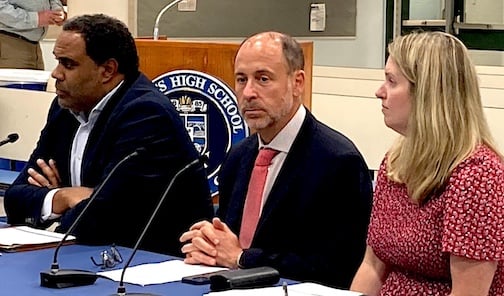
Results of the latest School Climate Survey, discussed by the Board of Education last week, are concerning to some members.
“That is not anything we would hope for for the district,” board member Jill Dillon said of student engagement numbers during a discussion that lasted nearly two hours.
Others wonder if the right questions are being asked.
“Maybe we are measuring the wrong things,” said board member Robert Harrington, suggesting he doesn’t really believe survey numbers that say only 24 precent of middle and high school students feel engaged during their classes. That is one point lower than the last time the survey was conducted.
“That is not anything we would hope for for the district.”
Jill Dillon, Board of Education member
At the elementary level, 55 percent of third- through fifth-graders say they enjoy classes.
Harrington called it a complicated situation, adding that all the effort being devoted to improving the situation isn’t moving the dial on engagement.
State law requires biennial climate surveys by local school districts. Westport conducts them in one form or another every year, using results to measure efforts to give students a better sense of belonging.
School administrators and staff spend time each summer developing plans to address concerns expressed on the survey.
The efforts, Assistant Supt. Michael Rizzo told the board, all feed into district efforts to improve student academic performance.
Last spring, the survey was completed by 3,241 students, 631 staff members and 906 families.
Broad areas covered include school climate, safety, student-teacher relationships and engagement.
Improvement — some modest, some more substantive — was shown in 18 of 22 categories, said Rizzo.
“Overall the trend is very positive,” Rizzo said.
There is more work to do, Assistant Supt. Anthony Buono added. The document discussed by the board included survey highlights, but not all of the questions asked.
School climate showed the largest growth.
On the 2024 survey, 60 percent of 6-12th graders described school climate as very or somewhat positive. That compares to 54 percent on the 2022 survey.
At the elementary level students rating school energy as positive rose to 83 percent in 2024.
“Overall the trend is very positive.”
Assistant Supt. of Schools Michael Rizzo
Asked if they feel they “belonged” at their school, 67 percent of 6-12th graders responded favorably compared to 61 percent in 2022. Two percent responded they did not feel they belonged at all in 2024 compared to 4 percent in 2022.
On safety, 73 percent of 6-12th graders and 79 percent of 3-5th graders say they feel safe at school.
At the elementary level, 59 percent said they were interested in their classes in 2024, up two points from 2022.
On the family survey, 70 percent of respondents said their children like going to school.
Asked what one or two things the school could do to improve the social climate for students, 28 parents responded, the board was told. They suggested issues like addressing racism, bullying behavior and sticking to consequences.
Bedford Middle School Principal Adam Rosen told the board that between the survey results and events of last year, when several parents reported their children were subject to bias acts at school, that decisive and collective measures have been taken to confront students’ biased language and acts that intrude into school culture.
The school’s climate plan includes a discussion in each Bedford student team about bias.
Students are encouraged to engage in similar conversations at home. The school, as is the district, is also working toward receive a “No Place For Hate” designation from the Anti-Defamation League.
So far this year, Rosen reports positive energy at the middle school.
Coleytown Middle School Principal Janna Sirowich said her school also has an anti-bias initiative. Both middle schools are working to strengthen student voices.
At Staples High School, Principal Stafford Thomas said student engagement is extremely high in student clubs — there are 123 of them — and a new student council. There also is a focus on the new Code of Conduct.
As for gauging student engagement in classes, Thomas deemed some of the survey questions as awkward. For instance, asked students how long they think about a class after they leave it, he said.
Perhaps questions more tailored to the school should be used, it was suggested.
Board Chair Lee Goldstein said the survey results should not be the sole measure of how students feel about school.
“We don’t look at [standardized test] reading scores and say that is how our children are doing,” Goldstein said.
She said the best use of the results — though responses are anonymous — is to focus on what the district is doing for students “not feeling it yet.”
“We don’t look at [standardized test] reading scores and say that is how our children are doing.”
Lee Goldstein, Board of Education chair
Dillon said full results of the survey should be released so parents can see them. She also wants to see how the Westport responses to the Panorama Education survey compare to the nation.
With “belonging” numbers pretty high, board Vice Chair Dorie Hordon said she hopes staff efforts shift to academics. But she is concerned that a large number of students are not excited to go to class.
Buono said the vast majority of district work is focused on academics.
“We do academics extremely well,” added Thomas.
At Staples, students do not aimlessly roam hallways, Thomas said. They are in class.
Rizzo acknowledged that some survey results lead to more questions than answers. He said he doubts the numbers will never reflect or capture the minute-to-minute work staff puts into building student relationships.
“It doesn’t add up to what you see going on in the buildings,” said Supt. of Schools Thomas Scarice.
Freelance writer Linda Conner Lambeck, a reporter for more than four decades at the Connecticut Post and other Hearst publications, is a member of the Education Writers Association.










Recent Comments