
By Linda Conner Lambeck
WESTPORT–A day-long budget session to explain why the school district is seeking a 5.48 percent operating budget increase is bound to bring up questions.
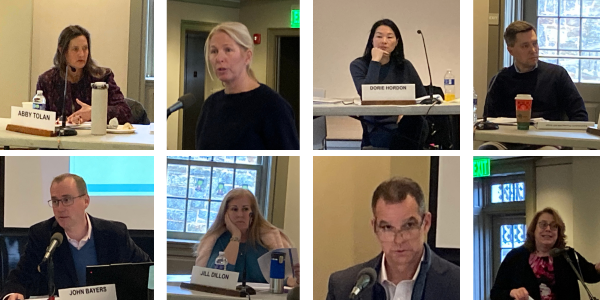
The school board, meeting Friday, Jan. 9 at the Saugatuck Congregational Church, had plenty.
Here are a few:
- Can the administration put a dollar amount on the laundry list of reductions considered–and rejected–during a leadership brainstorming session? That list included things like offering employees an early retirement incentive and becoming a special education provider for other school districts.
- Can those rejected ideas be ranked in order of impact on the district?
- What are the fiscal implications on the school district if other school districts start to drop out of the State Partnership Plan that is currently used for health insurance?
- How has the elimination of two school buses impacted the length of bus rides?
- Would there be a financial benefit to implementing cluster bus stops instead of door to door.
- How important is the district’s middle school team model and what are alternatives?
- How do district budget increases compare with similar school districts over the years?
- How many students pay tuition to the district?
- What is the appetite for charging more for student performances and athletic games?
- How long has it been since the district issued a request for quotes for special education attorney services?
- What training do special education paraprofessionals receive?
- Should the in-house vans being proposed to run in-house special education programs be purchased out of the district’s carryover account or should it be a capital expense?
- What impact will upcoming security recommendations–discussed only in private so far–be on the budget?
The board also wants a more robust discussion of School Superintendent Thomas Scarice’s pitch to have the district start picking up the tab for athletic team uniforms. The initial cost is $95,000, part of his proposed $8.2 million increase over the $150.3 million operating budget being spent in the 2025-26 fiscal year.
Scarice and his administrative team will start answering the questions when the board picks up the budget discussion at its next meeting at 7 p.m. on Thursday, Jan. 15 at
Staples High School, Cafeteria B. The board has until the end of January to put its stamp of approval on the proposal before sending it to town funding bodies.
Also new in Scarice’s 2026-27 operating budget proposal of nearly $158.9 million is the equivalent of one additional staff member.
The plan adds an additional special education teacher at Bedford Middle School, a long-sought assistant facilities director and two board certified behavior analysts to handle the growing behavioral challenges of some students.
Offsetting those new positions is a reduction of three classroom teachers made possible by how elementary class sizes are expected to land in the fall. There will also be an administrative restructuring, whereby a 12-month health services supervisor becomes a 10-month position. The change would save $82,000 in salary and benefits that would be applied to a new Assistant Director of Facilities and Security position costing $170k with benefits.
What else is in the budget? Scarice’s cabinet spent six hours on Friday explaining various components before the session ended after 3 p.m.
Staffing
Last year the district’s five elementary school principals were at the budget workshop to make the case for two additional elementary school assistant principals. It was a request that the board rejected.
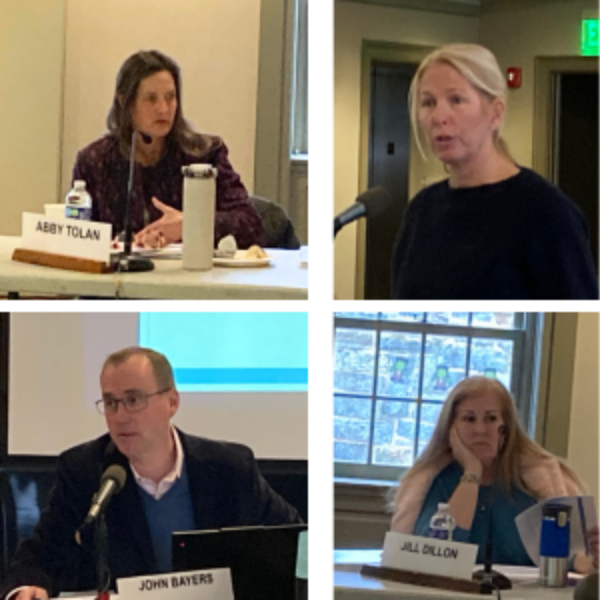
This year, Assistant Superintendent John Bayers explained why an anticipated 71 additional students, including 16 at the elementary level, would require three fewer classroom teachers.
Enrollment is projected to be at 5,251 next fall. The plan is for the full-time equivalent of 390.33 regular and special education teachers. In addition, there are administrators, coordinators, paraeducators, custodians, administrative assistants, secretaries, school psychologists, counselors, social workers, speech pathologists, nurses, security, technology and facilities staff, bus monitors, and central office administrators. Combined, their salaries and benefits account for 80 percent of the budget. All are getting raises. Only one bargaining unit, for 36 administrative assistants, has a contract up for negotiation in 2026-27.
Teaching and Learning
Assistant Superintendent Anna Mahon called the budget she oversees the lifeblood of the school system.
At about $1.4 million this year, the Teaching and Learning budget pays for all of the district’s professional development, curriculum writing, instructional improvements, textbooks and supplies. Her request for next year is for $1.52 million. There is some grant money beyond that.
Some $82,450 of the proposal would be spent on the district’s strategic plan. Textbook purchases–both online and physical–account for $454,229 of the teaching and learning request. Even so, it is $83,000 less than was originally requested by staff.
Hanover Research, which is on call to conduct climate studies and various surveys for the district, would get $108,184.
Board Vice Chair Dorie Hordon asked what the cost would be if there were fewer surveys.
Special Education
Some 14.6 percent of the district’s student population _ 770 students _ is identified as having special needs. It is a percentage that has been relatively flat for five years and three percentage points less than the state average.
More than half of those students are classified as having a learning disability or an Attention Deficit Disorder.
More than three quarters of those identified with special needs spent 80 percent or more of their school day in general education classrooms.
Some 32 students are currently in out of district placements costing $3.87 million in tuition costs. The request for next year is for $4.05 million.
Assistant Superintendent Michael Rizzo said out-of-district tuitions have skyrocketed from an average of $51,412 in 2020 to $130,926 projected for next year.
The request in his department for two on-staff board certified behavior analysts would support elementary students with complex behavioral needs and supplement a program the district already has in place with an outside firm called Effective School Solutions. Rizzo is also proposing transportation efficiencies by providing in-house transportation for the district’s Connections Program. The program sends high school aged students with disabilities into the community to gain life skills. Outsourcing that transportation costs $207,600. With board-purchased vehicles from a carry over account, the district estimates it would cost $41,719 to fuel and maintain the vehicles and hire drivers.
Michelle Vitulich, a parent who sat through the day’s proceedings, asked questions about differences she has noticed between out-of-district costs listed by the district and reported to the state.
She also asked about the impact of legal settlements tied to special education and wondered how many students who transfer from the school district to private schools have Individual Education Plans, signaling they have a disability.

Technology
The big takeaway from the district technology budget proposed by Natalie Carrignan, Director of Technology, is that of a $3.37 million request, more than $1.1 million is to replace teacher laptops previously covered under the now-defunct federal CARES Act grant, as well as planned improvements to the Bedford Middle School auditorium.
Her budget also covers hardware, technology training, software replacements, and next year will have to buy some cameras to make up for now-banned student cell phones that were formerly used to take pictures in science and art classes.
Hordon asked if the need for chrome book replacement could be cut down if the technology was eliminated in younger grades.
“Do we or do we not want K-3 online,” Hordon asked.
Later this school year, the district will conduct a technology audit to see how much students district-wide are online for academic purposes.
Transportation
Next year’s transportation budget is projected at $7.2 million, a 4.8 percent increase over this year.
The district uses 54 buses, two fewer than the year before. No more can be cut without changing school start times, Scarice told the board.







Recent Comments