
By Linda Conner Lambeck
WESTPORT — While controversy continues in political circles over last year’s “Banned Books” display at Staples High School’s library, a new one has taken its place.
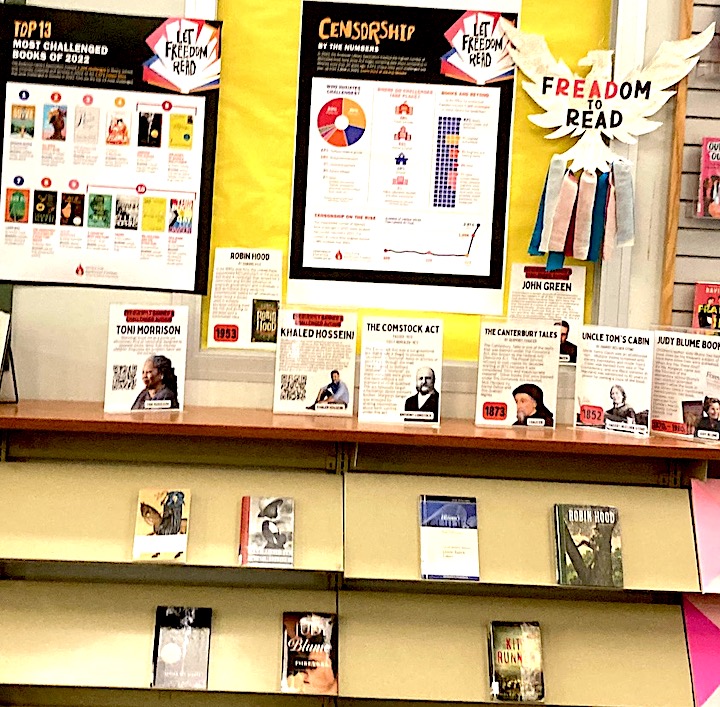
The 2023 Banned Books Week display includes many of the titles challenged in the last school year, but mostly on posters, not on the shelves that greet those who enter the library.
“Staples has had a tradition since 2005 of participating in the [American Library Association] Banned Book Week with a display in our library,” Jennifer Cirino and Nicole Moeller, co-librarians of the Staples library, explained in an email. “Each year, the display design is refreshed.”
This year, Banned Books Week was observed Oct. 1-7.
In consultation with Supt. of Schools Thomas Scarice and the district’s administrative team, Cirino and Moeller said they decided collectively to continue the tradition, but were mindful the display could be seen as a provocative act.
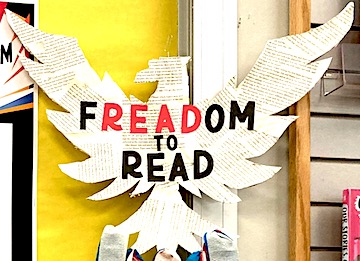
As such, the theme this year was “FREADOM to Read,” and the focus was educating students on how far back the historical debate about the freedom to read extends and what laws have been enacted to protect that freedom.
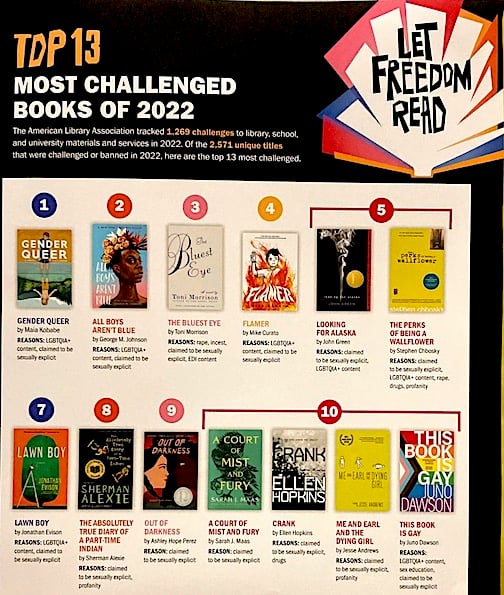
Along with images of “Gender Queer” by Maia Kobabe, “Flamer” by Mike Curato and “This Book is Gay” by Juno Dawson — all LGBTQ-themed books from last year’s display that were formally challenged — this year’s display includes hard copies of the “Canterbury Tales” by Chaucer, “Uncle Tom’s Cabin” by Harriet Beecher Stowe and several Judy Blume books, along with others. All have been included on the ALA’s list of challenged books at one time or another.
“‘Canterbury Tales’ was my favorite book in college, Scarice said, surveying the display last week before a school board meeting. He said he loved the book so much he named one of his dogs Chaucer.
In 1873, however, the 14th Century story of honor and honesty ran afoul of the Comstock Act, also known as the Federal Anti-Obscenity Act, and the U.S. Postal Service refused to mail copies of it because it was considered vulgar and inappropriate material.
Other books in the display include Toni Morrison’s “The Bluest Eyes,” challenged by some because of its depiction of child sexual abuse, and John Green’s “Looking for Alaska,” a coming-of-age-story that references drug use and sex.
There also are highlighted quotes from some of the authors, including Green, who is quoted as saying the idea that teens need to be protected from some material is condescending.
“Kids do not read ‘Animal Farm’ and think, ‘We really need to get rid of all these pigs, they’re revolutionaries.’ they think, ‘Ah, this is a metaphor.’ ”
The poster that lists the 10 most-challenged books nationwide for 2022 is actually 13 titles long. There was a two-way tie for fifth place and a four-way tie for 10th place.
There was an unparalleled number of book challenges reported in 2022, according to the ALA’s Office for Intellectual Freedom. A record 2,571 unique titles were reported to be challenged in 2022, a 38 percent increase from the 1,858 challenged the year before.
The vast majority were about the LGBTQ community or by and about people of color.
While books like “Flamer” and “Gender Queer” didn’t make it to the display shelf this year at the Staples library, they remain part of the high school library’s collection and are available for check out, Scarice said.
“This year [the librarian staff] did a little bit of a different angle and added historical aspect,” Scarice said.
The superintendent said no one from the public, other than the Westport Journal, had asked to see the new display.
Last year’s Staples Banned Book Week display prompted a formal challenge lodged against three of the books after several people complained at school board meetings. One parent, Tara McLaughlin (Tesoriero), followed board policy and filed the formal challenge, referred to a separate committee that unanimously rejected her objections in April.
Three of the Board of Education’s seven seats are being contested in the Nov. 7 election. On the Democratic slate are incumbent Democrats Lee Goldstein and Neil Phillips. The Republican Party has nominated Jamie Fitzgerald and Camilo Riano.
In a recent campaign email, Goldstein and Phillips asked: “Who decides what books our children can access?” The books challenged at Staples “are in every high school library in our area, and have won multiple awards,” the Democrats noted in their statement.
Riano and Fitzgerald responded by challenging the Democrats to circulate images from the books, which the Republicans consider offensive, to recipients of their initial campaign emailer.
On Friday, Riano said he had not yet seen the new Staples library display for Banned Books Week.
Freelance writer Linda Conner Lambeck, a reporter for more than four decades at the Connecticut Post and other Hearst publications, is a member of the Education Writers Association.







Promoting freedom is good, i give it a thumbs up. Books, speach, religion, race, beliefs, thoughts….political views… freedom to make money, all of these freedoms make America wonderful… as long as there is equal opportunity… not equal outomes, that is communism, opportunity is why America is wonderful
A leader is one who leads, not follows. The fact that there was a RECORD number of book challenges in school libraries across America in 2022 by Moms for Liberty, and Camilo spews the same exact rhetoric as these anti- Lgbtq bigots, is all I need to know as a voter.
Equal outcomes are not part of DEI. Camilo spews rhetoric that we are Marxist commies. Who said that in our dark history? Who else has he parroted?
I would like to see some books concerning the tragic outcomes that some gender transitioned people have experienced. Maybe some of the permanent health issues that can follow these extreme surgeries can be shown in picture form. I’m sure with a little effort the school system can find books that offer balanced views on controversial issues. Having said that, it would be refreshing if the schools would get back to teaching traditional subjects that will set them up for future success in higher education and the work force.