
By Kerri Williams
Editor’s note: This is an occasional series of columns by Journal reporter Kerri Williams, exploring her journey with backyard gardening, offering tips for success, and highlighting some of the horticultural beauty found right here in Westport.
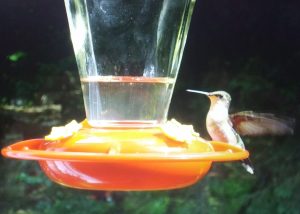
A female Ruby-throated Hummingbird at my brother’s feeder.
Photo by Kevin French
I was looking out my kitchen picture window one early May day last year when I had a visitor. The tiny creature hovering right in front of my face was impossible to miss.I recognized it immediately as the male Ruby-throated Hummingbird back for another season. And his message to me was clear: Time to set up my feeder!
It’s something I’ve enjoyed doing for years — filling a small, plastic feeder with homemade sugar water to attract the little birds to my yard and garden. Watching them flit here and there, courting and occasionally fighting over who gets the first drink, has become one of my favorite parts of summer in the Northeast.
It’s no wonder I enjoy hummingbirds because both my mother and mother-in-law, and even my brother, have fed them most of their lives. Just like me, they appreciate the little birds with larger-than-life personalities that look like something out of a fairy story.
Treat our little flying friends with respect
But hummingbirds have something even better to offer us. Like butterflies, native bees, and bats, they are pollinators that enable plants to reproduce. Groups across Connecticut, such as The Pollinator Pathway and Protect Our Pollinators (POP), are trying to raise awareness about these creatures and how to protect them on your property.
The message is clear, according to my friend Holly Kocet, one of the founders of POP. Don’t use pesticides and put in native flowers and plants. Hummingbirds, as well as many beneficial insects, rely on those native plants for food or nesting sites.
POP has a list of plants that attract hummingbirds on its website. Some of my favorites are the Black-eyed Susan, Coneflower, Coral Bells, and Foxglove. I had Coneflower in abundance in my Newtown garden, where I would spot butterflies and hummingbirds continually.
Another flower in early spring that hummingbirds enjoy is called Ajuga and comes up naturally in many lawns in town. Susan Joy Miller sent me a picture of the purple blooms filling her yard on Newtown Turnpike last May.
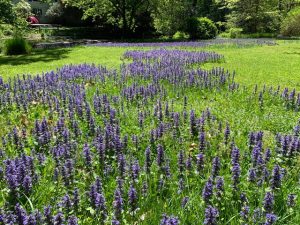
Ajuga, which attracts hummingbirds, blooming last spring in the yard of Susan Joy Miller. She lives on Newtown Turnpike and participates in “No Mow May.”
Susan takes part in “No Mow May,” a nationwide initiative that encourages people to leave their lawn, or a portion of it, unmown during May. Letting your yard grow even a little longer in spring, when flowers are hard to find, allows plants to bloom like the Ajuga for native bees and hummingbirds.
Miller has noted many pollinators in her yard, including hummingbirds, but she has not had luck with them coming to the feeders that she occasionally puts out for them.
Sweet recipe for hummingbird heaven
Another gardener in town attracts the tiny birds with both feeders and flowers. Andrea Turner, the Horticulture Chair of the Westport Garden Club, uses the recipe from the Audubon Society, which is one part sugar to four parts water. She boils the water before adding the sugar and then cools the mixture before filling her feeders. There is no need to add red dye to the water, which can be harmful to the birds.
Refilling the feeders each week and keeping them clean is critical for the hummingbirds. Sometimes the feeders can attract unwanted visitors, such as ants or even other birds.
Andrea said sometimes the Downy and Hairy Woodpeckers will find her feeders, drinking all the sugar water. If that becomes a problem, she removes the feeders for a bit and lets the hummingbirds feed on the flowers she provides for them, which include Honeysuckle, Phlox and Lobelia.
While some of us have fed hummingbirds for years, it’s never too late to start your own tradition.
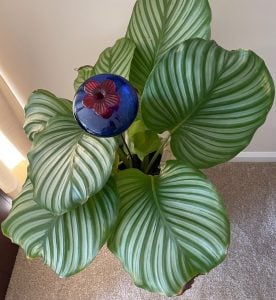
Maybette Waldron, of the Greens Farms Garden Club, has a hummingbird feeder ready to go outside this spring.
Maybette Waldron, president of the Greens Farms Garden Club, has a new feeder waiting to go in her yard this year. Feeders can be fancy, glass ones or the simple, plastic variety. Most incorporate the color red, which helps attract the birds.
Waldron was inspired to put up her feeder by friends in Vermont who enjoy the birds.
“I am fascinated by (hummingbirds),” she said. “I hope to see one or two, or more.”
Waldron was inspired to put up her feeder by friends in Vermont who enjoy the birds. “I am fascinated by (hummingbirds),” she said. “I hope to see one or two, or more.”
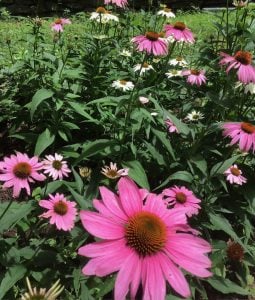
Some coneflower in Kerri’s Connecticut garden. The flower attracts hummingbirds and other pollinators.
For more information on hummingbirds and other pollinators, Gilbertie’s Garden Center, at 7 Sylvan Lane, is holding a program called “Your Yard, Their Habitat: Creating a Pollinator Paradise” at 11 a.m. on May 3. The talk is part of a three-month initiative by Sustainable Westport highlighting ways homeowners can fight against climate change in their own backyards.
Kerri Williams is a freelance writer who has worked in journalism for years, including as a reporter for the Norwalk Hour and managing editor of the Norwalk Citizen-News. If you have pictures or ideas to share, please send her an email at cultivatingwithkerri@gmail.com.




Thanks for the reminder… Hummingbirds are great for all the reasons pointed out here. They are fabulous aerial acrobats… BUT no need to wait. According to the Hummingbord Migration Map https://www.hummingbirdcentral.com/hummingbird-migration-spring-2025-map.htm
They are already here.