
The following is an opinion submitted by Richard D. Rogovin. Mr. Rogovin is an attorney based in Ohio and Chairman of US Bridge. His daughter and her family live on Darbrook Road.
WILLIAM F. CRIBARI MEMORIAL BRIDGE
Title, Ownership & Jurisdictional Analysis
Executive Summary
This document examines all available evidence bearing on the question of whether the State of Connecticut holds clear fee simple title to the William F. Cribari Memorial Bridge (State Bridge No. 01349) over the Saugatuck River in Westport. The analysis draws on newspaper archives, the legislative history of the Connecticut State Highway System, the statutory framework of Title 13a of the Connecticut General Statutes, the public trust doctrine as applied to navigable waters, and the detailed political and procedural record of the bridge’s 1986–1991 ownership dispute.
The central finding is this: the State’s claim to the bridge rests on jurisdictional highway control — the 1963 Route Reclassification Act and its incorporation of Bridge Street into Route 136 — rather than on any recorded deed conveying fee simple title from the Town of Westport to the State of Connecticut. No such deed has been identified in any publicly accessible archive. The bridge was built by and for the Town in 1884, and the Town has never executed a formal conveyance to the State.
This matters strategically because (a) highway jurisdiction and fee simple ownership are legally distinct, (b) the RTM-rejected 1987 ownership transfer was never consummated, leaving the State’s claim legally incomplete, (c) the riverbed and pier substructure may be subject to independent public trust and riparian rights questions, and (d) the State itself has repeatedly acknowledged the need to formally ‘transfer’ the bridge — language that presupposes the transfer has not yet occurred.
Thread 1: Chronological Ownership History
1807–1884: Municipal Origins
The site has hosted public bridge crossings since around 1807, when the first bridge replaced an 1746 ferry as part of the old Connecticut Turnpike. That turnpike was subsequently discontinued and its roads reverted to municipal or private jurisdiction. When the wooden 1869 bridge deteriorated, it was the Town of Westport — not the State — that contracted for and paid for a replacement.
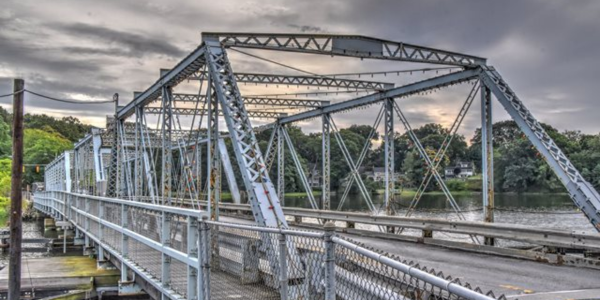
In the summer of 1884, the Town of Westport contracted with the Union Bridge Company of Buffalo, New York (then operating as Central Bridge Works) to construct the current wrought iron swing bridge. The total cost was $26,700 plus $362 to demolish the old wooden bridge. The original 1884 design drawings were presented to the Town by the builder’s secretary, and the Town has retained them ever since — currently held by the Westport Historical Society.
Key point: The 1884 bridge was a municipal asset, built on a municipal contract, paid for with town funds. The original drawing is in the Town’s possession. There is no record of any contemporaneous deed, conveyance, or legislative act transferring ownership to the State.
1884–1932: Municipal Operation
For nearly five decades the bridge operated as a town-owned structure. Historical records show it accommodated trolley service, with catenary infrastructure bolted to the overhead members — presumably authorized by the Town. The State’s involvement during this period appears to have been limited to occasional interest in the route.
1932: Route 136 Established
Route 136 was established during the 1932 statewide highway renumbering as a renumbering of old Highway 335, a coastal road serving beach communities from Darien to Southport. At this point the route primarily ran along the coast, not through Saugatuck. The Saugatuck bridge appears to have been incorporated into the route numbering system during this period, but a route number designation is not equivalent to a transfer of property title.
1961–1963: The Route Reclassification Act — The Critical Moment
This is the most legally significant moment in the ownership history. In 1961, the Connecticut General Assembly passed Public Act 603, ordering a functional reclassification of all public roads in Connecticut. The State hired engineering consultants Edwards and Kelcey to produce recommendations, resulting in the January 13, 1961 official state highway map.
In 1963, pursuant to this reclassification, Route 136 was relocated to its current alignment — including the Saugatuck Bridge section — as a formally designated Connecticut State Highway. Simultaneously, the coastal portion of old Route 136 in Westport and Fairfield was returned to local control.
Critical legal question: Did the 1963 Route Reclassification Act transfer fee simple title to the bridge and underlying land from the Town to the State, or did it merely change which governmental entity exercised highway jurisdiction over the road? Under Connecticut law, a ‘state highway’ designation is defined as ‘a highway, bridge or appurtenance to a highway or bridge designated as part of the state highway system’ — a jurisdictional designation, not a deed.
Connecticut General Statutes Section 13a-99a — enacted in 1967, four years after the reclassification — provides illuminating guidance. It states that when a town road lies within a state highway right-of-way, that road ‘shall be state highway property subject to an easement to the town for travel.’ This language suggests the legislature understood that state highway designation creates a right-of-way interest, not necessarily outright ownership. Notably, this statute was enacted after the reclassification, potentially to clarify exactly this ambiguity.
1967–1985: State Highway Control, Repeated Replacement Proposals
From the mid-1960s onward, the State Highway Department (predecessor to CTDOT) treated the bridge as falling under its jurisdiction. In 1967, the Bridgeport Post reported that First Selectman Kemish had asked the State Highway Department to replace the bridge. This request implies the Town understood the State to have authority over the structure — but requests are not deeds.
The State proposed replacement in 1967 (high-level fixed bridge), again in the early 1970s with four-lane concepts, and again in 1975 with scaled-down plans. In each case, local opposition defeated the proposals. Critically, in none of these episodes did the State produce or rely upon any recorded deed as the basis for its authority. The authority appears to have rested entirely on the Route 136 designation.
1986–1991: The Ownership Transfer Crisis — The Most Important Episode
In 1986, the State DOT proposed for the fifth time to replace the bridge. The Town again opposed replacement and demanded restoration. DOT’s response was legally revealing: it claimed that a state statute prohibited it from repairing the bridge because the repaired bridge would not meet current federal or state design standards. As a result, DOT stated it would only agree to repair the bridge if the Town first agreed to assume ownership.
This demand — that the Town ‘assume’ ownership as a precondition for repairs — is a striking admission. It implies that title resided with the State, but that the State wanted to divest itself of that title before expending repair funds. However, the mechanism by which the State originally acquired title was never articulated.
The ensuing dispute is procedurally complex and strategically important:
- First Selectwoman Martha Hauhuth opposed replacement and took the position that the bridge should be restored by the State.
- The RTM’s Bridge Committee concluded it needed RTM approval to authorize any ownership transfer. The Town Attorney disagreed; the Committee hired its own attorney who agreed with the Committee.
- The Bridge Committee issued a report critical of the proposed transfer terms, citing engineering concerns. The RTM voted 18 to 11 against approving the ownership transfer.
- First Selectwoman Hauhuth stated she would not sign the transfer agreement until DOT addressed all engineering concerns.
- She also lobbied Governor O’Neill directly and — crucially — quietly arranged for the bridge to be added to the National Register of Historic Places in 1987.
- On November 11, 1987, a newly appointed DOT Commissioner reversed the agency’s position entirely, announcing that it was possible to restore the bridge without violating state or federal standards.
- A new governor (Lowell Weicker) appointed a new DOT Commissioner who lived in Weston. He reportedly changed the characterization from ‘rehabilitation’ to ‘repair,’ which freed the project from federal design standards compliance.
- The bridge was removed from service in the late 1980s, transported to the Sherwood Island Connector area for rehabilitation, and a temporary fixed span was built on State land north of the original bridge.
- The rehabilitation was completed circa 1991-1993. The State paid for the work.
The definitive legal ambiguity: The RTM voted down the proposed ownership transfer in 1986-87. The State then performed the restoration anyway — apparently without the ownership transfer being consummated. The 1991 restoration agreement, whatever form it took, is not publicly available. Its terms may define the current legal status of the bridge more precisely than anything else.
1993–2015: Post-Restoration Status Quo
For approximately twenty years after the restoration, the bridge remained in service under CTDOT management. The State continued to treat it as a state asset — maintaining it, posting weight limits, and operating the swing mechanism. There was no formal ownership resolution during this period.
2015–Present: Renewed Controversy and Repeated Transfer Proposals
In May 2015, CTDOT notified Westport of its interest in repairs, characterizing the bridge as ‘functionally obsolete.’ This triggered the current cycle of controversy. Key ownership-relevant statements since 2015:
- 2015: First Selectman Marpe’s statement referred to ‘the State-owned bridge’ — but this was a political characterization, not a legal finding.
- 2017: DOT proposed to repair the bridge and then transfer ownership to the Town, with Route 136 rerouted so Bridge Street would no longer be a state road. The RTM and town did not accept this proposal.
- 2021: DOT Deputy Commissioner Rolfe stated that ‘one potential solution is for the DOT to restore the existing bridge to a state of good repair and then transfer ownership of the bridge and a segment of Route 136 to the Town of Westport.’ The word ‘transfer’ — used repeatedly by the State — presupposes that a formal conveyance has not yet occurred.
- 2025: CTDOT announced its preferred plan to replace the bridge with a new structure at $78-$80 million.
- 2026: CTDOT is soliciting Letters of Interest from parties wishing to obtain ownership of the bridge superstructure if it is replaced, with a deadline of April 17, 2026.
Thread 2: Statutory and Legal Framework
The Definition of ‘State Highway’ Under Connecticut Law
Connecticut General Statutes Section 13a-1 defines ‘state highway’ as: ‘a highway, bridge or appurtenance to a highway or bridge designated as part of the state highway system within the provisions of chapter 237, or a highway, bridge or appurtenance to a highway or bridge specifically included in the state highway system by general statute.’
This definition is jurisdictional, not proprietary. It describes a classification of infrastructure, not a property interest. A bridge can be ‘designated’ as a state highway asset without the State holding fee simple title to the underlying real property.
The distinction between highway jurisdiction and fee simple ownership is fundamental to Connecticut property law. The State can exercise regulatory, maintenance, and operational control over a road or bridge through highway designation without owning the underlying land in fee simple. Historically, many Connecticut highways cross private lands under easement or right-of-way, not outright ownership.
The 1961 Route Reclassification Act (P.A. 603)
The Reclassification Act directed a comprehensive reorganization of Connecticut’s highway system, transferring approximately 300 miles of state routes to towns and incorporating approximately 400 miles of town roads into the state system. The Act itself — and its implementing legislation — focused on defining maintenance responsibility and funding allocation, not on transferring property title.
Notably, under the Act’s framework, transfers from state to local jurisdiction required the State to put the road ‘in reasonably good condition’ before transfer and to negotiate with selectmen about conditions. This process was designed for highway management, not real estate conveyancing. No recording requirements equivalent to a deed were specified.
CGS Section 13a-44: Transfer of State Highway to Town
This statute provides the formal mechanism for transferring state roads to town jurisdiction. It requires the Commissioner to put the road in good condition before transfer and to negotiate with town selectmen. Significantly, it deals with maintenance jurisdiction and right-of-way, not fee simple conveyance.
CGS Section 13a-73: Acquisition of Real Property by the State
When the State actually acquires property in fee simple for highway purposes, it does so through purchase or condemnation under Section 13a-73. This process requires a formal assessment of damages and benefits, filing of a certificate with the Superior Court clerk, and compensation to the former owner. There is no record that any such proceeding was initiated with respect to the Cribari Bridge or the underlying land.
The absence of any such condemnation record is significant. If the State had formally taken the bridge site in fee simple, there would be a recorded certificate in the Superior Court and a compensation payment to the Town. No such record has been identified.
CGS Section 13a-80h: Bridge Project Agreements
This statute, which governs agreements between municipalities and CTDOT regarding acquisition of real property for bridge projects, further illustrates that bridge ownership and highway jurisdiction are treated as distinct matters requiring explicit agreement — not automatically transferred by highway designation.
CGS Section 13a-99a: Town Roads Within State Rights-of-Way
Enacted in 1967, this statute deals with the relationship between town roads and state highway rights-of-way. Its language is revealing: it states that a town road within a state right-of-way ‘shall be state highway property subject to an easement to the town for travel’ — but only when the town road is ‘no longer maintained or used by such town.’ This implies that mere inclusion in the state highway system does not automatically extinguish the town’s underlying property interest.
CGS Section 13a-86a: Design Standards for Bridges
This statute, cited by CTDOT in the 1986 dispute as the basis for its claimed inability to repair the bridge without the town assuming ownership, was later reinterpreted by the newly appointed DOT Commissioner as not applying when the project was characterized as ‘repair’ rather than ‘rehabilitation.’ This flexible statutory interpretation suggests that the State’s claimed legal constraints in 1986 were at least partly policy positions rather than immutable legal requirements.
Thread 3: The Riverbed, Piers, and the Public Trust Doctrine
The Saugatuck River as a Navigable Tidal Waterway
Connecticut case law has confirmed that the Saugatuck River is a navigable waterway where the tide ebbs and flows (State v. Brennan, 3 Conn. Cir. 413 (1965)). This classification has significant property law implications.
Public Trust Doctrine in Connecticut
Under Connecticut’s well-established public trust doctrine, the State holds title to all submerged lands and waters waterward of the mean high water line in tidal, coastal, or navigable waters, in trust for the public. This principle has been confirmed by a line of Connecticut Supreme Court cases dating back to the earliest days of the republic.
The practical consequence is that the State of Connecticut, through DEEP (the Department of Energy and Environmental Protection), holds sovereign title to the bed of the Saugatuck River under the bridge. This is entirely separate from the question of who owns the bridge structure or the highway right-of-way above it.
Implications for the Bridge Piers
The Cribari Bridge’s piers and abutments rest on — or are embedded in — the riverbed of the navigable Saugatuck River. The original masonry piers, constructed in 1884 using stone from Stony Creek, Connecticut, rest on the subaqueous lands that the State holds in trust for the public under the public trust doctrine.
The 1953 modification of the pivot pier — which involved adding steel H-piles, steel beams, and a concrete shell — constituted a construction activity in the public trust waters. Such construction would normally require permits from the State’s regulatory authority (now DEEP). Whether such permits were obtained, and in whose name, may shed light on who the State considered to be the owner of the pier structure at the time.
The 1991 restoration involved the addition of ‘a 1991 concrete pier at the center of the [fixed] span.’ This new pier construction in navigable waters would have required Army Corps of Engineers and State permits. The permit records, which are public documents, would identify the applicant — presumably CTDOT — and would constitute evidence of the State’s claimed ownership.
Research opportunity: Section 404 permits (Army Corps) and DEEP Structures, Dredging and Fill (SDF) permits for pier construction in the Saugatuck River would be public records identifying the permit applicant and thus the party claiming ownership authority at the time of construction. Permit records from the 1953 pier modification, the 1991 restoration, and any subsequent work should be obtained via FOIA.
The Bridge Structure vs. the Riverbed: Two Distinct Properties
Even if the State holds some interest in the bridge structure (through highway designation), the underlying riverbed belongs to the State through sovereign title under the public trust doctrine — but in a different capacity, as trustee for the public, not as the DOT or the Highway Commissioner. This creates an unusual situation: CTDOT’s claimed authority to demolish or replace the bridge would affect both the bridge structure (over which its jurisdiction may be administrative rather than proprietary) and the riverbed (which it holds in a sovereign/public trust capacity, not a proprietary one).
Any replacement bridge project would require DEEP permits for in-water construction, Army Corps permits, and potentially consultation under the public trust doctrine. These requirements exist independently of the title question and provide additional leverage for the Town and preservation advocates.
Thread 4: The 1991 Restoration Agreement — The Missing Document
What We Know
Following the RTM’s 18-11 vote against the proposed ownership transfer in 1986-87, and following the new DOT Commissioner’s November 1987 reversal of the agency’s position, some form of agreement was reached between the Town and the State to allow the restoration to proceed. The key facts:
- The State funded and performed the restoration (estimated cost in the millions).
- A temporary fixed span was built on State-owned land north of the bridge.
- The bridge was removed to the Sherwood Island Connector area for rehabilitation.
- The restoration was completed circa 1991-1993.
- The ‘rehabilitation’ was recharacterized as ‘repair’ to avoid federal design standard requirements.
- Structural engineer Jim DeStefano described the result: ‘DOT carefully hid a modern support deck beneath a historic span.’ The original trusses were retained as non-load-bearing decorative elements.
- DeStefano referred to ‘the agreement we made with DOT back in the day’ — indicating some form of documented understanding was reached.
What We Don’t Know
The specific terms of the 1991 agreement are not publicly available. Critical unanswered questions include:
- Was ownership formally transferred to the State as part of the 1991 agreement, notwithstanding the RTM’s earlier vote?
- Was the agreement a Memorandum of Understanding rather than a deed, preserving the Town’s underlying interest?
- Did the First Selectwoman have authority to execute such an agreement without RTM approval, given the competing legal opinions?
- Was the Route 136 designation amended or clarified in connection with the restoration?
- Did the agreement include any reverter clause — i.e., would the bridge revert to town ownership if the State ceased to maintain it?
The 1991 agreement is the single most important document in the ownership chain. It must be obtained through FOIA. If the agreement did not constitute a formal deed conveyance, the State’s fee simple title may be significantly weaker than it claims. If it did, it may clarify the terms of that title, possibly including restrictions the State has not honored.
The RTM Vote and Its Legal Effect
The RTM voted 18-11 against approving the ownership transfer in 1986-87. Multiple legal opinions were obtained: the Town Attorney concluded RTM approval was not required; the RTM’s own outside attorney disagreed. This dispute was never formally resolved in court.
If RTM approval was legally required for any ownership transfer, and the RTM’s vote was never superseded by a valid subsequent vote, then any purported transfer made without RTM approval would be legally vulnerable. A municipal transfer of real property that circumvents required legislative approval may be void or voidable under Connecticut law.
Thread 5: Westport Land Records — Status and Next Steps
Current Accessibility
Westport’s Town Clerk maintains land records that are accessible online through the Town’s website with a registered account. However, older records — particularly from the 19th and early 20th centuries — may require in-person review. The online system allows searches by grantor/grantee name and parcel address.
What to Search For
A title search for the Cribari Bridge and its underlying land should include:
- Grantor-grantee index search: Town of Westport as grantor, State of Connecticut or Connecticut Highway Department as grantee, from 1932 through 1995.
- Parcel address search: Bridge Street at the Saugatuck River — look for any recorded instrument transferring rights from the Town to the State.
- Search for any recorded right-of-way agreements, easements, or highway layout maps filed with the Town Clerk in connection with the Route 136 designation.
- Search for any recorded agreements from the 1986-1993 period relating to the restoration.
- Review town meeting records and RTM minutes from 1986-1993 for any vote authorizing a transfer or signing authority.
Historical Records
For records predating the online system, in-person research at the Westport Town Clerk’s Office is recommended. The grantor-grantee index books (physical volumes) trace back to Westport’s incorporation. The Westport Historical Society and the Connecticut State Library may hold relevant records, including highway layout maps filed under the old State Highway Department.
The Connecticut State Library in Hartford maintains records of highway layout proceedings, including any formal layouts or takings under the old State Highway Department and its successor agencies. These would include any condemnation certificates filed in connection with Route 136 through Westport.
Thread 6: FOIA Requests — Recommended Targets
Connecticut DOT
The following documents should be requested from CTDOT under the Connecticut Freedom of Information Act (CGS Chapter 14):
- Any deed, conveyance, or instrument of title by which the State claims fee simple ownership of Bridge No. 01349 and its underlying land.
- Any right-of-way map, highway layout, or condemnation certificate relating to Route 136 in the vicinity of the Saugatuck River bridge in Westport.
- The 1991 restoration agreement or Memorandum of Understanding between CTDOT and the Town of Westport relating to Bridge No. 01349.
- All DEEP/Army Corps permits obtained for construction in the Saugatuck River at the bridge site, including the 1953 pier modification and the 1991 restoration work.
- Any correspondence or legal opinions regarding the State’s claim of title to Bridge No. 01349.
- The complete project file for Project No. 0158-0214.
- All documents supporting CTDOT’s claim that ‘Westport authorized us to replace the bridge’ (as stated at the May 15, 2025 PAC meeting).
Connecticut Secretary of the State / State Library
The official state highway maps and route designation records from the 1961 reclassification are on file with the Commissioner of Transportation and the Secretary of the State under CGS Section 13a-16. These maps and any amendments should be obtained to determine the precise boundaries of the Route 136 right-of-way as it passes over the Saugatuck River.
Army Corps of Engineers
Section 404 permit applications and approvals for in-water construction at the Cribari Bridge site are public records held by the New England District of the Army Corps of Engineers. These records would identify the permit applicant (i.e., who claimed the right to construct in the waterway) and any conditions attached.
DEEP Land and Water Resources Division
Connecticut DEEP maintains records of Structures, Dredging and Fill (SDF) permits for construction in tidal and navigable waters. Permit applications for the 1953 pier modification, 1991 concrete pier, and any other in-water construction at the bridge site should be requested.
Strategic Synthesis: The Ownership Argument
The State’s Likely Position
CTDOT will argue that the bridge is state property by virtue of its incorporation into the Route 136 state highway system, that the State has maintained and operated the bridge at public expense for decades, and that long-standing practice and acquiescence have established its ownership. It may point to the 1991 restoration — in which the State spent millions of dollars — as evidence of its proprietary interest.
The Town’s Countering Arguments
Based on the research above, the following arguments can be marshaled in support of a position that the State’s title is unclear or incomplete:
1. No Recorded Deed
There is no recorded deed conveying the bridge or its underlying land from the Town to the State. A highway designation under the 1963 Route Reclassification Act is a jurisdictional classification, not a property conveyance. Under Connecticut law (CGS 13a-1), ‘state highway’ means a road or bridge ‘designated’ as part of the system — designation language, not ownership language.
2. The Town Built and Paid for the Bridge
The 1884 bridge was constructed on Town contract, with Town funds, for Town purposes. The Town has retained the original design documents. There is no contemporaneous record of any governmental transfer of ownership.
3. The 1987 RTM Vote Was Never Superseded
The RTM voted 18-11 against the ownership transfer in 1986-87. If Connecticut law required RTM approval for such a transfer — as the RTM’s own attorney concluded — and no valid subsequent vote was obtained, then any purported administrative transfer lacks democratic legitimacy and may lack legal validity.
4. The State’s Own Language Presupposes Transfer Has Not Occurred
In every proposal since 1986 — in 2017, in 2021, and by implication in 2025 — the State has offered to ‘transfer’ the bridge to the Town. Parties do not offer to transfer something they do not currently own. But conversely, parties do not need to transfer something that has already been transferred. The State’s repeated use of ‘transfer’ language strongly implies it views the formal conveyance of title as an uncompleted future act, not an accomplished historical fact.
5. Jurisdictional Control vs. Fee Simple Ownership Are Legally Distinct
Under Connecticut highway law, the State can exercise jurisdictional and maintenance authority over a bridge without holding fee simple title. CGS 13a-73 provides a formal mechanism for acquiring property through purchase or condemnation — with required filings and compensation payments. No evidence of such a proceeding has been found for the Cribari Bridge.
6. The Riverbed Question Is Independent
The State holds the Saugatuck riverbed in trust for the public under the public trust doctrine — but in its capacity as sovereign, not as DOT. Any bridge project affecting the riverbed requires separate permits and considerations that go beyond highway jurisdiction. This creates a parallel venue for challenging the demolition or replacement of the bridge on public trust grounds.
Negotiating Leverage
Even if the State can ultimately demonstrate valid title, the uncertainty created by these arguments provides real negotiating leverage. The State will want to proceed quickly with its replacement project; a clouded title dispute — if credible — complicates its financing, permitting, and timeline. The threat of litigation, even if ultimately unsuccessful, can shift the terms of any settlement.
More importantly, the existence of the National Register listing, the Bridge Street Historic District designation, the State Scenic Highway designation, and the federal Section 106 process requirements under the National Historic Preservation Act create independent legal constraints on CTDOT’s ability to demolish or replace the bridge without adequate consideration of alternatives. These constraints exist regardless of who holds title.
The optimal negotiating position combines: (1) a credible challenge to the clarity of the State’s title, (2) invocation of all federal and state historic preservation requirements, (3) demonstration that rehabilitation is feasible and less expensive than replacement (as the 2016 RSR appeared to confirm), and (4) a willingness to accept a carefully negotiated ownership transfer on terms protective of the bridge’s historic character — rather than being forced into an unfavorable transfer under duress.
Recommended Action Plan
- Immediate (within 30 days): File FOIA requests with CTDOT for all title documents, the 1991 restoration agreement, all right-of-way maps, and all permit records for in-water construction at the bridge site.
- Immediate: Engage the Westport Town Clerk for an in-person search of grantor-grantee records from 1932–1995, specifically looking for any instrument by which the Town conveyed rights to the State.
- Short-term (30–60 days): Retain a Connecticut municipal law attorney, specifically one familiar with highway takings and CGS Title 13a, to issue a formal title opinion on the bridge.
- Short-term: Request RTM meeting minutes from 1986–1993 from the Town Clerk’s archive. These will document the legal debate over ownership and the RTM vote, providing a contemporaneous record of the Town’s position.
- Short-term: Contact the Connecticut State Library for any highway layout maps or condemnation certificates filed with the Secretary of State in connection with Route 136 through Westport.
- Medium-term (60–90 days): File FOIA with Army Corps of Engineers (New England District) and CTDEEP for all permits and permit applications relating to in-water construction at the bridge site.
- Medium-term: Obtain Martha Hauhuth’s recollection of the 1987–1991 negotiations and whether any ownership transfer document was executed, and by whom. As former First Selectwoman, she is a primary source on what agreement was or was not reached.
- Ongoing: Monitor the CTDOT ‘Potential Reuse’ process (Letters of Interest due April 17, 2026) and assess whether participation by a preservation-minded third party could protect the bridge’s historic fabric if replacement ultimately proceeds.
Conclusion
The State of Connecticut’s claim to fee simple ownership of the Cribari Bridge rests on decades of administrative practice and jurisdictional control rather than on any identified recorded deed. The bridge was built by the Town of Westport in 1884, the ownership transfer proposed in 1986-87 was rejected by the RTM and apparently never formally consummated, and the State has repeatedly used language presupposing that a formal transfer is a future act rather than a historical fact.
These circumstances do not necessarily mean the Town can win a quiet title action. Long-standing maintenance of a structure under highway jurisdiction, with public funds, may be sufficient under Connecticut law to establish the State’s possessory interest even without a recorded deed. But the absence of a clear chain of title creates genuine legal uncertainty that can be exploited in negotiation.
The most powerful position is not to claim outright that the State has no title, but rather to demonstrate that the title is sufficiently uncertain to justify a negotiated resolution on terms favorable to preservation — including binding restrictions on any replacement design, guaranteed public access, and truck traffic prohibitions that would accompany any ownership transfer to the Town.
The April 17, 2026 deadline for Letters of Interest in the bridge superstructure also creates an immediate tactical opportunity: preservation organizations and the Town itself may be well-positioned to submit letters expressing interest in ownership, with terms that would protect the bridge’s historic character far better than the State’s current replacement plan.
Richard D. Rogovin
Attorney at Law
Chairman, U.S. Bridge
dickrogo@gmail.com
(614) 209-5010
Research conducted February 2026. This document is for informational and strategic use only and does not constitute legal advice.








This is clarity. The town owns the bridge. The state’s usage is not by deed.
My take away is… we need clarity on a vision for the future. Do we want an old rickety bridge that does not allow big trucks or do we want a new broad sweeping path for bike and walkers and huge trucks.?
It is for Westport to decide. And we can either pick can down the road, make a huge leap into the future, or something else.
We can’t turn Saugatuck into a short-cut for 18 wheelers. And the bridge is historic and beautiful. We own it.
I say we update it structurally but keep low beams so trucks can’t use it.
To: Attorney Rogovin, thank you for executing a herculean amount of research on our beloved bridge. I enjoyed reading the history of our circa 1884 wrought iron treasure.
Often, I helplessly witness structures listed on the National Register of Historic Places razed by ignorant, selfish, unsophisticated folk, (vis-a-vis; East Wing of the Whitehouse, Penn Station, etc.) who posses legal title. In our case, there certainly appears to be a gray area with respect to ownership of this bridge.
Again I will state my position for the record; Saugatuck’s gem should be historically rehabilitated.
To: The Westport Historic Society, you may want to consider producing Cribari Bridge preservation “merch”; coffee mugs, T-shirts, stationery, reprints of the original architectural drawings, etc., as a public outcry to spread the message; “Save our Bridge”.
Joseph Vallone, A.I.A.
https://view.earthchannel.com/PlayerController.aspx?&PGD=westportct&eID=344
Time stamp 2:52.45 ck it out!