

by Jarret Liotta
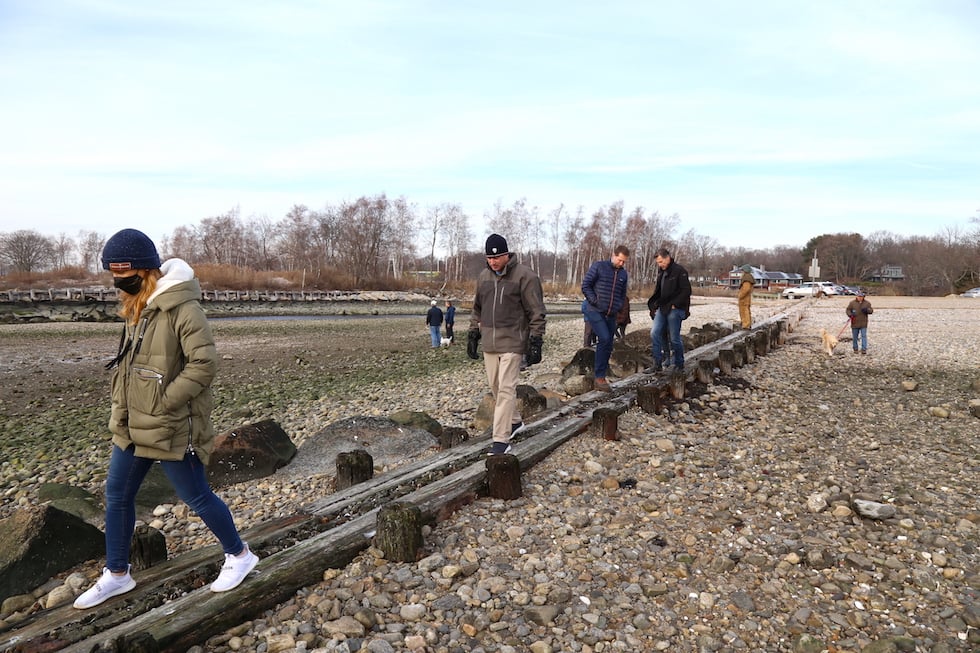
WESTPORT — A dozen or so town officials, including Board of Finance and Representative Town Meeting members, met at Burying Hill Beach Thursday afternoon to take a closer look at a pier-like sand barrier — known as a “groin” — that has been suffering decay for many years.
Peter Ratkiewich, director of the Department of Public Works, who led the visit, has requested that the town earmark $1.3 million of the $8.4-million windfall from the American Rescue Plan Act (ARPA) for the project.
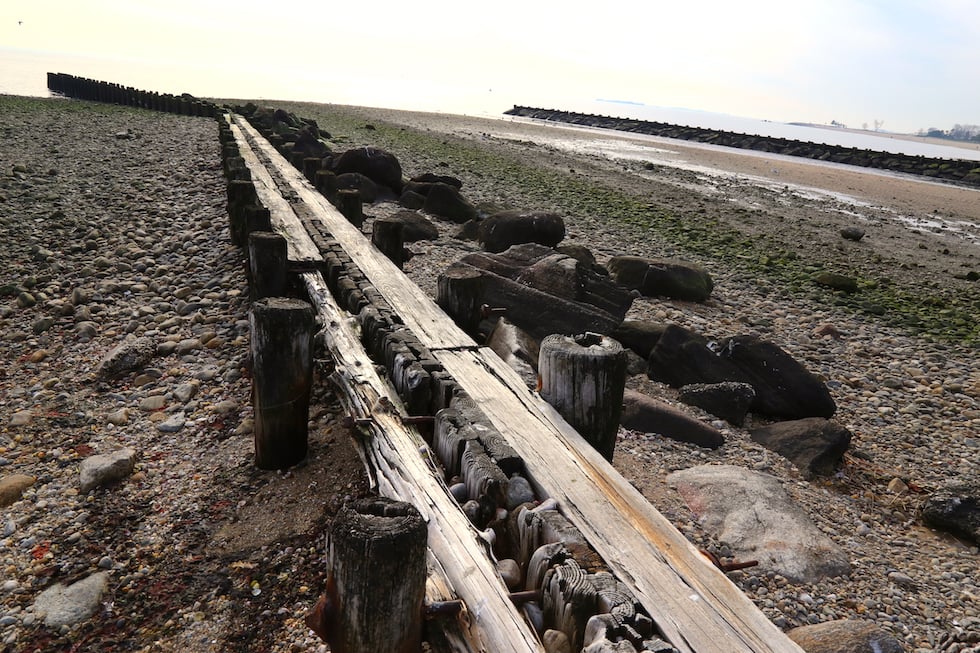
“There are some hazards here,” he said, pointing out details of the 70-year-old, 400-foot long decaying wood structure, which was installed by the U.S. Army Corps of Engineers in 1950 as a deterrent to sand build up in the adjacent New Creek, which runs just east of Sherwood Island.
Following the original construction, the corps handed over maintenance responsibilities to the town, and while it has been on the list of capital projects for several years to be improved, it has not been addressed.
BOF Chair Sheri Gordon said that the beaches have a significant importance to residents, and especially so during the pandemic.
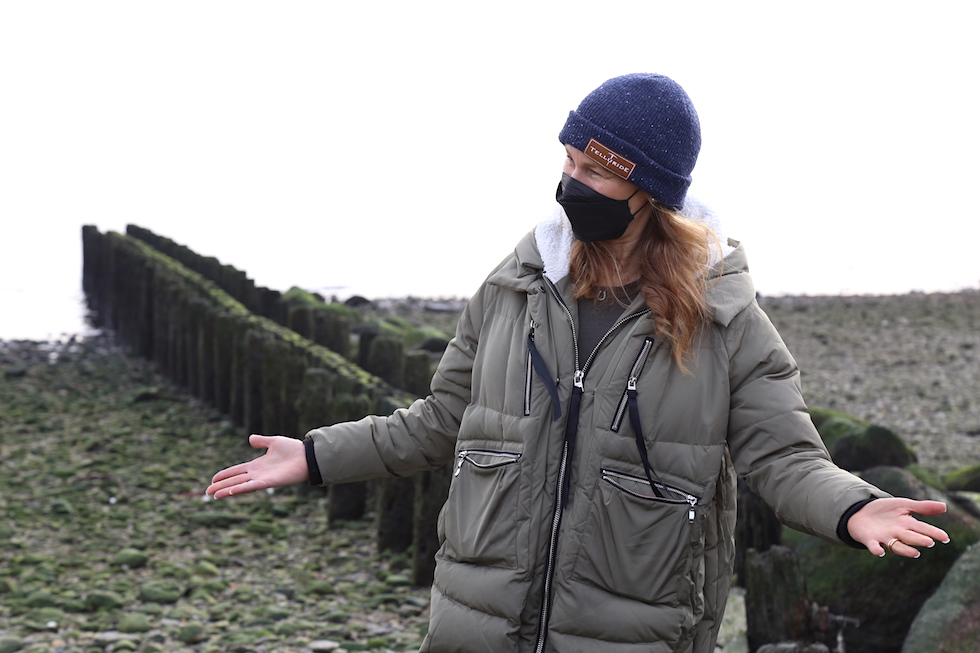
“We want to do everything we can to protect our beaches,” she said.
Last week the BOF discussed the funding of the project, but questions were raised as to why it had recently gone up in price from $900,000 to $1.3 million.
“The real driving force on the cost increase is the cost of the timber,” Ratkiewich explained, noting that marine timber in particular was expensive, and that the pandemic at large had been driving up both supply and labor costs.
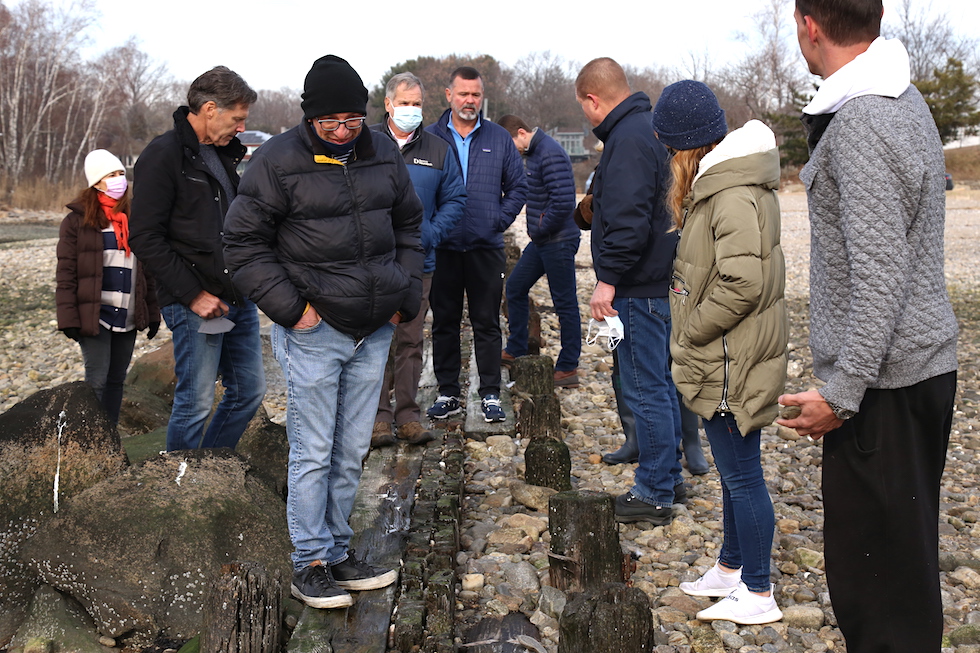
He also explained that though it may ultimately be more efficient to redesign the groin with different materials, it would make prompt approval from state and federal officials problematic.
“The easy path to get a permit and the fastest path to getting a permit is to do what they did originally,” he said.
“If you start modifying everything it could take five or six years to get a permit,” he said, while the project is currently considered “shovel-ready” in relation to the ARPA funding and could be underway within a few months.
Board of Finance members, who plan to discuss it further at their next meeting, are not yet sold on the idea. They asked Ratkiewich if he could bring the permit consultant to their next meeting to answer questions.







Once again, this story highlights the importance of the Westport Journal. The issue of sand and beach erosion is a very difficult one. The best long term approach needs to be explored and developed. Probably, simply replacing what exists is not the best approach. Permitting delays should not be relevant and they probably can be reduced from what DPW Director Ratkiewich suggested. Also, I think the Federal funds can be addressed to preserve a large amount for a different approach.
We need to do the “right thing”. Burying Hill Beach was beautiful when we moved to Westport over forty years ago. While still a grand space, the beach is no longer beautiful.
I believe that we owe it to the residents of the town . It is a beautiful quiet beach . Westport took over the care and preservation of this lovely beach approximately 60 years ago.
Let’s keep our promise and save our beach .
The project Is shovel ready .
It is a beach infrastructure project .
It conforms to arpa s regulations.
It has picnic tables and is a true treasure. Let’s get the jerry fixed before we lose our beach . And the cost of a new construction will take endless time and way more money
pS. Waiting 4 or 5 years opens us up to the possibility of a huge form taking this sad jetty down.
The additional time and money will mean we watch our beach wash away .
The bill to repair this is certainly not going to go back down again, and in 6 years, you can guarantee that even alternative materials will cost significantly more. This is a beautiful and peaceful area in our town, it allows folks to avoid the crowds and headaches of Compo, the Mill Pond beach, and Sherwood island. You can enjoy a wonderful view while enjoying a meal in the picnic areas, you can safely allow children to run around in the shaded grass, and enjoy swimming without worrying about being beaned by a ball. In certain seasons, you can learn about fly fishing by those who are generous with their knowledge as they cast their lines. If you’re lucky, you might even catch the town’s first responders using the river for marine search and rescue training.
This area is utilized by so many people, in many different ways, despite the neglect from the town. Please don’t allow it to become unsafe. The last thing we need is a lawsuit, because leaders wanted to be penny wise and pound foolish.
I agree that we must repair the jetty. To delay maintenance will only increase the cost. Just get it done before permits expire and material costs skyrocket.