
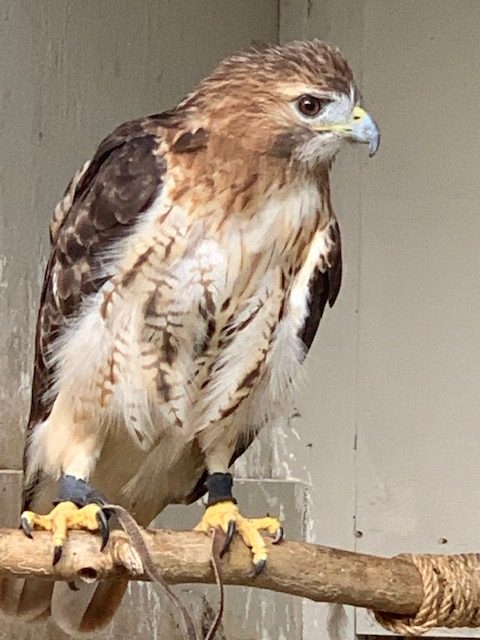
.By Gretchen Webster
WESTPORT — Trained hawks will soon swoop into Westport as part of a new falconry exhibit at Earthplace. But first, they need a place to land.
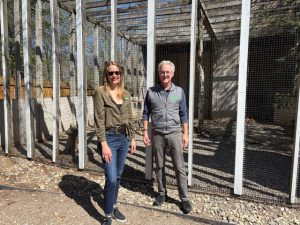
Tony McDowell, right, Executive Director of Earthplace, and Sophie Pollmann, Director of Marketing and Development, stand in front of the current aviary for the nature preserve’s bald eagles. New buildings will house the birds of prey at Earthplace, providing a better home for the birds and a better viewing site for the public.
The Planning and Zoning Commission on Monday will review plans for four new buildings at the Woodside Lane nature preserve, which will house both hawks for a new falconry as well as updated digs for the bald eagles, owls, ravens, vultures, and crows that have been part of the center’s permanent Birds of Prey exhibit for more than 30 years.
Assuming the plan passes approval at Monday’s Planning and Zoning meeting, the center plans to erect new buildings on property adjacent to the current birds of prey housing, said Executive Director Tony McDowell. The plan was approved by the Architectural Review Board at their April 22 meeting.
Once the current resident birds are moved into their new homes, new hawks will be purchased and will begin training with a professional falconer on the Earthplace staff. The hawks will be purchased as nestlings, unlike the other animals that arrive at the preserve injured or in need of life-supporting care.
The project to build the new structures, move birds into them, and train the young hawks will take about a year, McDowell said, with the expectation that the falconry program will be ready for public viewing in 2026.
“Each of the birds will be more visible. You will be able to see them from more angles,” he said, adding that that the new aviary buildings will not only provide a better home for the birds, they will also present a better viewing experience for the public.
Besides creating better homes and exhibition spaces for the birds, the new buildings will replace existing buildings that have become old, outdated, and in need of repair, McDowell said. There will also be additional site work on the area surrounding the new aviaries and a rain garden that will be designed to absorb surface water.
An ancient birding art takes roost in Westport
Birds of prey are no stranger to regular visitors at the preserve, where the birds are fed every day at 11 a.m. and the public is invited to watch, and has become the most popular attraction at Earthplace, said Director of Marketing and Development Sophie Pollmann. The new falconry program promises to be just as popular, she said.
Falconry is the ancient art and sport of using trained birds of prey, like falcons, hawks, and eagles, to hunt wild quarry. According to the North American Falconers Association, the art has existed since the 3rd millennium B.C. Interest in falconry in this country didn’t begin until the 1930s, according to the associations’ website, but has become more popular in recent years.
Although the activity is named after falcons, other birds of prey including hawks are used for falconry, McDowell said. Red-tailed hawks are native to this area, but Earthplace naturalists have chosen Harris’s Hawks for the new falconry program because they are easier to train, and smaller than falcons, he said.

An architectural drawing of the proposed new falconry barn at Earthplace was presented to the Architectural Review Board April 22.
The new bird habitats are being designed to accommodate the varying needs and habits of the center’s winged friends, McDowell said, adding that different species of birds require different living arrangements. For instance, some birds become frightened if people are viewing them from behind, while others are more social and relaxed with human visitors.
McDowell and the rest of the staff of the nature center are excited about the new falconry program coming to Earthplace, where visitors will be able to view the high-flying raptors out in the field, a spectacle that residents in this area may only have seen in films.
“There are very few falconers in New England,” McDowell said.
Freelance writer Gretchen Webster, a Fairfield County journalist for many years, was editor of the Fairfield Minuteman and has taught journalism at New York University and Southern Connecticut State University.






Recent Comments