
By Dirk Langeveld
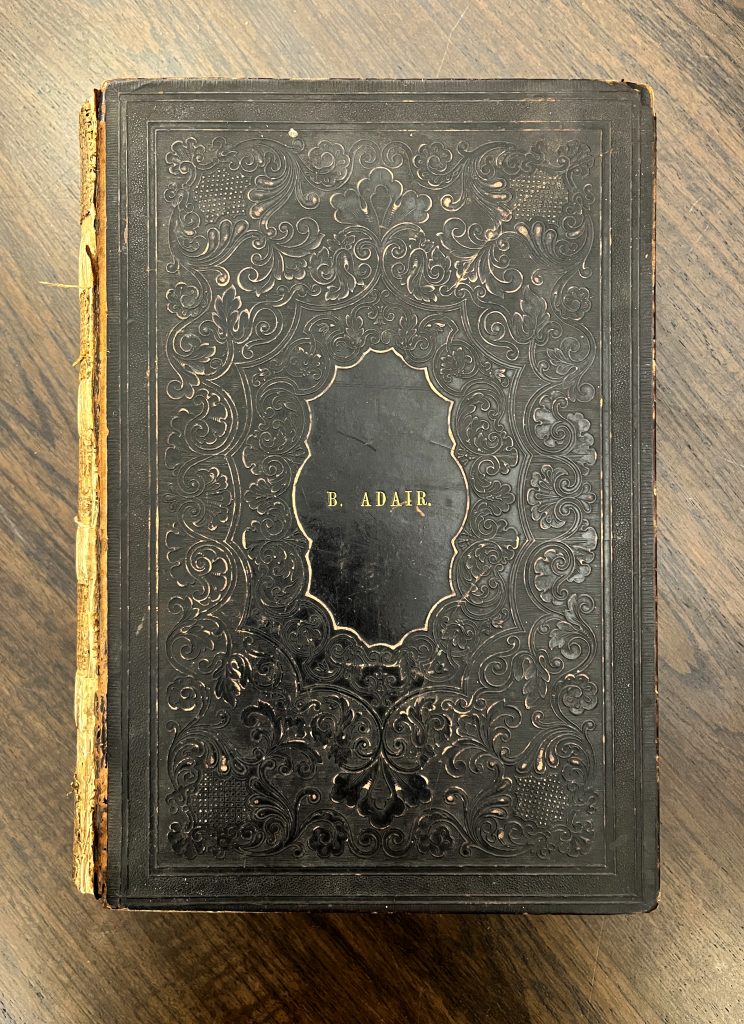
WESTPORT — A teenager’s “out of the blue” decision to purchase an old Bible at a library book sale has uncovered a lost heirloom from a prominent Westport family.
The book once belonged to the Adair family, one of the few prominent Black landowning families in Westport in the 19th century. It will soon join a collection of the family’s papers at the Westport Museum for History and Culture.
“This particular Bible, it was like a needle in the haystack,” said Cecily Dyer, special collections librarian at the Pequot Library in Southport. “I’m so glad that someone found it and we were able to connect it with the Adair collection, because it so easily could have slipped through the cracks.”
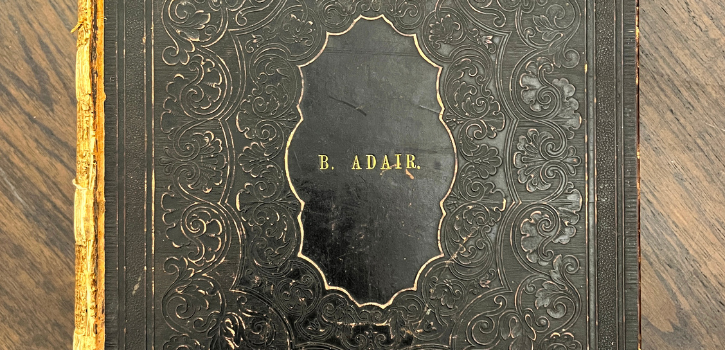
“B. Adair”
The Bible was discovered by Morgan Kofron, the son of Pequot Library youth services librarian John Kofron. Morgan was visiting the library’s summer book sale, an annual event featuring more than 100,000 items, when he picked it out.
“He just wanted to get a cool old Bible, and that one is a neat, pretty, old book,” said John, “and he just decided he would get that one.”
Dyer said family Bibles are often donated to the sale, so they are not an uncommon find. The book that Morgan selected was inscribed with the name “B. Adair,” and included some additional inscriptions inside.
John said he attempted some research on the spot using his phone, but wasn’t able to find any information on the previous owner. It was only later, after he took a closer look at the Bible and began researching families in the surrounding communities, that he was able to determine its former owner.
Some newspaper clippings were tucked into the Bible, and John also discovered that there were a few pages directly inserted into the middle of the Bible to hold a genealogical record. Dyer said these records are a common feature in family Bibles, and are typically included either in the end papers or in between the Old and New Testament.
“Because they’re passed down through families they also function as a way to record births, deaths, and marriages,” she said.
The Adair family
Ramin Ganeshram, executive director of the Westport Museum for History and Culture, said she and a museum volunteer became curious about the Adair family while cataloguing gravestones at Evergreen Cemetery in the summer of 2020. They noted how the family’s enclosure looked particularly affluent, but their family name was not a well-known one among early Westport residents.Through their research, they realized that the Adairs were a prominent Afro-Indigenous family that had been well-known in Westport for three generations.
Benjamin Adair originally came from Charleston, South Carolina, and was possibly a former slave. After moving to New York City, he worked for a time as a waiter and coachman in New York City. He married Ursula Mingo, of Black and Indigenous descent, before moving to Connecticut.
After arriving in Westport, Benjamin purchased his first property in 1852. He was able to build personal wealth through savvy real estate transactions while also managing a small family farm, and left behind a substantial estate upon his death in 1891.
The family’s fortunes later changed, as Benjamin and Ursula’s descendants struggled to keep up with property taxes. Ultimately, the town seized and auctioned off the property in 1946.
Ganeshram and the volunteer were able to track down the modern day descendants of the Adairs, who agreed to give the museum their family papers for safekeeping and to be made available for research. The materials were later featured in the 2023 exhibition Legacy: The Adairs of Westport.
Gaps in the path
It’s unclear how the Bible became separated from the other Adair papers, and ultimately ended up in the donation bin for the Pequot Library’s book sale. The inscriptions in the Bible suggest that it was passed on to Ursula and then to her daughter. The book also includes a return address label for Daniel Ratzenberger, a Bridgeport police officer who was featured in a 1961 Connecticut Post article on his passion for collecting historical books and other vintage items, suggesting that it was once part of his collection.
Dyer said the Bible may have somehow gotten transferred to someone else after the Adairs lost their Westport property. Ganeshram said she believes it was likely in the possession of a family member who lived in Fairfield, and that it was given away after their death.

“We see this a lot—that the value of family papers are simply misunderstood after someone passes away—especially if they do not have their own heirs,” she said.
Ganeshram said she hopes more research can be done into the provenance of the Bible to determine how it ended up for sale in Southport.
“It is something of a forensic study,” she said. “We believe it was in the possession of a collector who eventually discarded it. How he obtained it will be tricky to learn as I believe this person is no longer alive, but we have our ways.”
Coming home to Westport
The Bible was kept at the Pequot Library for several months while staffers there decided what to do with it. John said there was some consideration of keeping it at the library to help tell the stories of Black and Indigenous families in the region, but that the decision was eventually made to donate it to the Westport Museum for History and Culture.
“It seemed like it really ought to belong with the rest of the Adair Papers,” he said.
Ganeshram said she was at the Pequot Library to do research on a completely different subject matter when Dyer informed her of the find. She said she was ecstatic to hear the news, and grateful to the library for their decision.
“Honestly, I was fully shocked. Absolutely,” she said. “Family Bibles can be of enormous value to us in terms of finding out details that might not be in the public record. We are very eager to have a careful look at this Bible to see if we can definitely determine the parentage of Benjamin Adair, the patriarch of the family.”
Ganeshram hopes to collect the Bible in mid-April and display it in June as part of an exhibition on the “Great Migration” from the South to the North in the early 20th century.
“It is vitally important for our histories to be celebrated, especially now,” said family member Heather Thomas Flores in a statement. “We are incredibly grateful to Morgan for finding the Bible and for John’s role in connecting it to the Adair collection. The return of the Adair Bible feels like welcoming home a long-lost member of our family.”
Ganeshram also thanked Morgan for agreeing to donate the Bible, saying he “displayed great maturity” for doing so. John said the action didn’t go unrewarded.
“We gave him his money back,” he joked.

Dirk Langeveld
Dirk Langeveld has worked as a news reporter, content marketing specialist, and freelance writer. He is the author of “The Artful Dodger: The 20-Year Pursuit of World War I Draft Dodger Grover Cleveland Bergdoll” and has contributed to several books on Connecticut history.




Recent Comments