

By Ken Valenti
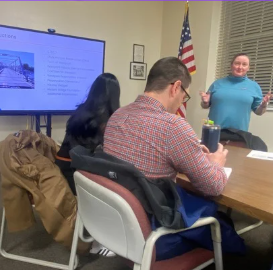
WESTPORT–A state-led discussion on the historic-but-dilapidated William F. Cribari Memorial Bridge last night became bogged down in concerns about how many stakeholders were alerted about the session.
Connecticut Department of Transportation representatives held the meeting in Town Hall to discuss its preferred plan, which is to replace the 1884 truss bridge rather than rehabilitate it, but stressed that no decision has been made.
Need a do-over
Some community members complained that the DOT had not spread the word widely enough. Valerie Seiling Jacobs of Save Westport Now! said she felt the meeting was inappropriate because many people who live in the historic district near the bridge did not know about it.
“I really believe we need a do-over on this,” she said.
One of many opportunities
DOT Cultural Resource Supervisor Mandy Ranslow, who led the meeting, said the session was only one of many opportunities residents and others will have to make their voices heard.
“Anybody with a vested interest can join in at any time,” Ranslow said after the meeting.
Groups notified based on 2017 discussions
She said community groups were notified based on a list from discussions of the project in 2017, and that the team would update their lists, including with a sign-in sheet passed around last night.
141-year-old bridge deemed “deficient”
The bridge, which was listed on the National Register of Historic Places in 1987, carries Route 136, also known as Bridge Street, over the Saugatuck River. The state has estimated a $78-$80 million cost to replace the span that the DOT flagged a decade ago as “severely deficient” and in need of extensive repairs or replacement. DOT Supervising Engineer James Barrows said the project would be funded 80 percent by the federal government and 20 percent by the state.
New bridge cannot put limits on traffic
While the design is still under way, Seiling Jacobs said that state officials had previously rejected a suggestion from stakeholders to design the bridge with a clearance too low to accommodate 18-wheelers. Barrow affirmed that position, saying that the structure cannot be designed with the intention of limiting traffic. But the DOT team noted that the town could enact its own ordinances limiting traffic on its streets.
Section 106: impact on historic properties; public review February
Last night’s meeting was intended specifically to discuss the bridge project’s impact on historic buildings nearby, a necessary step to use federal funds under Section 106 of the National Historic Preservation Act of 1966. The broader review will include the combined federal Environmental Assessment and state Environmental Impact Evaluation, Ranslow said. It also will include a 45-day public comment period, expected to start in mid-February, which would include a public hearing.
Town / organizations need to prioritize mitigation measures
Ranslow encouraged the organizations and town to propose a prioritized list of measures to mitigate the impacts on historic structures to include in a Memorandum of Agreement (MOA) with the state. It would be submitted by Feb. 6, before the 45-day public comment period.
The DOT will soon post the slide presentation she showed at the meeting on its site about the project, Ranslow said. She said it would include links with more information on MOAs.
Traffic not part of Section 106 purview
When a resident expressed a concern about traffic a new bridge would attract, including 18-wheelers, Ranslow made a distinction: Traffic issues would not be discussed in the Section 106 review, but related impacts could be.
“Traffic impacts will be mitigated under another aspect (of the review),” she said. As an example of a Section 106 topic, she added; “If there are vibration issues with these houses with the trucks going by, that would be something we’d talk about for historic mitigation.” That could include a vibration monitoring plan during construction, she said.





Some takeaways from lstvnight’s information session:
The process is a Gordian knot of bureaucratic requirements
It is very early in the process and nothing has yet to be decided.
It is possible to improve the functionality and safety of the bridge- whether by replacing it or repairing it – while discouraging or preventing its use by oversized trucks a combination of design choices and state and town actions to restrict truck traffic on adjacent roads.
I cannot recall enduring that much dissembling from a single presenter within the space of a two hour public meeting. It was as if someone had dragged a fire hose into the room -and turned it on. I don’t think the DOT “cultural resource” person grasped just how insulting her performative patter was to those in the room. But the “meeting” did yield one useful benefit: anyone listening who previously doubted we have a fight on our hands was thoroughly disabused of that notion. DOT is coming for our bridge. Period.
Despite the haphazard manner in which notice of the December 18 meeting was provided—accurately reported in this article—Room 201 at Town Hall was filled with Westport residents from across town. As Chris Tait observed, had CTDOT provided clear, timely, and widely distributed notice, the Town Hall auditorium itself would likely have been filled.
That turnout underscores the depth of concern in our community: for historic preservation, for sensible traffic management, and for how deeply Westport cherishes the William F. Cribari Bridge as an iconic and meaningful threshold to our town. It also demonstrates how intelligent, perceptive, and persistent Westport residents are when it comes to protecting what is dear and important to them.
The frustration expressed about notification is therefore not a procedural quibble—it goes to the heart of meaningful public participation, especially in a Section 106 process intended to assess impacts on historic resources and the surrounding National Register district. Reliance on notification lists from 2017 is plainly inadequate for a project of this scale, cost, and consequence.
At the same time, the presence of thoughtful, forthright local leadership at the meeting gives reason for cautious optimism. Westport can and should work constructively with both the Federal Highway Administration and the Connecticut Department of Transportation. But that cooperation depends on vigilance, sustained public engagement, and a firm insistence on transparent, proactive communication—particularly as the Memorandum of Agreement is developed and the 45-day public comment period approaches.
This bridge has stood for 141 years. Decisions about its future deserve a process that is as careful, inclusive, and publicly visible as the structure itself is significant.
If, as stated by DOT person, the town can enact its own ordinances regarding traffic, does that not solve the problem? An ordinance prohibiting trucks above a certain size on the bridge or road leading to or from the bridge.
I am curious about jurisdiction. The DOT spokesperson said that the town could enact its own ordinances regarding the size of trucks etc.
The bridge is on Route 136 a state road. It seems to be that the state has exclusive jurisdiction on a state road and the town has none.
We are strong Westporters by adoption and historians by nature and reside in a state – Ohio –
which treasures its connection to history through preservation for active use of the actual
buildings and bridges used by earlier generations.
As bridge builders whose company will celebrate its 90th aannivrsary this summer, we take
pride in the dozens of high truss iron bridges we have restored, with four awaiting their turn in
our shops. However, we know the differences in objectives among our 88 county engineers
and hundeds of ODOT professionals. Many of them pefer modernity to history, safety
to sentiment. They use computers rather than slide rules, and in terms of abstract values –
tradition vs life –their choice would not be surprising. My own feelings as a lawyer who
respects tradition and a bridge builder who values life might be in conflict until I no longer had
an even choice and would have to compromise. No historical bridge is worth a single life but
with modern technology it is not necessary to forget the past to protect the present, Cribari can
be recreated down to the dome-headed bolts that resemble rivets so that, within a very few years,
passersby will be able to mentally relive an era that preceded them and derive as much
pleasure from the replica as from .the original, in total safety..
So my advice to all our friends and family in Westport is to strike a deal for the reproduction of
Cribari that looks and feels like the original, slightly modified as required., and
demand that its new birthday be celebrated each year in an appropriate historical manner, It will
cost more than a cold, modern design. but you have the political power now if you use it
appropriately. Do not permit CDOT to control the narrative. Concede necessity in exchange for
authenticity regardless of cost. Demand that, stick to your position in unity, hire your own
architect to ensure the achievement of this and you will not be disappointed.
Repectfully,
Richard & Linda Rogovin
Chaiman and Director of US Bridge
Cambridge, Ohio
‘
614-209-5010
dickrogo@gmail.com
our
=====
Floating on the the ocean of absurd double talk last night was the startling announcement at the beginning that the project’s “Purpose and Need” statement has been modified. The term “historic resource” has apparently now been broomed from the list of things which are to be considered. And yet there we all were to, ostensibly, review and consider the project’s possible impact on historic resources. Good times.
I like Mr. Rogovin’s suggestion. Rebuild the Cribari in its own image. Honor its history with a modern and safe bridge that looks just like it.
The best way to notify people of meetings such as this is to use Westport’s public notice process, which is managed by the town clerk, Jeff Dunkerton. A public notice can also include links to documents and other materials that possible attendees might find useful to read before the meeting.
Dick
Thanks for your guidance…
However, as you can seen from the correspondence between the Town Clerk and me… There was no public notice for the May 15 meeting where Tooker and CTdOT announced that the William F Cribari Bridge would be demolished.
Nor was there any pubic notice for the two following meetings where CTDOT has reiterated and affirmed the decision to ignore the National Historic status of the Bridge.
I doubt if most Westporters realize that the former First Selectwoman determined the replacement without public notice of input when she funded the project on February 15, 2024 and allowed The Hamlet developers access to $12,000,000 in Brownfields clean-up funds.
Follow is my correspondence beginning August 25, 2025…
Hi Werner,
This was not an official meeting of the Town, which is why it does not appear on the Town calendar. It appears that the State simply used the Auditorium to host the event. Any questions regarding the publication or notice of this event should be directed to the State DOT.
Jeff
Jeffrey M. Dunkerton, CCTC
Town Clerk
(203) 341-1105 | jdunkerton@westportct.gov
110 Myrtle Avenue, Westport, CT 06880
From: Werner Liepolt
Sent: Thursday, August 28, 2025 2:53 PM
To: Dunkerton, Jeffrey
Subject: Fwd: Invitation: Cribari Bridge Project Advisory Committee Meeting – May 15, 2025
CAUTION: This email originated from outside of the Town of Westport’s email system. Do not click links or open attachments unless you recognize the sender and know the content is safe.
Hi Jeffrey
I am forwarding the invitation to the meeting. It was a presentation and a fairly long Qand A moderated by CTDOT officials. Several residents on Bridge St learned of it by word of mouth and attended.
A second similar meeting took place in the Town Hall Auditorium in the evening dealing with Historical Site issues.
Werner Liepolt
27 Bridge St.
Westport, CT 06880
Begin forwarded message:
From: Werner Liepolt
Date: April 4, 2025 at 1:54:03 PM EDT
To: Doug Weber , M Boyd
Subject: Fwd: Invitation: Cribari Bridge Project Advisory Committee Meeting – May 15, 2025
Werner Liepolt
27 Bridge St.
Westport, CT 06880
203 226 4842
Begin forwarded message:
From: “Barrows, James R.”
Date: April 4, 2025 at 1:36:58 PM EDT
To: wliepolt@mac.com
Cc: “Heredia, Ashley M”
Subject: Invitation: Cribari Bridge Project Advisory Committee Meeting – May 15, 2025
Dear Werner Liepolt,
My name is James Barrows II, and I am the Connecticut Department of Transportation (CTDOT) Project Manager for State Project 0158-0214. This project involves the Rehabilitation or Replacement of Bridge 01349 (William F. Cribari Memorial Bridge), which carries Route 136 over the Saugatuck River in Westport, Connecticut.
In 2018, a Project Advisory Committee (PAC) was established to assist CTDOT in its decision-making process. As a stakeholder and user of the bridge, your participation provided critical input considered in the Environmental Assessment and Environmental Impact Evaluation (EA/EIE).
The last PAC meeting was held on May 8, 2019. We recognize it has been some time, and since then, there have been significant developments both within the community and concerning the project itself. CTDOT is now scheduling a new PAC meeting to provide updates and discuss the project’s progress.
We invite you to attend:
Date: Thursday, May 15, 2025
Time: 4:00 PM – 6:00 PM
Location: Westport Town Hall Auditorium
Kindly RSVP by May 8, 2025, by replying to this email so we may finalize arrangements. Please be sure that myself and Ashley Heredia receive the reply.
Should you have any questions before the meeting, please do not hesitate to contact me at james.barrows@ct.gov or (860) 594-3192, or the Project Engineer, Ashley Heredia, at Ashley.Heredia@ct.gov or (860) 594-3488.
Further information on the project can be found on the project website: https://portal.ct.gov/dot/projects/cribari-bridge
I look forward to meeting with you and providing a comprehensive update on this important project.
Sincerely,
JAMES BARROWS II, P.E.
Project Manager
Connecticut Department of Transportation
Consultant Bridge Design – Major Bridges & Structures
Phone: 860-594-3192
james.barrows@ct.gov
Oh, and by the way… when I did query the Connecticut Department of Transportion they refused to answer and directed me to their Freedom of Information attorney.
So… seemingly, as in the case of the Community GArdens, Long Lots Elementary School, The Hamlet, and the CTDOPT garage bordered by Hillendale and West Parish… the public has NOT been properly notified of crucial decisions on matters of vital interest.
I have been thinking about this bridge a lot and today the following occured to me:
1. The State wants to move as quickly as possible while the opponents lack unity, some of us prioritizing history, others prioritizinig traffic control, many priorizing fairness of process – the right to notice and an unbiased hearing. If I were in charge of the Cribari Project at CDOT I would continue to apply the subtle pressure of limiting notice of hearings and liimiting participation until the Public forgets about the the real reason for the bridge’s exisience.
2. That’s what we need to remind ourselves. The Cribari Bridge would be of little value without Cribari. And there are other heroes for whom this bridge could stand. Do our childreen know about Roger Sherman, Samuel Huntington, William Williams and Oliver Wolcott?
3. What if the Cribari Bridge stood for all these heroes? So I propose the following, which should satisfy everyone. A new, taller Heroes Bridge, built of modern steel , in 19th Century style, a replica and the most impressive swing bridge in the country. Let the State fund a model with the input of Westport, of substantial size, paid for by CDOT, and insist the State put any action on Cribari on hold until a special electiion to approve the final design, erected in the most open and accessible building in Westport. Now lets see CDOT oppose a new bridge of heroes that will attract visitors from all over the country and the world. Let us begin with an artists rendering, a $500,000 budget or more for the model, and a new flag for Westport. I want my Westport grandchildren to learn that patriotism can be found in their home town.
You are correct
THE CONNECTICUT DEPARTMENT OF TRANSPORTATION HAS DECIDED TO DEMOLISH THE WILLIAM F CRIBARI BRIDGE
and this is
THE WAY THEY DID IT
On February 15, 2024 at a meeting of the Western Connecticut Council of Governments, former First Selectwoman Tooker released Statewide Transportation Improvement Program (STIP) funds of $4,100,000, previously withheld by former First Selectman Jim Marpe, to the Connecticut Department of Transportation (CTDOT) to start the Cribari Bridge Project.
On May 15, 2025, at an invitational meeting in the Westport Town Hall Auditorium, CTDOT, with Tooker in attendance, announced they were replacing the bridge with “a preferred option,” one that can accommodate all vehicles. Invitations were based on the inactive-since-2018 Planning Advisory Committee list of stakeholders. This meeting was neither publicly noticed by Westport’s Town Clerk nor on the CTDOT Project page for the William F. Cribari Bridge, and the few Westporters who learned of it had to request an invitation.
On December 18, 2025 at another invitational meeting held in Room 201 of the Westport Town Hall at 6pm, Mandy Ranslow, Supervisor, Cultural Resources,CTDOT confirmed their “preferred option” is to demolish the William F. Cribari Bridge and offered to move it wherever the town wanted. CTDOT officials agreed that tractor trailer trucks would not be restricted by structural limits on the preferred option replacement bridge and that it was up to Westport to deal with it. Invitations to this meeting were sent to only a few consultants, several consultants did not receive invitations. Attendance by elected officials depended on forwarded emails and word of mouth. My published opinion piece in the Westport Journal and a sentence introducing Wendy Crowther’s tribute to the bridge in Dan Woog’s 06880 were perhaps the only publicity for the meeting.
CTDOT officials promised to schedule and properly notice a meeting for public comment on their replacement plan in February.
But these “invitational” meeting are ludicrous. The list of invited “stakeholders” is from 2018. Half of them don’t show because they have moved or don’t care. Not one of the 28 property owners in the National Bridge Street Historic District has received notice either by public noticing on the CTDOT website or the Westport Town Calendar or by specific mailing. I doubt any of them even know about the decision to demolish the bridge or about the meetings.
Moreover. CTDOT has been almost silent on the studies they have yet to release: Environmental and Right of Way.
Westporters will soon learn that CTDOT is going to ignore the effect tractor trailer trucks have on their ability to breathe.
Westporters will also soon realize that CTDOT can take their front yards with no compensation 25 feet from the center line.
I believe CTDOT has ignored the right of the public to be involved in the Section (106) process… but unless the public wakes up the bridge is doomed to be demolished.
Several local “stakeholders” who want the bridge demolished have cited the banning of trucks on Rt 136 (Tokeneke Road) in Darien, and suggested that can be done in this case. That ban took two decades to resolve.
The push to restrict truck traffic on Route 136 was not a short campaign — it spanned more than two decades before the State Traffic Commission finally approved the prohibition:
Local frustration dates back to at least the early 1980s when a federal court consent decree in 1984 required Connecticut DOT and Norwalk to “alleviate present levels of truck traffic through Rowayton along Route 136.”
There is an elementary school on the route that was a factor.
The most active phase of advocacy began around 2005, when a small group of residents and officials organized to formally petition the state.
After numerous meetings, engineering studies, and procedural hurdles — including retirements of Traffic Commission members and a tabling of the case — the State Traffic Commission finally approved the “No Thru Trucks” designation on August 21, 2007.
So the core controversy stretched at least from the mid-1980s through 2007 with 20+ years of complaint and advocacy, especially concentrated in the 2005–2007 period.
In order to attempt to restrict truck traffic from Greens Farms Road, our Local Traffic Authority— namely our Board of Selectpersons—would have to initiate the process outlined on the “Through Trucks and Prohibitions” State of Connecticut webpage:
https://portal.ct.gov/dot/osta/through-trucks-and-prohibitions
Since Greens Farms Road already handles truck traffic at the Nyala Farm office complex and the DDD zoned office building on the north side of Greens Farms Road near the cemetery, I believe a Westport application to prohibit truck traffic would go nowhere.
And who is keen for and organized enough to undertake a two decades battle with the Connecticut Traffic Division?