
By Dirk Langeveld
FAIRFIELD — In what it describes as an “unmistakable warning sign,” the Connecticut Audubon Society has reported troubling lows for osprey breeding numbers in the state.
Connecticut Audubon recently ended the 2026 season of its Osprey Nation program, which relies on approximately 450 volunteer stewards to monitor about 1,000 current and historical osprey nest sites. This year’s data shows a productivity rate of only 0.87 chicks per breeding pair of ospreys, down from 1.26 in 2025.
For the first time in Osprey Nation’s 13-year history, the majority of the observed nests—61 percent—produced just one chick. Thirty-three percent produced two, with only 6 percent—23 nests in total—having three or more chicks. In all previous years of the study, the majority of osprey nests have produced at least two chicks, while up to 20 percent of nests have produced three or more chicks.
“This is an unmistakable warning sign,” said Matt Joyce, Connecticut Audubon’s conservation science manager. “This is probably the strongest evidence we have that there is an issue with prey provisioning.”
The findings mark the second year that Connecticut Audubon has raised concern about osprey breeding in the state. In 2025, it noted how the osprey breeding rate had fallen to the lowest point in Osprey Nation’s history, with similar declines in the Chesapeake Bay region and New Jersey.
Osprey populations have made a substantial population recovery since the mid- to late 20th century, when factors such as habitat loss and eggshell thinning due to pesticides like DDT led to serious declines. In 1974, only nine nests were observed between New York and Boston. Conservation efforts led to a significant rebound in nesting sites.
Connecticut Audubon said flagging reproductivity rates can be the result of various factors, such as weather, predation, or the inexperience of the parenting birds. However, it suggested that this year’s figures are the first time that the data indicates that food stress and starvation are a likely factor in the dropping numbers of chicks.
The organization said an additional concern is that 40 percent of the attempted nests in the state failed this year. A failure is defined as a nest producing no chicks or chicks that hatch but do not survive to fledgling.
Osprey Nation involves a large dataset, which must be reviewed, analyzed, and verified by Connecticut Audubon scientists. The figures were released early this year in an effort to convince the Atlantic States Marine Fisheries Commission to significantly reduce its limit on how much Atlantic menhaden can be fished in Chesapeake Bay.
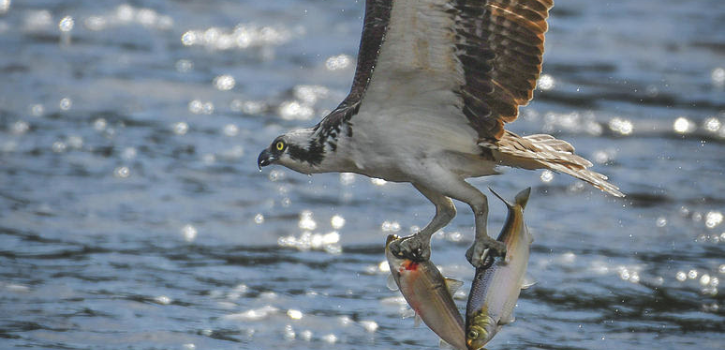
Atlantic menhaden is a principal food source for the osprey, but is also harvested to process into fish oil or feed for salmon farms. The commercial fishing industry has argued that fishing limits will negatively impact jobs in the Chesapeake Bay region. ASMFC will make a final determination at its November annual meeting.
Connecticut Audubon said its final Osprey Nation report will be released later in the year. It does not anticipate substantial changes to its figures, since 99 percent of the dataset has been reviewed.
Several osprey nest sites in Westport are among those that are under observation by volunteer stewards. For a full list of monitored nesting sites and their associated data, click here.
Expanded coverage of Fairfield County cultural events is made possible with support from the Fairfield University Quick Center for the Arts








Recent Comments